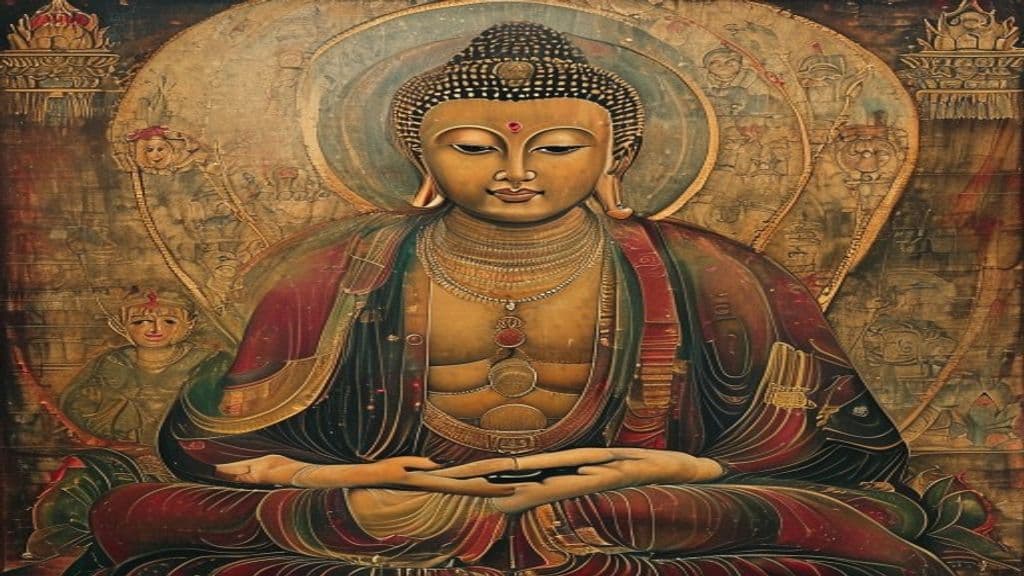
The term arhat is a Sanskrit present participle from the verbal root √arh 'to deserve' (Pāli arahant). The etymology indicates someone 'worthy' or 'deserving' of honor because of spiritual attainment. The sources attest that the word and concept predate Buddhist doctrinal refinements: in pre‑Buddhist contexts (e.g., usage in the Ṛgveda and Indian śramaṇa milieu) the term was associated with saintly ascetics and, in some accounts, with miraculous powers; Buddhist authors subsequently shaped the concept into a soteriological category denoting one who has eradicated the fetters and attained nirvāṇa.
There is no single canonical physical description of arhats as a class in the provided sources. Scriptural and doctrinal texts define arhats by status (enlightenment, cessation of rebirth) rather than by fixed bodily traits. In devotional and artistic contexts, especially in East Asia, arhats are depicted as named, individualized figures (e.g., the Sixteen Arhats or Eighteen Arhats, called luohan/lohan) with varied iconographic conventions; these group portraits and temple statues develop local visual types, but such depictions reflect later hagiography and artistic tradition rather than a uniform canonical bodily description.
Doctrinally the central 'ability' of an arhat is final liberation: having gained insight into the nature of existence, an arhat has realized nirvāṇa and will not be reborn. Narrative and hagiographic literature sometimes ascribes supernormal or psychic powers to particular arhats—examples in secondary sources include accounts like Arhat Cūḷapanthaka appearing in many forms to a messenger—yet encyclopedic sources note that miraculous powers became less central to the arhat identity in many Buddhist developments. Across schools there is variation: Theravāda emphasizes eradication of unwholesome roots and non‑rebirth; some early schools and Mahāyāna writings debate the perfection or fallibility of arhats compared with buddhas and bodhisattvas.
Weaknesses
- otherNot framed as vulnerable to supernatural wards (canonical literature does not present arhats as entities requiring warding); doctrinal critique—some schools argue arhats are fallible or a lesser ideal compared to buddhas/bodhisattvas (e.g., Mahāsāṃghika, Sarvāstivāda positions)
Wards
None recorded.

Buddha (Siddhartha Gautama)
Siddhartha Gautama, most commonly called the Buddha, is presented in the provided sources as a historical wandering ascetic and religious teacher of the 6th–5th century BCE who attained nirvana, taught Dharma, and founded the monastic community (sangha) that became Buddhism.

Bodhisattva
A bodhisattva is a being or practitioner in Buddhist thought who has generated bodhicitta — the wish and compassionate intention to attain awakening (bodhi) for the benefit of all sentient beings. In Early/Theravāda contexts the term often denotes the Buddha in his pre‑awakening lives, while Mahāyāna expands it into an ideal and category of spiritually advanced, active helpers and devotees.
Acala
Acala (Sanskrit: अचल, 'The Immovable') is a wrathful protective deity (dharmapala) in Vajrayāna and East Asian esoteric Buddhism, classed among the Wisdom Kings (Vidyārāja). He functions as a ritual focus for visualization and mantra practice intended to remove obstacles and bind or destroy hostile forces.
Acalanātha (Acala / Achala)
Acalanātha (also Acala or Achala) is a wrathful deity and dharmapāla — a protector of the Dharma — prominent in Vajrayana and East Asian Mahayana Buddhist contexts. Presented as a fierce, non‑human or semi‑divine protector-figure, Acalanātha functions to defend the teaching and practitioners by removing obstacles and confronting threats to the transmission and practice of Buddhism.
Agni
Agni is the Vedic personification of fire in Hindu tradition: a sacred, mediating principle that manifests as terrestrial fire, atmospheric lightning, and celestial sun, and that receives and conveys sacrificial offerings. Prominent in the Rigvedic corpus, Agni functions as sanctifier, witness of rites of passage, and a transformational inner principle in later Upanishadic literature.
Aizen Myō-ō (Rāgarāja)
Aizen Myō-ō corresponds to the deity Rāgarāja, a wrathful/transformation-oriented figure venerated in Esoteric and Vajrayāna Buddhist traditions. The figure is especially revered in Chinese Esoteric Buddhism in Chinese communities and in the Japanese Esoteric schools Shingon and Tendai.
Akhu Tönpa
A Tibetan trickster figure, sent by Chenrezig to teach the art of being shrewd and witty, while championing the common man against social hierarchies. (Note: - Power tier should be Lesser or Minor Spirit, not Ancient, as it's more aligned with local spirit level of trickster figures. - The ability to outwit those in positions of power suggests Greater or P)
Akshobhya
Akshobhya is a transcendent buddha of Mahāyāna and Vajrayāna Buddhism, one of the Five Wisdom (Dhyāni) Buddhas. He personifies 'mirror knowledge' (ādarśa-jñāna), is conventionally placed in the East, and is lord of the eastern Pure Land Abhirati; in esoteric texts he is associated with the eastern Vajra division and invoked in mantra/mandala ritual contexts.
Akuma
Akuma (悪魔/あくま) in Japanese sources is an evil spirit, devil, or demon associated with misfortune and mental disturbance. The term appears in Buddhist texts and Heian-period literature and was later used to translate the Christian figure of Satan, as well as the Buddhist Mara.
Amanojaku
Amanojaku (天邪鬼 / あまのじゃく) is a Japanese yōkai-type being portrayed as a contrarian, heart-reading trickster. Treated in different contexts as a small ogre (ko-oni), a wicked demon (jaki) in Buddhist iconography, and a folkloric spirit that provokes human vice, it appears across regional tales with variable roles from malicious kidnapper to household oddity.
Amida Nyorai
Amida Nyorai (Amitābha / Amitāyus) is a principal Mahayana Buddha venerated across East Asia as the embodiment of Infinite Light and Infinite Life who presides over a Western Pure Land and is invoked as the savior who receives the dying into rebirth there.
Amitābha
Amitābha is a central celestial Buddha of Mahayana Buddhism who presides over the western Pure Land called Sukhāvatī. Devotional practices invoking his 'measureless' light and life (nianfo/nembutsu) are presented in Pure Land traditions as a path by which beings may be reborn in his buddhafield and quickly attain Buddhahood.
Amitābha Buddha
Amitābha is a principal Mahayana Buddha who presides over the Western Pure Land (the Land of Ultimate Bliss). Devotional practices—most centrally recitation of his name and chanting of Pure Land sutras—are presented in sources as the means by which Amitābha welcomes practitioners for rebirth in his hindrance-free realm.
Amoghapāśa
Amoghapāśa is recorded in the supplied sources as a named manifestation or form of the bodhisattva Avalokiteśvara/Lokeśvara attested in Mahāyāna and Vajrayāna contexts. The evidence in the provided material is archival and bibliographic (sūtra/dhāraṇī/maṇḍala filenames and database entries) rather than descriptive narrative or doctrinal exposition.
Community Record
- [1]Arhat (Wikipedia). "In Buddhism, an Arhat (Sanskrit: अर्हत्) or Arahant (Pali: अरहंत्, 𑀅𑀭𑀳𑀦𑁆𑀢𑁆) is one who has gained insight into the nature of existence, has achieved nirvana, and has been liberated from the endless cycle of rebirth."; etymology and sectarian discussion.wiki
- [2]Arhat (Wikidata). "in Buddhism, one who has gained insight into the true nature of existence" (Wikidata summary).wiki
- [3]Sixteen Arhats (Wikipedia). Discussion of the Sixteen Arhats as a legendary group brought to China and Tibet and their role in East Asian iconography.wiki
- [4]Q&A: Arhat Cūḷapanthaka's display of psychic powers. Secondary discussion of a narrative account in which an arhat displays psychic/miraculous ability (Cūḷapanthaka appearing as many).other
- [5]Q&A: Do Arhats sleep?. Discussion page noting debates or questions about whether arhats sleep in the ordinary way; presented as a topic of discussion rather than settled doctrine.other
- [6]City of 10,000 Buddhas - The Vajra Sutra with Commentary. Representative Mahāyāna material referenced among sources regarding doctrinal contexts where arhats and bodhisattvas are contrasted.other