
In the Norse cosmogony the gods encounter two pieces of wood or two trees on a shore and from them create the first human pair. In the Poetic Edda (Völuspá stanza 17) three gods named Hœnir, Lóðurr and Odin find Ask and Embla and give them gifts; in the Prose Edda (Gylfaginning ch. 9) the three brothers Odin, Vili and Vé walk along a beach, find two trees and from the wood create Ask and Embla, clothing them, naming them and placing them in Midgard. The accounts agree that the pair originate at the mythic beginning and that the gods bestow the capacities that make them human.
Primary attestations describe Ask and Embla as created from trees or wood (the Prose Edda says the gods took two trees on a beach and made them into the first man and woman). Ask's name transparently connects him to the ash tree (Old Norse askr = 'ash tree'); Embla's etymology is uncertain, with scholarly proposals including derivations meaning 'elm', 'vine', or a compound interpreted as 'firemaker'/'smokebringer'. No detailed anthropological physical description (height, hair, complexion) is preserved in the cited sources; the focus is on vegetal/material origin rather than corporeal detail.
Initially the pair are described as limited—Völuspá says they were 'little able' and lacking ørlög (fate/law/destiny) until the gods endowed them. The Prose Edda specifies that the three divine agents gave them the breath of life, movement and intelligence, and form, speech, hearing and sight; they were also clothed, named and placed in Midgard. After these gifts they function as the first humans and progenitors, capable of living and reproducing. The precise wording of the gifts and the identities of the two helper gods differ between sources and are matters of scholarly debate.

Ymir
Ymir is the primeval progenitor in Norse myth whose body is transformed by the gods into the material world; he is named in the Poetic Edda and the Prose Edda as ancestor of the jötnar and a source-substance for earth, sea, mountains, sky and more.
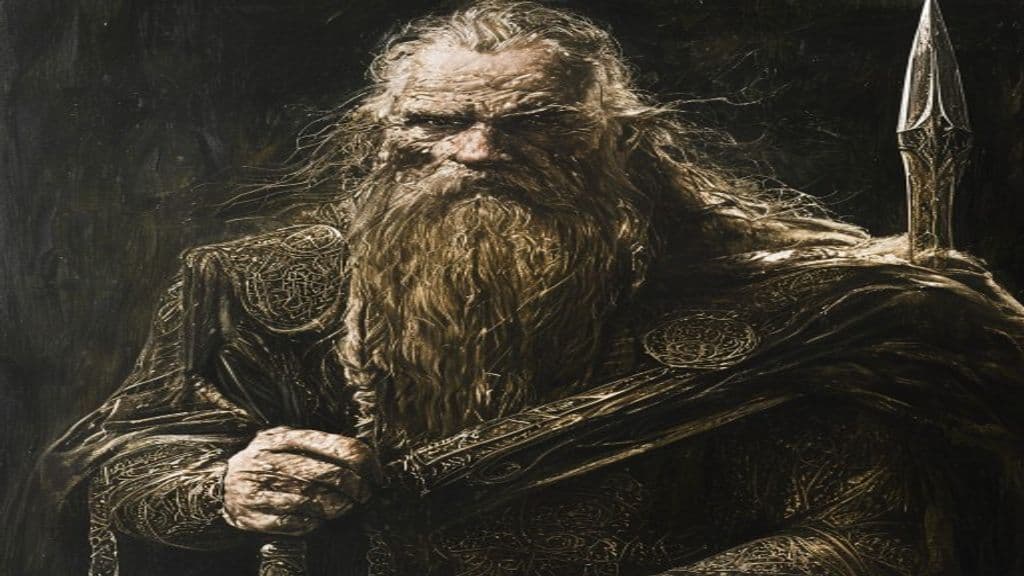
Odin
Odin (Old Norse: Óðinn) is the chief god of the Norse (Æsir) pantheon, a multifaceted deity associated with wisdom obtained by sacrifice, poetic inspiration, death and warfare, and rulership over the hall Valhöll where chosen slain warriors (einherjar) dwell. He appears throughout Germanic tradition from Roman-era accounts through the Viking Age and in later folklore as leader of the Wild Hunt.
Adils
Adils (Old Norse Aðils; also Eadgils, Adillus, Athisl, Adhel) is a semi‑legendary sixth‑century Swedish king attested in Old Norse saga material and later medieval traditions. He appears in saga episodes as a storied royal figure involved in warfare, court acts, and marriage suits rather than as a supernatural being.
Agilaz (Egil)
Agilaz (reconstructed Proto-Germanic) — commonly recorded in medieval sources as Egil or Ægil — is a legendary archer attested in Germanic heroic tradition. He appears as the brother of Völund (Wayland/Weland) in the Old Norse poem Völundarkviða and in the Thidreks saga, and his name is also inscribed on early medieval objects (Franks Casket, Pforzen buckle). The attested material presents him as a named heroic human archer within saga and inscriptional contexts rather than as a recurrent supernatural species.
Agnarr Geirröðsson
Agnarr Geirröðsson is a mortal prince attested only in the Poetic Edda poem Grímnismál; he aids Odin (disguised as Grímnir) during Geirröðr's torture and, after Odin reveals himself and King Geirröðr dies, Agnarr succeeds as king.
Agne
Agne (also attested Agni, Hogne, Agni Skjálfarbondi) is a semi-legendary king of Sweden in Old Norse saga tradition, preserved in the Ynglingatal corpus and prose expansions such as Snorri Sturluson's Ynglinga saga. He is portrayed as a mighty and famous warrior-king whose campaign in Finland, marriage to Skjalf, and death by hanging form a remembered episode connected to local place-names and a burial mound.
Alf and Alfhild
Alf and Alfhild are legendary human figures from Old Norse/early Scandinavian narrative tradition preserved principally in Saxo Grammaticus' Gesta Danorum. The tale presents Alf as a Danish prince and Alfhild as a Geatish princess who becomes a shieldmaiden and leader of a fleet of female raiders; their story includes combat, recognition, marriage, and later dynastic conflict.
Algaut
Algaut (also rendered Algöt or Algaut Gautreksson) is a semi-legendary Geatish king of West Götaland recorded in Scandinavian saga and genealogical tradition. Saga summaries (via Snorri Sturluson's Heimskringla as reported in later compilations) record that he was the father of Gauthild and was burnt to death by his son-in-law, the Swedish king Ingjald Ill-ruler.
Almáttki áss
Almáttki áss is an epithet-attested divine figure invoked in an Icelandic legal oath recorded in Landnámabók (Hauksbók 268). In the sole attestation the phrase functions as an invoked áss (god) described with the adjective almáttki ('almighty') and serves as the divine guarantor or witness for an oath sworn on a temple ring. Scholarly sources debate whether the epithet refers to a named Norse god (Thor, Ullr, Odin, or Týr) or is a Christianizing formulation by a later author.
Alrek and Eirík
Alrek and Eirík (also rendered Alaric and Eric) are legendary Swedish kings from the Old Norse saga tradition who are presented as joint rulers and as members of the Ynglinga royal genealogies. They appear in saga narratives as sons and heirs of King Agni, famed for martial and athletic prowess, and as hosts who receive the hero Starkaðr after the sacrificial death of Vikar.
Alvaldi
Alvaldi (Old Norse: Alvaldi / Ölvaldi) is a jötunn in Norse mythic genealogies, attested chiefly as the father of the notable jötunn Þjazi and described in one source as exceedingly rich in gold. He survives in the record mainly as a familial antecedent and an etiological figure rather than as an active participant in preserved narratives.
Alvíss
Alvíss (Old Norse: 'All‑Wise') is a dwarf in Norse mythology who appears in the Poetic Edda poem Alvíssmál as a prospective husband for Thor's daughter Þrúðr. In the surviving narrative Thor tests Alvíss's wisdom through a lengthy question-and-answer session that lasts until sunrise, whereupon the dwarf is petrified by exposure to sunlight.
Amleth
Amleth (Old Norse: Amlóði; Latinized Amlethus) is a legendary medieval Scandinavian prince and saga-hero best known from Saxo Grammaticus' Gesta Danorum. He is a human protagonist whose story centers on feigned madness, cunning survival, exile to Britain, marriage, wealth-gathering, and eventual vengeance against his father's murderer; the tale later inspired the character of Shakespeare's Hamlet and numerous adaptations.
Ancient Kings of Finland
In early literary sources, the Ancient Kings of Finland are described as hypothetical or mythical monarchic systems associated with ancient Finland. (Note: 1. Power tier: Lower to Primordial (given the lack of specific abilities and behaviors) 2. Abilities and behaviors are described as 'generally vague', so this section should be reworded or removed 3. )
Community Record
- [1]Ask and Embla - Wikipedia. Wikipedia, 'Ask and Embla'wiki
- [2]Gylfaginning (Prose Edda) — chapter 9 (summary). Summary of Prose Edda account cited in sources (Gylfaginning ch. 9)literary
- [3]Völuspá stanza 17 (Poetic Edda reference). Poetic Edda (Völuspá stanza 17) as summarized in source materialliterary
- [4]Fire & Ice: The Heathen Concept of Being (archive). Archive copy, contains modern interpretive material referencing Eddic loreother
- [5]Where Did I Come From? (Academy Storytime) (archive). Asatru Academy children's adaptation referencing Eddic cosmogonyfolk
- [6]Gunlög Josefsson (etymological interpretation cited in notes). Gunlög Josefsson's proposal connecting Embla to eim + la ('firemaker') and to fire‑plough symbolism, discussed in supplied materialacademic
- [7]Comparative Indo‑European parallels (summary). Summaries noting parallels to Vedic Yama and Yamī, Iranian Mašya and Mašyānag, Anglo‑Saxon Æsc, and continental examplesacademic