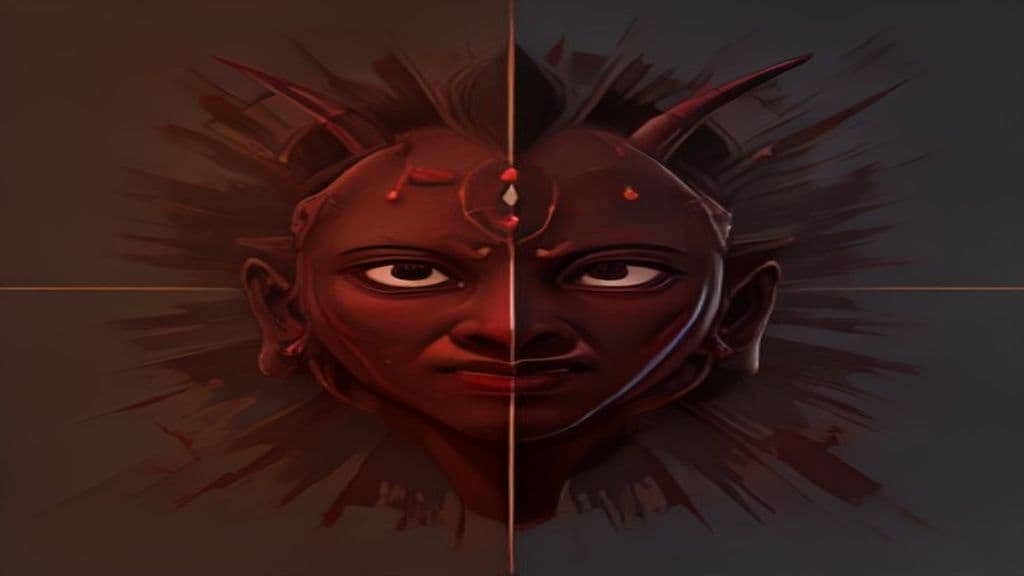
Sources record multiple, historically layered accounts rather than a single uniform origin. Linguistically, modern scholarship finds Old Indic asura cognate with Avestan ahura, deriving from Proto-Indo-Iranian *háSura with a sense of 'lord' — an archaic semantic field of powerful lords. In Puranic mythic etiologies one strand explains the name via a-sura ('not sura') tied to the Samudra Manthana narrative (rejection or acceptance of Varuni) as an explanatory folk etymology; certain Buddhist commentarial traditions (e.g., accounts attributed in summaries of Buddhaghosa) describe asuras as a dispossessed group cast down from Mount Sumeru/Trāyastriṃśa, producing a mythic origin of their antagonism to the devas. These variants indicate the term's shift from an older honorific sense toward a socially and morally contested category in later texts.
There is no single stable physical template for all asura in the surveyed sources; as a taxonomic class they are described across literature without a uniform corporeal description (Sources 1, 5). Individual mythic asura receive specific iconography: Rahu is described as the severed head of an asura and in art is depicted as a serpent-like, head-only figure (a 'serpent with no body'), while Ketu is represented as the headless, half-bodied or smoky-bodied entity formed from the asura's remaining body joined with a snake (Sources 3, 4).
Hindu sources characterize asura broadly as power-seeking beings who contest the Deva for influence (Source 1). Buddhist accounts treat asura as demigods or titans of the sensual realm who enjoy more pleasurable lives than humans yet are governed by wrath, pride, envy, and insincerity (Source 5). In specific myths, asura can enact cosmically consequential deeds: the beheading of Svarbhānu produces Rahu and Ketu, who are said to 'swallow' the sun or moon and thus cause eclipses; Rahu is also described in mythic/astrological texts as a master of deception and an agent associated with illusion and sudden changes (Sources 3, 4). Astrological writings attribute to Ketu associations with illusion, detachment, asceticism, and spiritual transformation, but these are interpretive associations within astrological tradition rather than claims about a corporeal ability (Source 3).
*Péh₂usōn (reconstructed)
Péh₂usōn is a hypothetical Proto‑Indo‑European pastoral guardian reconstructed by comparative scholars from parallels in Greek and Vedic traditions. Proposed as a Graeco‑Aryan ancestor‑figure, the reconstruction describes a protector of flocks, roads, and travellers rather than an attested historical cultic personality.
Abhimanyu
Abhimanyu is a youthful Kuru/Pandava warrior-hero in the Sanskrit epic Mahābhārata. Son of Arjuna and Subhadra, he is famed for entering the Chakravyuha battle formation on the thirteenth day of the Kurukshetra War and dying at age sixteen; his posthumous son Parikshit continues the Kuru line.
Acala
Acala (Sanskrit: अचल, 'The Immovable') is a wrathful protective deity (dharmapala) in Vajrayāna and East Asian esoteric Buddhism, classed among the Wisdom Kings (Vidyārāja). He functions as a ritual focus for visualization and mantra practice intended to remove obstacles and bind or destroy hostile forces.
Acalanātha (Acala / Achala)
Acalanātha (also Acala or Achala) is a wrathful deity and dharmapāla — a protector of the Dharma — prominent in Vajrayana and East Asian Mahayana Buddhist contexts. Presented as a fierce, non‑human or semi‑divine protector-figure, Acalanātha functions to defend the teaching and practitioners by removing obstacles and confronting threats to the transmission and practice of Buddhism.
Achyuta
Achyuta (Sanskrit: अच्युत, acyuta) is primarily an epithet/theonym in Vaishnava Hindu tradition applied to Vishnu and Krishna, signifying the divine quality of being 'not fallen' — immutable, infallible, and imperishable. It functions as a devotional name in scripture, liturgy, and Pancharatra lists of divine emanations rather than as an autonomous folkloric spirit.
Acintya
Acintya is an Indonesian Hindu theological-symbolic representation of the ineffable supreme divine principle. In Balinese and Javanese practice it functions as a way to make ultimate reality present in ritual and art—often aniconically as an empty throne (padmasana) or anthropomorphically as a naked, flame-surrounded figure—rather than as a narrative, intervening deity.
Adi (asura)
Adi is attested in modern reference works as the name of an Asura who 'appears in the Matsya Purāṇa.' Beyond this single-line citation in secondary sources, no descriptive material about the figure is provided in the supplied research notes.
Adi Shakti
Adi Shakti (also Adi Parashakti, Mahadevi, Adya Shakti) is the primordial feminine power in Hindu/Shakta theology, regarded as the ultimate reality (Para Brahman) and the source from which all goddesses and gods manifest. She is both an impersonal cosmic principle (Mulaprakriti) and a focus of devotional invocation in temples, mantras, and pilgrimage sites such as Shakti Peethas.
Adi Vinayaka
Adi Vinayaka (Ādi Vināyaka; also called Nara Mukha Vinayaka) is a named iconographic and devotional form of the Hindu god Ganesha portraying the deity with a human head, described in sources as the form before the episode of decapitation by Shiva. It is rarely worshipped and appears in a small number of South Indian shrines and in devotional/musical repertoires.
Aditi
Aditi is a major Vedic goddess in Hindu tradition who personifies the boundless, infinite cosmic principle and functions as the maternal matrix from which many celestial deities (the Ādityas and other groups) are born. In the Vedic hymns she is invoked as a protective liberator who guards petitioners, provides wealth and safety, and frees devotees from hindrances such as sin and sickness.
Agastya
Agastya (also Agathiyar/Agasti) is a revered Vedic and later-period Indian rishi (sage) figure credited in textual traditions as an inspired seer, ascetic, teacher, culture-founder, and attributed author of Vedic, Puranic and Tamil works; in South Indian tradition he is associated with origins of Tamil grammar and Siddha medicine and is identified astronomically with the star Canopus.
Aghasura
Aghasura is an asura from the Vaishnava/Hindu narrative tradition (notably the Srimad‑Bhāgavatam) who, at the command of Kamsa, assumed the form of a vast serpent to ambush Kṛṣṇa and the cowherd boys in Vṛndāvana. The episode demonstrates Kṛṣṇa’s protective, divine power as he enters and destroys the demon from within.
Community Record
- [1]Asura (Hinduism) - Wikipedia. Wikipedia, 'Asura (Hinduism)'wiki
- [2]Asura (Buddhism) - Wikipedia. Wikipedia, 'Asura (Buddhism)'wiki
- [3]Ketu - South Node of the Moon (archive item). Archive item describing Ketu: 'Ketu - South Node of the Moon' (referenced for Ketu mythic/astrological description)other
- [4]Rahu - North Node of the Moon (archive item). Archive item describing Rahu: 'Rahu - North Node of the Moon' (referenced for Rahu mythic/astrological description and iconography)other
- [5]Asura - Netflix series commentary (blog). Leanne Ogasawara, 'Asura: A New Series on Netflix' (used for interpretive summary noted as modern commentary/interpretation)other
- [6]Asura - Wikidata (term usage and non-mythic instances noted). Wikidata entry for 'Asura' (listed among supplied materials; noted in research notes as non-mythic usages present)other
- [7]Massively Speaking Podcast Episode 166 (archival listing included among supplied materials). Archive.org listing of Massively Speaking Episode 166 (included among provided sources; tangential/pop-cultural use of the term noted in research notes)other
- [8]Zoltan Biro - Chill Out Session 310 (archival listing included among supplied materials). Archive.org listing (included among provided sources; modern/pop-cultural uses of 'Asura' present in supplied materials)other
- [9]Wikidata entry: asura (Q1637262). Wikidata: classificatory note describing asuras as among the lower ranks of deities or demigods of the Kāmadhātu.other
- [10]Peacock King Duology [NES] — archive note (popular culture reference). Archive game blurb noting modern popular culture usage of 'Asura' as a character term; cited to indicate contemporary adaptations rather than traditional ritual content.other
- [11]Two archived sermons (contextual references). Archive: contextual material referencing Buddhist terms in modern religious discourse; cited for lack of ritual material in the supplied corpus.other
- [12]Archived service video: 'The Third Largest Religion' (contextual). Archive: contextual reference; included among supplied materials but not a primary source of doctrinal ritual concerning asuras.other
- [13]Krishna - The Birth Movie (2006 Telugu) (plot synopsis). Archive.org item: Krishna - The Birth Movie (2006 Telugu) (plot summary noting Kamsa's recruitment of Asuras to fight Indra)literary
- [14]Asura's Wrath - Trailer (archive reference). Archive.org listing for a videogame trailer referencing 'Asura' in popular mediaother
- [15]I.D.E. Thomas: Christian Pioneer Exposing The 'Alien' Strong Delusion (archive reference). Archive.org item referencing comparative commentary that includes Asura among other mythic beingsother
- [16]The Hymns of the Rigveda. Griffith, R.T.H. (1889)academic
- [17]Historical Vedic Religion. Wikipedia: Historical Vedic Religionwiki