
In the genealogical framework recorded in Javanese sources, Batara Sambu is the first-born son of Batara Guru (the supreme god in the local Hinduized cosmology) and Batari Uma. As a named member of Batara Guru's divine household he functions within that familial pantheon: he is identified specifically as the god of teachers and, in wayang narrative, as the progenitor or ancestor of the rakshasa (giants). These relationships place Sambu within a hereditary divine hierarchy that explains social functions (patronage of teachers) and the origin of particular classes of mythic beings in wayang storytelling. (Sources: Wikipedia: Batara Sambu; Wikidata: Batara Sambu; Wikipedia: Batara Guru.)
The supplied sources do not provide a detailed bodily or iconographic description of Batara Sambu (no specific notes on facial features, clothing, coloration, or weapons). Wayang-associated descriptions instead locate him spatially and materially: his kahyangan (heavenly abode) is named Kahyangan Swelagringging in the southern part of the heavens, his palace is described as made of copper, and he is said to have two wives—Bathari Siwagnyana and Bathari Astuti—details that mark his status and household within the pantheon even though they do not yield a physical portrait. (Sources: Wikipedia: Batara Sambu.)
The sources attribute to Sambu a small set of specific domains: he is the deity associated with teachers (patron of teaching and possibly learning) and, in wayang tradition, a god who rules the clouds, indicating an atmospheric or meteorological jurisdiction. He is also described as the ancestor of rakshasa (giants) within wayang genealogies. The provided materials do not record additional powers, moral dispositions, interactions with humans, or specialised rituals enacted by or upon Sambu. (Sources: Wikipedia: Batara Sambu; Wikidata: Batara Sambu.)

Batara Guru
Batara Guru is a supreme divine figure in multiple Indonesian mythological traditions (Indonesian Hinduism, Batak, Bugis, Javanese). He functions variously as a guru-aspect of Shiva, a creator or world-recoverer in Batak narrative fragments, an ancestor and progenitor in Bugis and Batak genealogies, and a high deity of the kahyangan in Javanese cosmology.
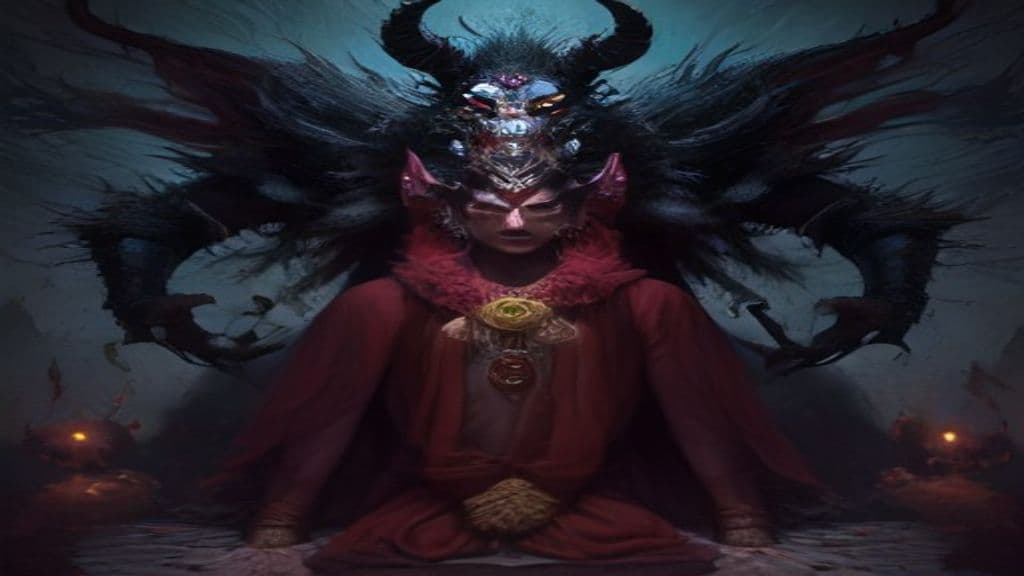
Rakshasa (Himalayan variants)
A Himalayan reception of the pan-Indian rakshasa motif: hostile or disruptive non‑human beings known from Sanskrit epic and Puranic literature, here noted where Himalayan sources and discussions intersect with the broader epic tradition. The supplied sources do not document distinct, well‑attested Himalayan folklore variants; the entry therefore presents primarily the epic/legendary profile as transmitted into Himalayan contexts in general references.
Acintya
Acintya is an Indonesian Hindu theological-symbolic representation of the ineffable supreme divine principle. In Balinese and Javanese practice it functions as a way to make ultimate reality present in ritual and art—often aniconically as an empty throne (padmasana) or anthropomorphically as a naked, flame-surrounded figure—rather than as a narrative, intervening deity.
Aji Saka
Aji Saka is a legendary Javanese culture-hero and foundational figure credited in tradition with pacifying Java, founding a kingdom at Medang Kamulan, instituting the Saka calendrical era in Java, and composing the hanacaraka mnemonic poem tied to the origin of the Javanese script.
Antaboga
Antaboga is a primordial serpent deity in Javanese and Sundanese traditional beliefs, later incorporated into Balinese Hinduism. Portrayed as an original creative being, Antaboga meditates and brings forth the world turtle Bedawang and other divine figures; its image appears widely in Javanese and Balinese ritual ornament and iconography.
Babi Ngepet
In Indonesian mythology, the Babi Ngepet is a boar demon associated with malevolent intentions towards humans. (Note: * Power tier: Downgrade to Ancient (deity-level) as there's no indication of Primordial powers. * Abilities: Specify what malevolent intentions towards humans implies, e.g., ability to curse or cause )
Barong
In Balinese mythology, the Barong is a panther-like creature and leader of good spirits. (Note: - Power tier: Greater (based on the description as a powerful regional entity, leader of hosts of good spirits) - Abilities: Specify that the Barong opposes Rangda's evil energies, implying a defensiv)
Batara Guru
Batara Guru is a supreme divine figure in multiple Indonesian mythological traditions (Indonesian Hinduism, Batak, Bugis, Javanese). He functions variously as a guru-aspect of Shiva, a creator or world-recoverer in Batak narrative fragments, an ancestor and progenitor in Bugis and Batak genealogies, and a high deity of the kahyangan in Javanese cosmology.
Batara Kala
Batara Kala is a Javanese and Balinese underworld deity associated with death, time, and destruction; feared as an ogre-like devourer of the unlucky, he is also ritually propitiated to avert misfortune, especially for at-risk children.
Bawang Merah dan Bawang Putih
A widely told Malay/Indonesian folktale about two eponymous human stepsisters — Bawang Putih (the humble, patient sister) and Bawang Merah (the vain, cruel sister). The story uses small supernatural motifs (magic pumpkins, a talking fish, a gift-bearing old woman) set in rural liminal spaces to reward virtue and punish vice; it functions as a didactic children's tale rather than an account of a discrete spirit being.
Busang
Busang is not attested as a supernatural being in the supplied sources; rather it is a polyvalent proper name found as a toponym (places in Borneo), a lect name (Busang Kayan), a mining prospect label (Busang deposit in the Bre‑X scandal), and as a personal name. No mythological origin, appearance, powers, or ritual practices directed at a supernatural Busang are recorded in the provided material.
Calon Arang
Calon Arang is a witch figure in Javanese and Balinese folklore, traditionally portrayed as a master of black magic whose cemetery ceremony—including the sacrifice of a young girl to the goddess Durga—brings flood and an incurable plague to the village of Girah. In the tale a royal ritual specialist (Mpu Bharadah) and his disciple (Mpu Bahula) neutralize her by recovering her magic scroll and confronting her in ritual contest.
Chen Fu Zhen Ren
Chen Fu Zhen Ren (陳府真人; Hokkien: Tan Hu Cin Jin) is a deified ancestral/tutelary figure venerated in East Java, Bali, and Lombok. Centered on a historical/legendary migrant craftsman who became a local immortal, his cult is maintained in Chinese temples and by indigenous Kejawen practitioners and functions as a protective, communal ancestor patron.
Damarwulan
Damarwulan is a Javanese legendary human hero central to a cycle of courtly-epic narratives and stage traditions (wayang klitik, Langendriyan, ketoprak). The figure—whose name is glossed as "radiance of the moon"—is portrayed as a princely warrior who defeats the Blambangan king Menak Jingga, suffers apparent death and is restored by a hermit, and is ultimately crowned in the Majapahit court. The story is especially associated with East Java and the Serat Damar Wulan manuscript tradition.
Community Record
- [1]Batara Sambu. Wikipedia contributors. "Batara Sambu." Wikipedia, The Free Encyclopedia.wiki
- [2]Batara Sambu (Wikidata). Wikidata entry Q4868627: Batara Sambu.wiki
- [3]Batara Guru. Wikipedia contributors. "Batara Guru." Wikipedia, The Free Encyclopedia.wiki