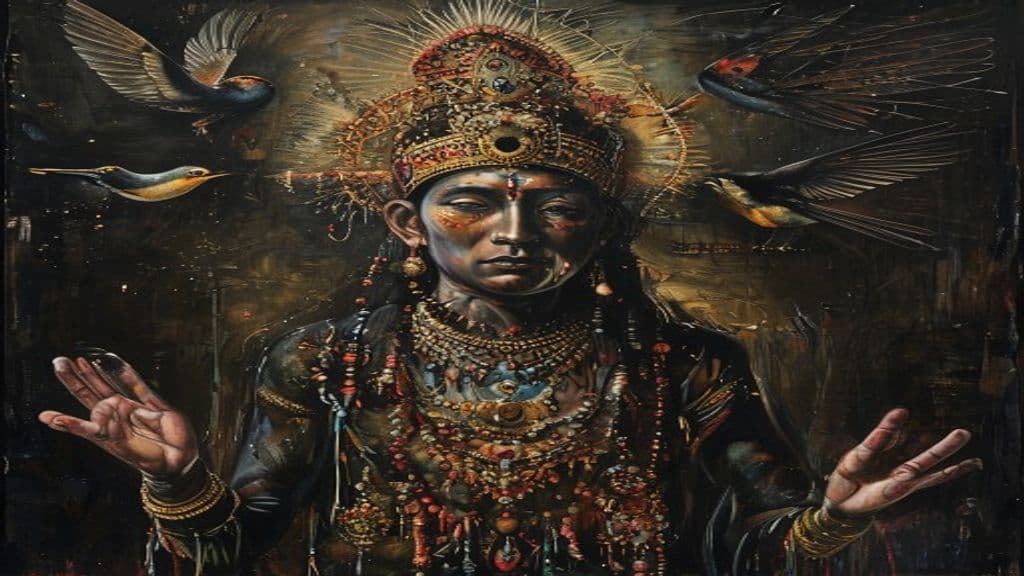
Historical sources and later scholarship present Bathalà/Maykapál as the Tagalog transcendent supreme being credited with creation and preservation of the world. Colonial-era records and later commentators record a range of names and epithets; scholars have proposed multiple competing etymologies — a common hypothesis derives Bathalà from Sanskrit bhattara/bhattaraka (cf. batara in Maritime Southeast Asia), other proposals include derivation from avatara, connections to Malay berhala, or to Arabic Allah-ta'ala, while José Rizal argued the phrase may reflect the native expression Bahalà ang May Kapál and that Tagalogs often avoided pronouncing the deity's name. Isabelo de los Reyes and other commentators distinguished Maykapál or Lumikhâ as the proper name for the supreme creator while treating Badhala/Bathalà as a more general honorific applied to deities, omens, and feared beings.
The sources supplied do not record a consistent corporeal iconography for Bathalà; the deity is described as a transcendent supreme god rather than an embodied figure. Separately, the same word was historically applied to omen birds, comets, and other heavenly bodies and to personal tutelary spirits, but colonial summaries do not present a single bodily depiction for the supreme Bathalà.
Cited sources attribute cosmogonic and sovereign functions to Bathalà — described as the originator, creator, and preserver of all things. In the pre‑colonial Tagalog lexicon the term also operated as an honorific that could be applied to lesser tutelary spirits, omen birds, comets, and other heavenly portents; those uses indicate a cultural expectation that entities labeled with the term could function as protectors or predictors of events. After Spanish missionary contact, Bathalà/Maykapál was equated with the Christian Dios, reflecting syncretic overlap in ascribed divine authority.

Adi Vinayaka
Adi Vinayaka (Ādi Vināyaka; also called Nara Mukha Vinayaka) is a named iconographic and devotional form of the Hindu god Ganesha portraying the deity with a human head, described in sources as the form before the episode of decapitation by Shiva. It is rarely worshipped and appears in a small number of South Indian shrines and in devotional/musical repertoires.
Agastya
Agastya (also Agathiyar/Agasti) is a revered Vedic and later-period Indian rishi (sage) figure credited in textual traditions as an inspired seer, ascetic, teacher, culture-founder, and attributed author of Vedic, Puranic and Tamil works; in South Indian tradition he is associated with origins of Tamil grammar and Siddha medicine and is identified astronomically with the star Canopus.
Agiya Baital
The fire-form of the Vetala — a cremation ground spirit of UP and Bihar that manifests as a wandering flame rather than a corpse-inhabitor, leading night travellers off roads and into marshland or flames with a dancing fire that seems always just ahead.
Agniveśa
Agniveśa is a legendary rṣi (sage) in the Ayurvedic textual tradition, traditionally credited as the pupil of Punarvasu Atreya and as the attributed author of the lost Agniveśa Saṃhitā / Agniveśatantra. Later Ayurvedic compilers, notably Charaka, are described in the sources as having compiled, edited, and modified material attributed to Agniveśa into texts such as the Charaka Saṃhitā.
Aguingay
Aguingay (also Agingay) is a legendary woman from the Bulusan epic of Sorsogon, Philippines. Presented as a mortal of exceptional beauty and tragic fate, her life and death are etiologically linked to local landscape features (Mt. Bulusan and two lakes) and commemorated in an annual festival.
Ahiravan (Mahiravan)
Ahiravan (also Mahiravan) is a rakshasa-king of Patala in Ramayana-derived narratives who abducts Rama and Lakshmana to sacrifice them to a goddess. Presented as a brother or trusted ally of Ravana in eastern Ramayana recensions, he is defeated and beheaded by Hanuman with divine aid.
Aiyanar
Aiyanar (Aiyaṉār, ஐயனார்) is a Tamil rural tutelary deity venerated chiefly in village contexts of Tamil Nadu and among Tamil communities in Sri Lanka. Portrayed as a martial guardian often mounted on a horse or elephant and accompanied by attendant spirits, he functions primarily to protect village boundaries, people, and livestock and has later been syncretized with the Sanskritic Sastha tradition.
Aiyyanar
Aiyyanar (also spelled Aiyanar) is a Tamil rural village deity venerated in South India and Sri Lanka, primarily among rural Tamil communities. He is associated in material culture with large, colorful roadside and temple statues often shown with companions and mounted on horses or elephants, and functions as a local protective/patronal figure within village devotional practice.
Akṣayakumāra
Akṣayakumāra appears in the Ramayana as the youngest son of Rāvaṇa and a warrior sent to oppose Hanuman in the Ashoka Vatika episode; described as about sixteen, he fights bravely from a chariot and is killed by Hanuman.
Alakh Niranjan
A doctrinal and devotional formula in the Nath-yogi tradition denoting the unseen, unblemished ultimate reality (Nirguna Brahman/Atman). Used as a salutational invocation, theological name, and signifier of realised Self rather than a personified supernatural being.
Alakshmi
Alakshmi is an inauspicious female supernatural figure in Hindu tradition, presented as the negation or shadow-counterpart of the prosperity-goddess Lakshmi. She personifies poverty, grief, jealousy and social discord and is managed in domestic ritual and festival practice.
Alamelu
Alamelu (also Alamelu Manga / Alarmel Mangai) is a South Indian devotional name for the goddess Padmavati, identified in sources as an avatar of Lakshmi and the consort of Venkateswara; the name is also used widely as a female personal name and in titles of cultural works in Tamil and Telugu contexts.
Community Record
- [1]Bathala (Wikipedia). Wikipedia contributors, 'Bathala,' Wikipedia, The Free Encyclopedia.wiki
- [2]Bathala (King of the Diwatas) — marvunapp appendix. Marvunapp, 'Bathala (King of the Diwatas)'.other