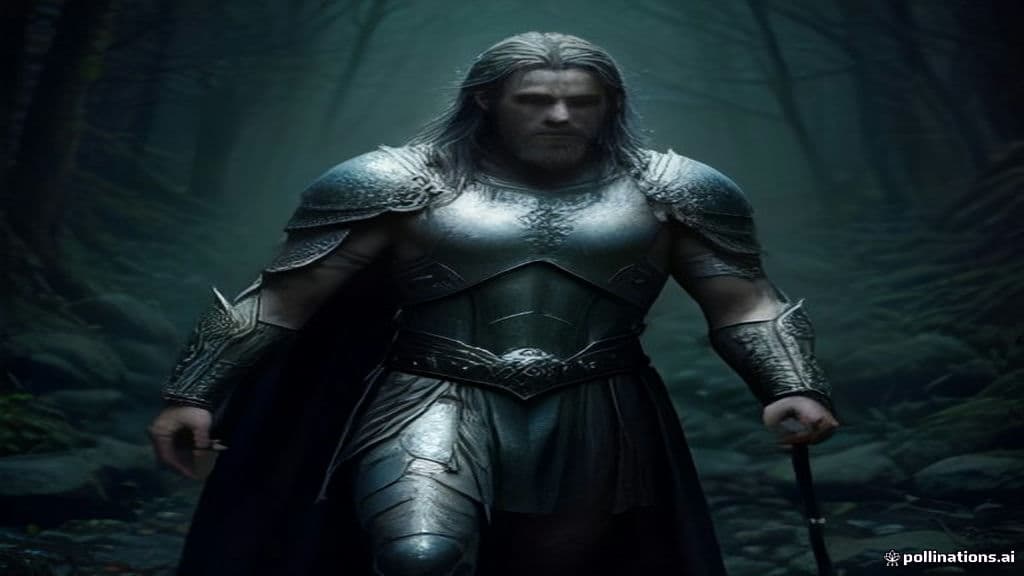
In the early Welsh manuscript tradition Bedwyr appears as a principal warrior in Arthurian material (attested under the Welsh form Bedwyr, including the epithet Bedrydant). Later medieval and chivalric romances, influenced by works circulating after Geoffrey of Monmouth, incorporate the figure into the pan‑Arthurian cycle as a Knight of the Round Table and court official (often marshal). The sources treat him as a legendary/historical character of the Arthur mythos rather than as a supernatural being.
The provided sources do not supply detailed physical description beyond martial attributes. Early Welsh verse presents him as a fierce, one‑handed great warrior (the epithet Bedrydant is associated with this portrayal) and later romances imply the conventional accoutrements of a medieval knight (armor, shield, sword) without giving precise physical details.
Sources emphasize Bedwyr's martial prowess and courtly role: early Welsh poetry describes him as devastating in battle (e.g., "By the hundred they fell before Bedwyr Bedrydant, for, furious was his nature with shield and sword"). In medieval romances he functions as a trusted retainer of Arthur (sometimes Arthur's marshal) and, in many English versions, performs the narrative act of returning Excalibur to the Lady of the Lake after Arthur's final battle. Literary criticism in later sources notes variation in portrayals, including morally complex readings in some modern analyses.
3-D Man
3-D Man is a Marvel Comics superhero identity associated with a 1950s-era origin in which the body of Chuck Chandler can materialize in three-dimensional existence when activated by his brother Hal via a pair of glasses. The mantle was later assumed by Delroy Garrett (formerly Triathlon) in modern continuity.
5 Ronin
5 Ronin is a 2011 Marvel Comics five-issue limited series that reimagines five Marvel superhero archetypes as rōnin (masterless samurai) in a fictionalized post‑Sekigahara feudal Japan. The work places Wolverine, Hulk, Punisher, Psylocke, and Deadpool analogues into period roles to explore displacement, revenge, and identity in an era of political upheaval.
A Elbereth Gilthoniel
An Elvish hymn in Sindarin addressed to Elbereth (Varda) from J. R. R. Tolkien's legendarium. Presented in The Lord of the Rings and later musical and dramatic adaptations, the hymn functions as devotional poetic language that evokes Elvish reverence for the star-kindler rather than an independent supernatural agent.
A.R.G.U.S.
A.R.G.U.S. is a fictional clandestine United States government agency in the DC Comics universe that investigates, contains, and manages superhuman, meta-human, and supernatural incidents and assets. Introduced in The New 52 continuity, it functions as an institutional actor providing intelligence, logistical support, covert task forces (notably Task Force X / the Suicide Squad), and a dedicated magic division across comics and media adaptations.
Abandinus
Abandinus is a locally attested Romano‑Celtic theonym known from a single inscribed bronze feather (votive object) dedicated at Godmanchester (the Roman fort Durovigutum) in Cambridgeshire. Scholars interpret him as a local god or male spirit tied to a specific place and possibly associated with a nearby spring or stream; this association is tentative and based on etymological readings of the name.
Abarta (Ábartach)
Abarta (also Ábartach) is a figure of Irish myth who, in surviving accounts, tricks Fionn mac Cumhaill's warriors by giving them a supernatural grey horse that bears them into the Otherworld. Sources variably identify him as a member of the Tuatha Dé Danann or as a Fomorian; after the incident he is compelled to release the captured warriors and is refused entry to the Fianna.
Abcán (Abhcán)
Abcán (modern spelling Abhcán) is a named dwarf poet and musician of the Tuatha Dé Danann in Irish myth. He appears in a small number of narratives as a musician whose art has soporific power and as the ferryman who brings the goddess Ruad from the Otherworld to the human world.
Abdiel
Abdiel (Hebrew עֲבְדִּיאֵל) is primarily a theophoric Hebrew personal name meaning "servant of El/servant of God," attested once in the Hebrew Bible (1 Chronicles 5:15). In later literature—most notably John Milton's Paradise Lost—Abdiel is reimagined as a faithful seraph who opposes Satan's revolt. The provided sources do not treat Abdiel as an autonomous folkloric spirit type or record rituals or wards associated with the name.
Abhean
Abhean is a named poet of the Tuatha Dé Danann in medieval Irish literature, described as a poet in particular of Lugh and recorded as having been killed by Óengus before Midir in a poem by Fland Mainistreach preserved in the Lebor Gabála Érenn.
Abiel
Abiel is attested in the supplied sources only as a male given name — borne by several historical American individuals and listed as two minor biblical figures. The provided materials contain no evidence presenting Abiel as a supernatural, mythological, or folkloric entity.
Abigail
Abigail is a female figure in the Hebrew Bible portrayed in 1 Samuel 25 as the intelligent and beautiful wife of Nabal who intervenes to prevent David from committing violence; later tradition regards her as one of the Tanakh's seven female prophets and as a model of beauty and wisdom.
Abin Sur
Abin Sur is a fictional extraterrestrial Green Lantern from the planet Ungara in DC Comics. A former history professor turned Green Lantern of Space Sector 2814, he discovered and investigated a prophecy tied to the "Blackest Night," died wounded on Earth and chose Hal Jordan as his ring-successor, and was later reanimated as a Black Lantern in the Blackest Night storyline.
Community Record
- [1]Bedivere (Wikipedia). "Bedivere is one of the earliest characters to be featured in the legend of King Arthur, originally described in several Welsh texts as the one-handed great warrior named Bedwyr Bedrydant."wiki
- [2]Black Book of Carmarthen (cited). "By the hundred they fell before Bedwyr Bedrydant, for, furious was his nature with shield and sword." (quotation as recorded in sources summarizing the Black Book of Carmarthen)literary
- [3]Early British Kingdoms: Sir Bedivere alias Bedwyr. Biographical summary noting Welsh origins, appearance in the Black Book of Carmarthen, and later role in English romances.literary
- [4]International Hero: Sir Bedivere. Summary of Bedivere/Bedwyr's role in Arthurian narrative and later medieval treatments.literary
- [5]University of Rochester — Bedivere (Camlet Theme). "In the English versions, Bedivere notably assumes Griflet's hitherto traditional role from French romances as the one who eventually returns Excalibur to the Lady of the Lake after Arthur's last battle."academic