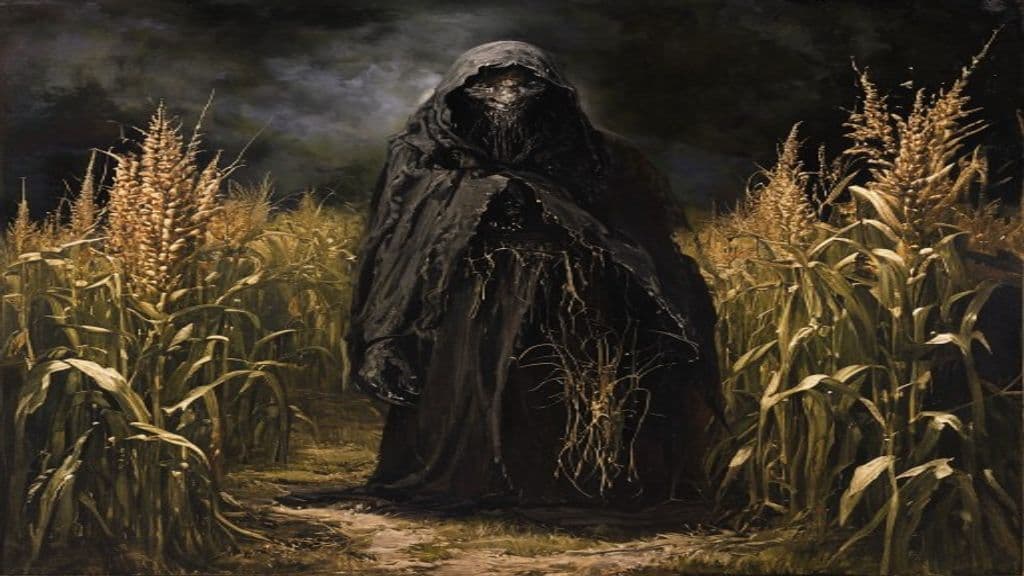
Bilwis appears in central European/Germanic folk-material as one of the Feldgeister or Korndämonen — spirits immanent in cultivated land and cereals. The entity is recorded in compendia of German folk motifs (Paul Herrmann) and is grouped with crop/harvest figures (Kornweib, Kornmuhme, Roggenwolf, Schnitter). While precise origin narratives or a single cohesive mythic genealogy are not provided in the supplied material, the tradition situates Bilwis within the countryside ontology that personifies agricultural fortunes: an animating presence of the field liable to be benevolent or harmful according to local lore and treatment. Secondary summaries (regional folklore summaries cited in modern fandom material) attribute an older ambivalent household/field-sprite role that later narratives emphasize as a bogeyman who harms crops.
Traditional/older folkloric sources in the provided material identify Bilwis primarily by function (a corn/field spirit) rather than a consistent physical description. Secondary/modern treatments add more concrete imagery: a roleplaying (5e SRD) entry describes Bilwis as a mirage‑like, wavering humanoid formed from grasses and weeds with hair like blowing corn silk. Separate secondary summaries (fandom) describe later portrayals of the being with agricultural implements (sickles on his feet, a pitchfork) used in accounts where he harvests or steals grain. The sources note the modern/derivative nature of some of these visual elaborations.
Across sources Bilwis is linked to actions upon crops and weather: as a Feldgeist/Korndämon Bilwis belongs to a family of beings associated with wind and with causing lightning and rain (per Feldgeister summaries). Secondary folkloric summaries describe a range of behaviors including domestic mischief (tangling children's hair in sleep), conditional healing/cure if treated well, and hostile activity such as entering fields to rob or damage crops, sometimes depicted using sickles or a pitchfork. The materials supplied do not give a detailed catalogue of magical powers beyond these functional attributions tied to agricultural success, damage and weather phenomena.
Abraun
Abraun is an attested name in German-language plant-legend scholarship (Der abraun, ein beitrag zur pflanzensagenkunde, 1916) and a short database entry (Wikidata) labels it as a spirit from German mythology. Surviving accessible documentation is extremely limited: the principal academic treatment is a 1916 contribution to pflanzensagenkunde (plant-saga studies), but the excerpts available here contain only bibliographic metadata and do not record tales, descriptions, or rituals.
Adils
Adils (Old Norse Aðils; also Eadgils, Adillus, Athisl, Adhel) is a semi‑legendary sixth‑century Swedish king attested in Old Norse saga material and later medieval traditions. He appears in saga episodes as a storied royal figure involved in warfare, court acts, and marriage suits rather than as a supernatural being.
Agilaz (Egil)
Agilaz (reconstructed Proto-Germanic) — commonly recorded in medieval sources as Egil or Ægil — is a legendary archer attested in Germanic heroic tradition. He appears as the brother of Völund (Wayland/Weland) in the Old Norse poem Völundarkviða and in the Thidreks saga, and his name is also inscribed on early medieval objects (Franks Casket, Pforzen buckle). The attested material presents him as a named heroic human archer within saga and inscriptional contexts rather than as a recurrent supernatural species.
Alaisiagae
A group of Germanic female deities attested in Roman Britain, worshipped by continental auxiliary troops at a shrine near Vercovicium (Housesteads) on Hadrian's Wall. Epigraphic evidence records dedications to named members (Beda, Fimmilena, and in other lists Baudihillia and Friagabis) alongside Mars Thincsus and the numen of the emperor; modern scholarship interprets them variously as war/victory goddesses, as goddesses associated with assembly/justice, or as part of Matronae‑type fertility/ancestor cults.
Alberich
In Germanic heroic legend, Alberich is a dwarf associated with elven qualities and power. (Note: 1. Power tier: Reduce to Ancient as Alberich's abilities are not described beyond being a dwarf with elven qualities. 2. Origin story: Clarify that Alberich is mentioned in multiple Germanic texts, bu)
Alcis
A pair of youthful brother-deities worshipped by the Naharvali, attested only in Tacitus' Germania (c. 98 CE). They were venerated in a sacred grove under the care of a priest in female attire and are compared by Roman ethnography to the Graeco‑Roman Dioscuri (Castor and Pollux).
Alf and Alfhild
Alf and Alfhild are legendary human figures from Old Norse/early Scandinavian narrative tradition preserved principally in Saxo Grammaticus' Gesta Danorum. The tale presents Alf as a Danish prince and Alfhild as a Geatish princess who becomes a shieldmaiden and leader of a fleet of female raiders; their story includes combat, recognition, marriage, and later dynastic conflict.
Allerleirauh
Allerleirauh is the eponymous heroine of a Brothers Grimm fairy tale (Grimm no. 65; ATU 510B) who flees an enforced-marriage crisis by disguising herself in a mantle of many furs, takes menial service in another court, and later reveals her identity through three magnificent dresses and token objects to secure recognition and marriage.
Alp
A German-speaking folkloric figure associated with nocturnal disturbance of sleepers. Historically tied to the broader Germanic family of 'elves' and treated variously as an eerie nature-being in medieval glosses and as a male nocturnal spirit in later folk accounts that sits on sleepers' chests and causes nightmares (Alptraum) and 'elf-pressure' (Alpdruck).
Alraune
Alraune is the German folkloric figure identified with the humanoid-shaped mandrake (Mandragora officinarum) and the eponymous female character in Hanns Heinz Ewers's 1911 novel. In folklore the mandrake/Alraune is associated with love philtres, fertility, and a medieval gallows-origin legend; in literature the name labels a woman artificially conceived from a criminal's semen, whose emotional life and actions dramatize the folk moral about such origins.
Altgermanische Religionsgeschichte
A historical survey of Germanic religious history, providing an overview of the pantheon of gods and goddesses. (Note: - Power tier is not applicable to historical surveys - The article should reflect that it's a historical survey, not an entity with abilities or appearance - Consider adding information on the signifi)
Amleth
Amleth (Old Norse: Amlóði; Latinized Amlethus) is a legendary medieval Scandinavian prince and saga-hero best known from Saxo Grammaticus' Gesta Danorum. He is a human protagonist whose story centers on feigned madness, cunning survival, exile to Britain, marriage, wealth-gathering, and eventual vengeance against his father's murderer; the tale later inspired the character of Shakespeare's Hamlet and numerous adaptations.
Community Record
- [1]Feldgeister (Wikipedia) — entry on corn spirits. Wikipedia: Feldgeister, section summary that 'Feldgeister or Korndämonen are corn spirits in German folklore' and that 'Feldgeister are often also wind spirits, causing lightning and rain.'wiki
- [2]Paul Herrmann — Deutsche Mythologie (archive listing/index references). Paul Herrmann, Deutsche Mythologie: Seelenglaube und Naturverehrung — Herrmann lists Bilwis among many field- and crop-related folk motifs and places it within the cluster of harvest/field spirits (index and collected topics).folk
- [3]Bilwis — 5th Edition SRD (creature entry, modern derivative depiction). 5e SRD 'Bilwis' entry: descriptive imagery — 'The vague outline of a person wavers to and fro, mirage-like, formed from grass and weeds seemingly caught on a breeze with hair of blowing corn silk.'other
- [4]Bilwis — Megami Tensei Wiki (fandom summary of folkloric motifs). Megami Tensei Wiki (fandom): summarizes regional folklore motifs attributing to Bilwis an older trickster/household-sprite role (tangling hair, curing illness if treated well) and later portrayals as a bogeyman who robs farmers of their crops using sickles on his feet and a pitchfork (noted as secondary/derivative source).other
- [5]Paul Herrmann — Internet Archive (alternate link). Archive mirror of Herrmann's Deutsche Mythologie; cited for the presence of Bilwis in Herrmann's catalogue of folk motifs and the broader contextual grouping with field, weather and harvest spirits.folk