
The supplied material does not record a single cohesive origin myth for the black dog. In the accounts summarized, the figure is part of popular folklore rather than a named progenitor narrative: it is presented as a longstanding uncanny presence that appears at liminal, historically charged, or dangerous places (crossroads, barrows, places of execution, ancient pathways) and in certain weather phenomena (electrical storms). In some strands, where Christian interpretive frameworks predominate, the black dog becomes associated with the Devil, folding older local uncanny motifs into a moral-cosmic schema in which such apparitions signal malign influence or divine warning. The sources emphasize geographic spread and motif continuity rather than a specific creation story or ancestral origin.
The black dog is consistently described in the available material as an unnaturally large canine, black in coloration, often with glowing red or yellow eyes. The supplied summary frames it in hellhound and spectral terms: a dog-shaped, non-human apparition rather than an ordinary animal. No further consistent morphological detail (such as tail form, coat texture, specific sounds, or precise dimensions) is recorded in the provided sources; accounts use general descriptors like ‘‘large’’ and note the striking feature of luminous eyes.
Reported behaviours vary by local tale. Commonly the black dog functions as an omen-bearer of death (for example, a Yorkshire dog said to presage death within a year). Several named variants (Barghest, Black Shuck) are recorded as directly harmful or aggressive toward passersby; the Aylesbury story records an attack after which the human was left paralysed. Conversely, other stories present benevolent or guardian behaviour: the Gurt Dog of Somerset guides travellers at night and protects them from danger, and an Isle of Man tale tells of a great black dog that blocked a skipper’s way, causing him to stay ashore and thereby avoid a deadly storm. The motif is also tied to liminal landscape features and stormy weather, and auditory phenomena such as baying or barking by unseen packs are reported in some accounts.
Weaknesses
- conditionavoidance/flight (narrative outcome)
- conditionconfrontation (recorded as coinciding with disappearance in at least one tale)
Wards
- othercompany / staying ashore (narrative protective action)
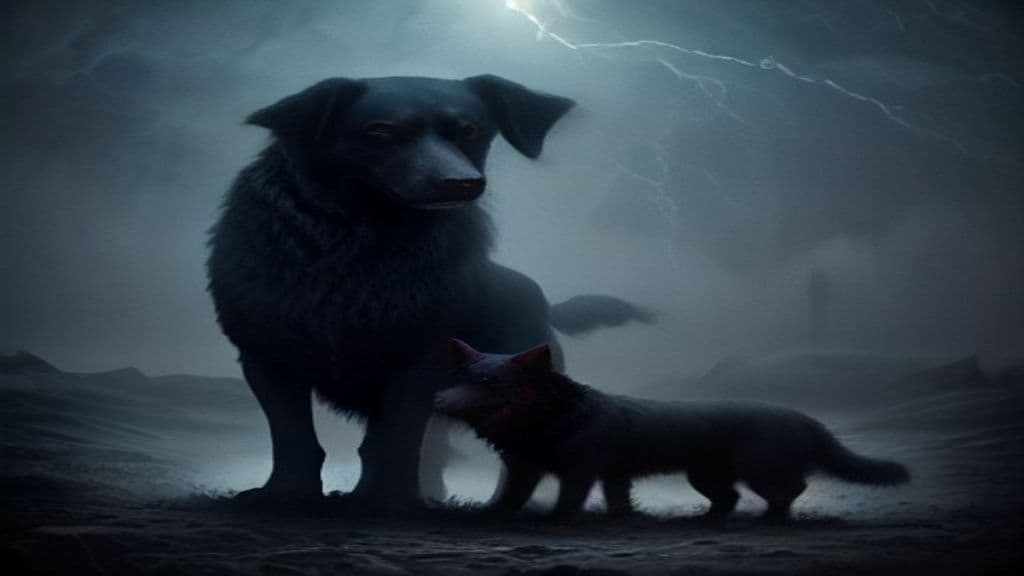
Black Shuck
A spectral black dog of East Anglian legend, with glowing red or green eyes. Its appearance is an omen of death. Its howl has been heard on clifftops during storms for centuries.

Barghest
A Northern English uncanny presence most often described as a monstrous black dog that serves as an omen of death; the term also covers variant local beings (ghosts or household elves) in some counties, making it a fluid category of liminal, threatening presences in regional folklore.

Cerberus
The three-headed hound of Hades, guardian of the underworld's gates — welcoming the dead in but allowing no shade to leave and no living mortal to enter uninvited.
*Perkʷūnos
*Perkʷūnos is the reconstructed Proto-Indo-European thunder‑god hypothesized by comparative linguistics and mythology. Scholarly reconstructions portray him as a storm or thunder figure associated with fructifying rain and as the combatant who fights a multi‑headed water‑serpent to release life‑giving waters; no direct attestations from the Proto‑Indo‑European period survive and the figure is inferred from later Indo‑European traditions.
*Péh₂usōn (reconstructed)
Péh₂usōn is a hypothetical Proto‑Indo‑European pastoral guardian reconstructed by comparative scholars from parallels in Greek and Vedic traditions. Proposed as a Graeco‑Aryan ancestor‑figure, the reconstruction describes a protector of flocks, roads, and travellers rather than an attested historical cultic personality.
57 Mnemosyne
57 Mnemosyne is a large main-belt asteroid (S-type) discovered in 1859 and named after the Greek Titaness Mnemosyne. It is a non-sentient astronomical body studied for its orbital and rotational properties and has been used in dynamical measurements related to Jupiter.
Abaddon
In Hebrew scripture Abaddon is primarily a noun meaning 'destruction' or a section/condition of the underworld paired with Sheol; in the New Testament Book of Revelation Abaddon is personified as an angelic figure (Greek Apollyon) described as the king of an army of locusts released from the abyss during the apocalypse.
Aban Yasht
The Aban Yasht is a hymn from the Persian tradition that praises Anahita, a goddess associated with water, fertility, and wisdom. It consists of 132 stanzas and is part of the 21 Yashts collection. (Note: - Power tier should be "Primordial" or possibly "Cosmic", given that it's a hymn of great spiritual significance and associated with a goddess. - The article incorrectly states that Anahita is associa)
Abath
No corroborated folkloric entity named "Abath" is documented in the provided sources. The string appears in the supplied material only as a surname/personal name in Aruban/Dutch-Caribbean archival records and as an unrelated taxonomic or encyclopedic hit; no mythic attributes, origin stories, rituals, or apotropaic practices for an entity called Abath are present in the documents reviewed.
Abatur
Abatur is an uthra (celestial emanation) in Mandaeism described as the 'father of the Uthras' and called the Ancient (ʿattīqā). He resides on the boundary between the World of Light and lower regions, functions as a judge who weighs souls (Abatur Muzania), and supplies instructions and materials to the demiurgic uthra Ptahil in accounts from the Diwan (Scroll) of Abatur.
Abatwa (Twa / Batwa)
Abatwa (also recorded as Twa, Batwa, Mutwa; singular forms Barhwa or Murhwa in some transcriptions) are indigenous hunter‑gatherer peoples of the Great Lakes region of Central Africa, historically identified as some of the earliest inhabitants of the area. The available sources treat them as human ethnic groups whose livelihoods, lands, and populations have been severely affected by conservation policies and modern violence.
Abdiel
Abdiel (Hebrew עֲבְדִּיאֵל) is primarily a theophoric Hebrew personal name meaning "servant of El/servant of God," attested once in the Hebrew Bible (1 Chronicles 5:15). In later literature—most notably John Milton's Paradise Lost—Abdiel is reimagined as a faithful seraph who opposes Satan's revolt. The provided sources do not treat Abdiel as an autonomous folkloric spirit type or record rituals or wards associated with the name.
Abellio
Abellio is a theonym attested in Roman‑period inscriptions from the Comminges area of the Pyrenees and reported as worshipped in the Garonne Valley of ancient Gallia Aquitania. Surviving evidence is limited to a small number of inscriptions; scholars have variously hypothesized solar or arboreal associations and compared the name to forms of Apollo or to Celtic Belenus, but the deity's precise role in local cosmology remains uncertain.
Abiel
Abiel is attested in the supplied sources only as a male given name — borne by several historical American individuals and listed as two minor biblical figures. The provided materials contain no evidence presenting Abiel as a supernatural, mythological, or folkloric entity.
Abigail
Abigail is a female figure in the Hebrew Bible portrayed in 1 Samuel 25 as the intelligent and beautiful wife of Nabal who intervenes to prevent David from committing violence; later tradition regards her as one of the Tanakh's seven female prophets and as a model of beauty and wisdom.
Community Record
- [1]Black dog (folklore) — Wikipedia. Wikipedia contributors. "Black dog (folklore)." Wikipedia, The Free Encyclopedia.wiki
- [2]Wikidata: black dog. Wikidata entry Q1321618 (black dog)other
- [3]Shuckin' and jivin' : folklore from contemporary Black Americans (table of contents). Dance, D. 'Shuckin' and jivin': table of contents and references to spirit-dog tales (archive).folk
- [4]Megalithomania — Conway Hall (archive listing). Coil, Megalithomania event listing (archive); indicates contemporary retellings but adds no ritual detail.other
- [5]Episode 27: Spooky Dog Stories part 2 and 3 (podcast archive). Podcast episode listing: 'Spooky Dog Stories' (archive).other
- [6]DVD Transfer 21 (Miscellaneous from December 1995-January 1996). Archive item listing: DVD Transfer 21 (Miscellaneous from December 1995-January 1996). https://archive.org/details/dvd-transfer-21other
- [7]VOA Global English : May 26, 2020 09:00AM-10:00AM EDT. VOA Global English broadcast transcript listing. https://archive.org/details/VOA_Global_English_20200526_130000other
- [8]Worldvision Enterprises (1989) Drawing. Worldvision Enterprises (1989) drawing listing. https://archive.org/details/worldvision-enterprises-1989-drawingother
- [9]Smashing Pumpkins Live at The Orange Peel on 2007-06-26 (track listing). Archive.org audio release (track listing) — provided but not folkloric source for the black dogother
- [10]Three Catholic Reformers Of The Fifteenth Century (contents listing). Archive.org contents listing (includes chapter titles referencing devils) — provided but does not give specific rituals relating to the black dog in supplied excerptsother
- [11]Episode 79 | Lolita (1962 & 1997) (podcast listing). Archive.org podcast episode listing — provided but unrelated to black dog folkloreother