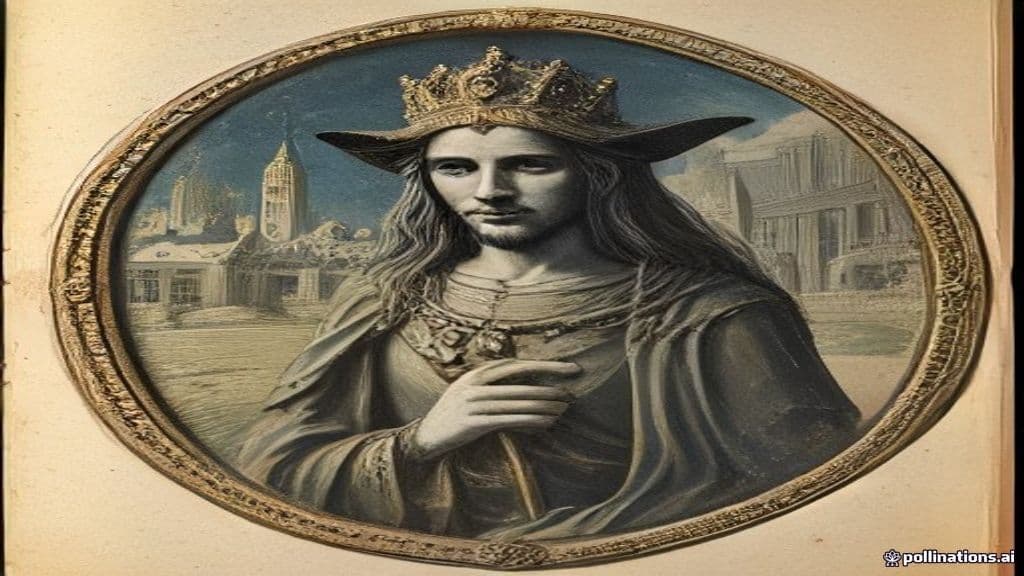
In the Geoffrey of Monmouth tradition and subsequent retellings Bladud is a prince who contracts leprosy and is exiled from court. While working as a swineherd at Swainswick he noticed pigs wallowing in warm black mud and that those pigs did not suffer from skin disease. After trying the mud-bath himself he was cured and was later restored to authority; he is credited with founding the city of Bath so others might benefit from the springs. Variants add that he was educated in Athens and brought philosophers with him, and some later accounts claim he founded a university at Stamford which was suppressed by Augustine of Canterbury for perceived heresies. The figure is presented as legendary; modern summaries note there is no historical evidence for his existence.
Primary medieval and early-modern sources provide little sustained physical description of Bladud as an individual beyond his social roles (prince, swineherd, king). Visual references are largely later civic representations: Bath features a statue associated with Bladud overlooking the King's Bath assembled from parts of older statuary, an eighteenth‑century reuse whose weathered appearance contributed to the local association of the figure with disease and cure. Nineteenth‑century and later literary retellings recycle the figure in narrative contexts but do not establish a consistent historical portrait.
Sources attribute to Bladud an etiological miracle of healing—his discovery and promotion of warm black mud and hot springs as a cure for skin disease—and the role of founder and patron of communal bathing at Bath. Some traditions present him as an introducer of learning (education in Athens; bringing philosophers; founding a university at Stamford in certain versions). Later embellishments credit him with practices of necromancy or divination through the dead and with constructing wings to attempt flight; these accounts end with his death by falling, striking a wall, or breaking his neck. These claims are folkloric and literary attributions rather than attestations of systematic supernatural powers.
Weaknesses
- conditionHubris leading to fatal flight (death by fall or collision)
- conditionEcclesiastical suppression of associated teachings (narrative motif: Augustine suppresses Stamford university)
Wards
None recorded.
57 Mnemosyne
57 Mnemosyne is a large main-belt asteroid (S-type) discovered in 1859 and named after the Greek Titaness Mnemosyne. It is a non-sentient astronomical body studied for its orbital and rotational properties and has been used in dynamical measurements related to Jupiter.
Aamon
Aamon (also Amon) is a named spirit in early modern Western grimoire tradition (Pseudomonarchia Daemonum; the Ars Goetia / Lesser Key of Solomon). He is presented as a high-ranking infernal officer (Marquis/Prince) who governs forty legions and is credited with knowledge of past and future and with affecting human relationships (reconciling or procuring feuds and favor).
Abandinus
Abandinus is a locally attested Romano‑Celtic theonym known from a single inscribed bronze feather (votive object) dedicated at Godmanchester (the Roman fort Durovigutum) in Cambridgeshire. Scholars interpret him as a local god or male spirit tied to a specific place and possibly associated with a nearby spring or stream; this association is tentative and based on etymological readings of the name.
Abarta (Ábartach)
Abarta (also Ábartach) is a figure of Irish myth who, in surviving accounts, tricks Fionn mac Cumhaill's warriors by giving them a supernatural grey horse that bears them into the Otherworld. Sources variably identify him as a member of the Tuatha Dé Danann or as a Fomorian; after the incident he is compelled to release the captured warriors and is refused entry to the Fianna.
Abcán (Abhcán)
Abcán (modern spelling Abhcán) is a named dwarf poet and musician of the Tuatha Dé Danann in Irish myth. He appears in a small number of narratives as a musician whose art has soporific power and as the ferryman who brings the goddess Ruad from the Otherworld to the human world.
Abdiel
Abdiel (Hebrew עֲבְדִּיאֵל) is primarily a theophoric Hebrew personal name meaning "servant of El/servant of God," attested once in the Hebrew Bible (1 Chronicles 5:15). In later literature—most notably John Milton's Paradise Lost—Abdiel is reimagined as a faithful seraph who opposes Satan's revolt. The provided sources do not treat Abdiel as an autonomous folkloric spirit type or record rituals or wards associated with the name.
Abhean
Abhean is a named poet of the Tuatha Dé Danann in medieval Irish literature, described as a poet in particular of Lugh and recorded as having been killed by Óengus before Midir in a poem by Fland Mainistreach preserved in the Lebor Gabála Érenn.
Abiel
Abiel is attested in the supplied sources only as a male given name — borne by several historical American individuals and listed as two minor biblical figures. The provided materials contain no evidence presenting Abiel as a supernatural, mythological, or folkloric entity.
Abigail
Abigail is a female figure in the Hebrew Bible portrayed in 1 Samuel 25 as the intelligent and beautiful wife of Nabal who intervenes to prevent David from committing violence; later tradition regards her as one of the Tanakh's seven female prophets and as a model of beauty and wisdom.
Abnoba
Abnoba is a Gaulish theonym and toponym attested in Roman-era sources and inscriptions: a localized deity associated with woods, springs and the sources of rivers (notably the Danube) and simultaneously the name applied to a mountain or mountain range in the Black Forest/Baar/Odenwald region. Roman altars equate her with Diana, reflecting syncretic cult practice in frontier provinces.
Abrahel
Abrahel is a demonological entity attested in early modern sources (notably Nicholas Rémy's Demonolatria as summarized in modern reference) portrayed as a female sexual spirit who seduced a man in 1581, induced him to kill his son, then restored the child to life in exchange for worship; the revival produced a diminished, foul-smelling corpse that later died again.
Abraxas
Abraxas (Abrasax) is a late‑antique Gnostic and magical name attested as a high-ranking cosmic power in heresiological summaries and as a potent name engraved on amulets (so-called Abraxas stones) in the Greco‑Roman magical milieu. Heresiologists associate Abraxas with rulership of 365 heavens and note the name's numerological value, while archaeological and papyrological contexts show its use as an amuletic formula.
Community Record
- [1]Bladud. Wikipedia, 'Bladud' article (summary of Geoffrey of Monmouth and later traditions)wiki
- [2]The Mystery of Bladud. BuildingHistory.org, 'The Mystery of Bladud' (discussion of the Bath legend and Swainswick motif)other
- [3]The pioneers of flight : a documentary history. The Pioneers of Flight (collection referencing later retellings that compare Bladud's winged flight to classical motifs)other
- [4]Swainswick. Wikipedia, 'Swainswick' (local association with Bladud's swineherd episode)wiki
- [5]The Pickwick Papers — 'The True Legend of Prince Bladud' (retelling). Charles Dickens, Pickwick Papers, Chapter 36 (19th‑century literary retelling of the legend)literary