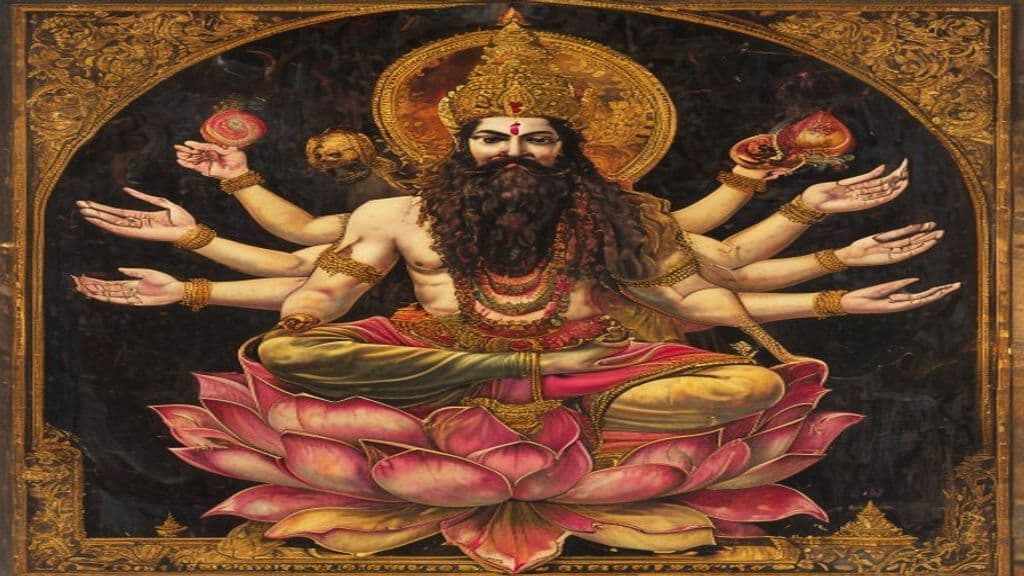
Brahmās appear in Buddhist cosmology as inhabitants of the higher, non‑sensual or fine‑form realms (Rūpadhātu and Ārūpyadhātu). Early Buddhist texts integrate and reinterpret Vedic categories so that Brahmā is not an independent creator but a powerful conditioned deva whose status and realms are the result of past kamma and/or meditative attainment. Textual traditions enumerate many Brahmā realms (ancient and medieval sources describe seventeen or more), and at times a leading figure called Mahābrahmā or several Mahābrahmās function as chiefs among these devas. Narrative episodes in the suttas (for example, the appearance of Brahmā Sahāmpati to the Buddha after his awakening) and named Brahmā figures (Baka, Ghaṭīkāra, Sanatkumāra) serve didactic roles in the literature rather than providing a single origin myth for the office.
Canonical descriptions in early Buddhist texts emphasize the Brahmās' status as devas of refined realms rather than fixed iconographic details. In later and vernacular cultural representations Brahmās are commonly visualized anthropomorphically (generally one‑faced, two‑armed, two‑legged, sometimes with beard in popular imagery), but the sources stress that such portrayals are cultural renderings: the primary textual emphasis is on their deva nature and high cosmological position rather than uniform physical features.
Brahmās inhabit refined heavenly spheres and consequently possess the high, non‑sensual pleasures, moral repute, and greatly extended lifespans appropriate to those realms. They can interact with beings in lower realms — several suttas record Brahmā appearances, speech, and interventions (notably Brahmā Sahāmpati encouraging the newly awakened Buddha to teach). Some Brahmās function as protectors of the Dharma (dharmapāla) in certain texts. At the same time Buddhist literature presents Brahmās as conditioned and capable of error (for example, Brahmā Baka's mistaken belief in his own world's permanence), and some named Brahmā figures are integrated into narrative accounts of past lives allied with the Buddha (e.g., Brahmā Ghaṭīkāra supplying requisites in a past life).
Weaknesses
- otherDecline in cultic prominence / demotion in Purānic narratives
Wards
- othernone attested in provided sources
Iblis
The primordial deceiver in Islamic theology; a jinn who refused God's command to bow before Adam and was expelled from heaven. The source of all temptation and whispered suggestion.

Prajapati
Prajapati (Sanskrit: प्रजापति) is a Vedic-Brahmana creator figure whose name means "lord of creatures." In Vedic and Brahmana texts he functions as a primordial creative principle and progenitor; in later Puranic layers the term becomes a flexible title applied to multiple creator‑figures (including Brahma and others).

Hiraṇyagarbha
Hiraṇyagarbha (Sanskrit: हिरण्यगर्भ, 'golden womb') is a Vedic and later Hindu cosmological concept: a primordial golden seed or 'cosmic egg/womb' from which the manifested universe is said to originate. It is presented variously as an impersonal formative principle, the 'Soul of the Universe' in Upanishadic language, and in Purāṇic and exegetical contexts as the first-born or creator (identified with Prajāpati or Brahmā).
*Péh₂usōn (reconstructed)
Péh₂usōn is a hypothetical Proto‑Indo‑European pastoral guardian reconstructed by comparative scholars from parallels in Greek and Vedic traditions. Proposed as a Graeco‑Aryan ancestor‑figure, the reconstruction describes a protector of flocks, roads, and travellers rather than an attested historical cultic personality.
Abhimanyu
Abhimanyu is a youthful Kuru/Pandava warrior-hero in the Sanskrit epic Mahābhārata. Son of Arjuna and Subhadra, he is famed for entering the Chakravyuha battle formation on the thirteenth day of the Kurukshetra War and dying at age sixteen; his posthumous son Parikshit continues the Kuru line.
Acala
Acala (Sanskrit: अचल, 'The Immovable') is a wrathful protective deity (dharmapala) in Vajrayāna and East Asian esoteric Buddhism, classed among the Wisdom Kings (Vidyārāja). He functions as a ritual focus for visualization and mantra practice intended to remove obstacles and bind or destroy hostile forces.
Acalanātha (Acala / Achala)
Acalanātha (also Acala or Achala) is a wrathful deity and dharmapāla — a protector of the Dharma — prominent in Vajrayana and East Asian Mahayana Buddhist contexts. Presented as a fierce, non‑human or semi‑divine protector-figure, Acalanātha functions to defend the teaching and practitioners by removing obstacles and confronting threats to the transmission and practice of Buddhism.
Achyuta
Achyuta (Sanskrit: अच्युत, acyuta) is primarily an epithet/theonym in Vaishnava Hindu tradition applied to Vishnu and Krishna, signifying the divine quality of being 'not fallen' — immutable, infallible, and imperishable. It functions as a devotional name in scripture, liturgy, and Pancharatra lists of divine emanations rather than as an autonomous folkloric spirit.
Acintya
Acintya is an Indonesian Hindu theological-symbolic representation of the ineffable supreme divine principle. In Balinese and Javanese practice it functions as a way to make ultimate reality present in ritual and art—often aniconically as an empty throne (padmasana) or anthropomorphically as a naked, flame-surrounded figure—rather than as a narrative, intervening deity.
Adi (asura)
Adi is attested in modern reference works as the name of an Asura who 'appears in the Matsya Purāṇa.' Beyond this single-line citation in secondary sources, no descriptive material about the figure is provided in the supplied research notes.
Adi Shakti
Adi Shakti (also Adi Parashakti, Mahadevi, Adya Shakti) is the primordial feminine power in Hindu/Shakta theology, regarded as the ultimate reality (Para Brahman) and the source from which all goddesses and gods manifest. She is both an impersonal cosmic principle (Mulaprakriti) and a focus of devotional invocation in temples, mantras, and pilgrimage sites such as Shakti Peethas.
Adi Vinayaka
Adi Vinayaka (Ādi Vināyaka; also called Nara Mukha Vinayaka) is a named iconographic and devotional form of the Hindu god Ganesha portraying the deity with a human head, described in sources as the form before the episode of decapitation by Shiva. It is rarely worshipped and appears in a small number of South Indian shrines and in devotional/musical repertoires.
Aditi
Aditi is a major Vedic goddess in Hindu tradition who personifies the boundless, infinite cosmic principle and functions as the maternal matrix from which many celestial deities (the Ādityas and other groups) are born. In the Vedic hymns she is invoked as a protective liberator who guards petitioners, provides wealth and safety, and frees devotees from hindrances such as sin and sickness.
Agastya
Agastya (also Agathiyar/Agasti) is a revered Vedic and later-period Indian rishi (sage) figure credited in textual traditions as an inspired seer, ascetic, teacher, culture-founder, and attributed author of Vedic, Puranic and Tamil works; in South Indian tradition he is associated with origins of Tamil grammar and Siddha medicine and is identified astronomically with the star Canopus.
Aghasura
Aghasura is an asura from the Vaishnava/Hindu narrative tradition (notably the Srimad‑Bhāgavatam) who, at the command of Kamsa, assumed the form of a vast serpent to ambush Kṛṣṇa and the cowherd boys in Vṛndāvana. The episode demonstrates Kṛṣṇa’s protective, divine power as he enters and destroys the demon from within.
Community Record
- [1]Brahma — Wikipedia. Wikipedia entry 'Brahma'.wiki
- [2]Brahma — Wikidata. Wikidata item Q11389 for Brahma.other
- [3]Brahma Gyana: The Cosmic Symphony of Creation, Consciousness, and Science (archival listing). Archival listing for 'Brahma Gyana' (modern interpretive work; excerptary descriptive blurb only in provided materials).other
- [4]Archive references (audio/video items listed in source notes). Archival items listed in research notes were consulted as metadata but did not supply additional extractable claims about Brahmā in the provided excerpts.other
- [5]Brahmā (Buddhism) — Wikipedia. Wikipedia, 'Brahmā (Buddhism)'wiki
- [6]Literary History Of Sanskrit Buddhism (First Edition). Literary History Of Sanskrit Buddhism (archive.org)literary