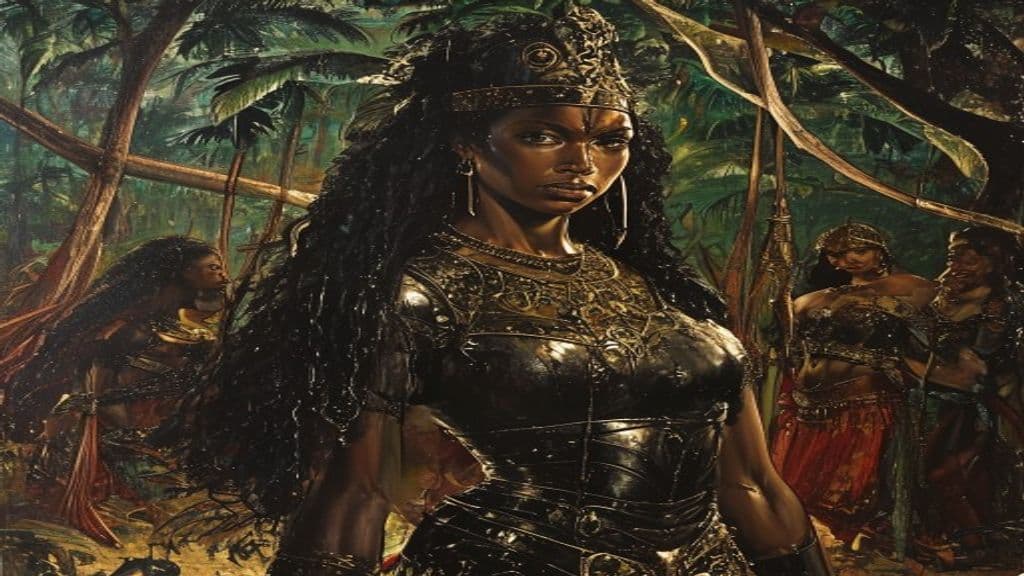
Calafia is a creation of Garci Rodríguez de Montalvo’s Las sergas de Esplandián (c. 1510). Within the romance’s frame, she reigns over a paradisiacal island called California, a women‑ruled polity populated with fantastic fauna. The character’s name is very likely an authorial formation evocative of the Arabic khalīfa / Spanish califa, a rhetorical choice that would have resonated for sixteenth‑century Spanish readers familiar with Christian–Muslim conflict; later readers and artists have treated Calafia as an origin‑figure for the place‑name California.
In Montalvo’s romance Calafia is described as “a regal black woman, courageous, strong of limb and large of person, full in the bloom of womanhood,” presented as the most beautiful of a long line of queens of the island. She and her women warriors are pictured wearing armor said in the text to be made of gold (the narrative claims there is no other metal on the island) and adorned with precious stones, and she is depicted riding and commanding fantastic beasts (griffins) into battle.
As rendered in the chivalric narrative, Calafia exercises formidable military and political abilities: she commands a fleet and naval forces, leads an army of women warriors on offensive campaigns, trains and controls griffins used as aerial combat animals, and displays prowess in single combat (throwing and enduring blows). Her role in the plot also includes political persuasion (convincing her people to take arms) and the capacity for ideological transformation when, after capture in battle, she converts to Christianity and marries, returning to her realm with a changed status within the romance’s moral order.
Weaknesses
- conditioncapture and judicial/religious subjugation (narrative vulnerability)
Wards
- othernone recorded in primary source (character is literary; no folkloric warding practices are documented in the supplied materials)

Griffin
The griffin (also griffon, gryphon) is a composite legendary creature combining the body, tail, and hind legs of a lion with the head, wings, and often taloned forelegs of an eagle. In classical and medieval Eurasian traditions it functions chiefly as a majestic guardian figure associated with rulership and the protection of treasure, and appears widely across artistic vocabularies rather than as a single codified religious being.
Will-o'-the-wisp
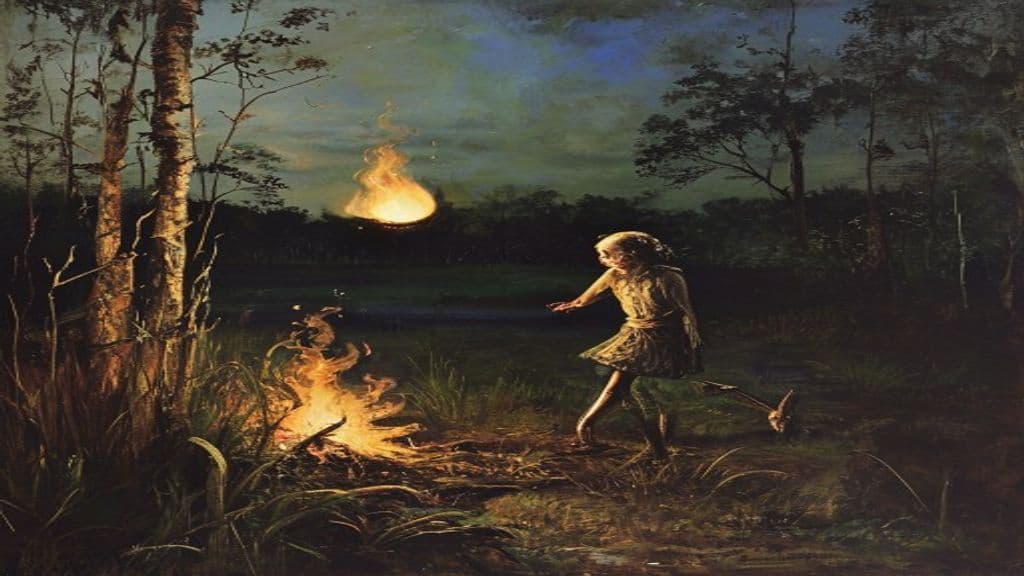
An atmospheric 'ghost light' — a small, mobile, lamp-like light seen at night over marshes, bogs, wet ground, or graveyards. In many cultures the phenomenon is interpreted as a supernatural being or manifestation (wandering nature-spirit, soul of the dead, transformed witch, or treasure-indicator); modern science offers chemiluminescent explanations for some occurrences.
*Perkʷūnos
*Perkʷūnos is the reconstructed Proto-Indo-European thunder‑god hypothesized by comparative linguistics and mythology. Scholarly reconstructions portray him as a storm or thunder figure associated with fructifying rain and as the combatant who fights a multi‑headed water‑serpent to release life‑giving waters; no direct attestations from the Proto‑Indo‑European period survive and the figure is inferred from later Indo‑European traditions.
*Péh₂usōn (reconstructed)
Péh₂usōn is a hypothetical Proto‑Indo‑European pastoral guardian reconstructed by comparative scholars from parallels in Greek and Vedic traditions. Proposed as a Graeco‑Aryan ancestor‑figure, the reconstruction describes a protector of flocks, roads, and travellers rather than an attested historical cultic personality.
3-D Man
3-D Man is a Marvel Comics superhero identity associated with a 1950s-era origin in which the body of Chuck Chandler can materialize in three-dimensional existence when activated by his brother Hal via a pair of glasses. The mantle was later assumed by Delroy Garrett (formerly Triathlon) in modern continuity.
5 Ronin
5 Ronin is a 2011 Marvel Comics five-issue limited series that reimagines five Marvel superhero archetypes as rōnin (masterless samurai) in a fictionalized post‑Sekigahara feudal Japan. The work places Wolverine, Hulk, Punisher, Psylocke, and Deadpool analogues into period roles to explore displacement, revenge, and identity in an era of political upheaval.
57 Mnemosyne
57 Mnemosyne is a large main-belt asteroid (S-type) discovered in 1859 and named after the Greek Titaness Mnemosyne. It is a non-sentient astronomical body studied for its orbital and rotational properties and has been used in dynamical measurements related to Jupiter.
58 Concordia
58 Concordia is a fairly large main-belt asteroid orbiting the Sun, discovered in 1860 and named after the Roman goddess Concordia. Astronomical sources classify it as a C-type (carbonaceous) body with a multi-year orbital period and measurable rotation and pole orientations.
9MOTHER9HORSE9EYES9
An anonymous Reddit screen name and online persona used by the author of the Interface series, a multipart speculative-horror narrative posted in short installments across Reddit in 2016. The name functions as the signature of an authorial identity and as a focal label for a fandom that created archives, a subreddit, and a wiki documenting the story and its fictional phenomena (notably entities called "flesh interfaces").
A Elbereth Gilthoniel
An Elvish hymn in Sindarin addressed to Elbereth (Varda) from J. R. R. Tolkien's legendarium. Presented in The Lord of the Rings and later musical and dramatic adaptations, the hymn functions as devotional poetic language that evokes Elvish reverence for the star-kindler rather than an independent supernatural agent.
A.R.G.U.S.
A.R.G.U.S. is a fictional clandestine United States government agency in the DC Comics universe that investigates, contains, and manages superhuman, meta-human, and supernatural incidents and assets. Introduced in The New 52 continuity, it functions as an institutional actor providing intelligence, logistical support, covert task forces (notably Task Force X / the Suicide Squad), and a dedicated magic division across comics and media adaptations.
Abaddon
In Hebrew scripture Abaddon is primarily a noun meaning 'destruction' or a section/condition of the underworld paired with Sheol; in the New Testament Book of Revelation Abaddon is personified as an angelic figure (Greek Apollyon) described as the king of an army of locusts released from the abyss during the apocalypse.
Aban Yasht
The Aban Yasht is a hymn from the Persian tradition that praises Anahita, a goddess associated with water, fertility, and wisdom. It consists of 132 stanzas and is part of the 21 Yashts collection. (Note: - Power tier should be "Primordial" or possibly "Cosmic", given that it's a hymn of great spiritual significance and associated with a goddess. - The article incorrectly states that Anahita is associa)
Abath
No corroborated folkloric entity named "Abath" is documented in the provided sources. The string appears in the supplied material only as a surname/personal name in Aruban/Dutch-Caribbean archival records and as an unrelated taxonomic or encyclopedic hit; no mythic attributes, origin stories, rituals, or apotropaic practices for an entity called Abath are present in the documents reviewed.
Community Record
- [1]Calafia - Wikipedia. Wikipedia entry 'Calafia' (summary of Las sergas de Esplandián and later cultural reception)wiki
- [2]Las sergas de Esplandián (c. 1510) by Garci Rodríguez de Montalvo — summarized in sources. Primary literary source summarized: Montalvo, Garci Rodríguez de, Las sergas de Esplandián (c. 1510) — character description and episodes as cited in summariesliterary
- [3]Huntington Library Seminar in Women's Studies (1991): 'Calafia: Race, Class and Culture in Early California'. Seminar listing and materials addressing later scholarly discussion of Calafia in race and cultural contextsother
- [4]La reina Calafia (novel) by Vicente Blasco Ibáñez. Modern literary work taking up the Calafia figure (listed among modern sources in supplied notes)literary
- [5]Calafia entry (Wikidata). Wikidata item linking to various uses of the name 'Calafia' (noting ambiguous modern usages)wiki