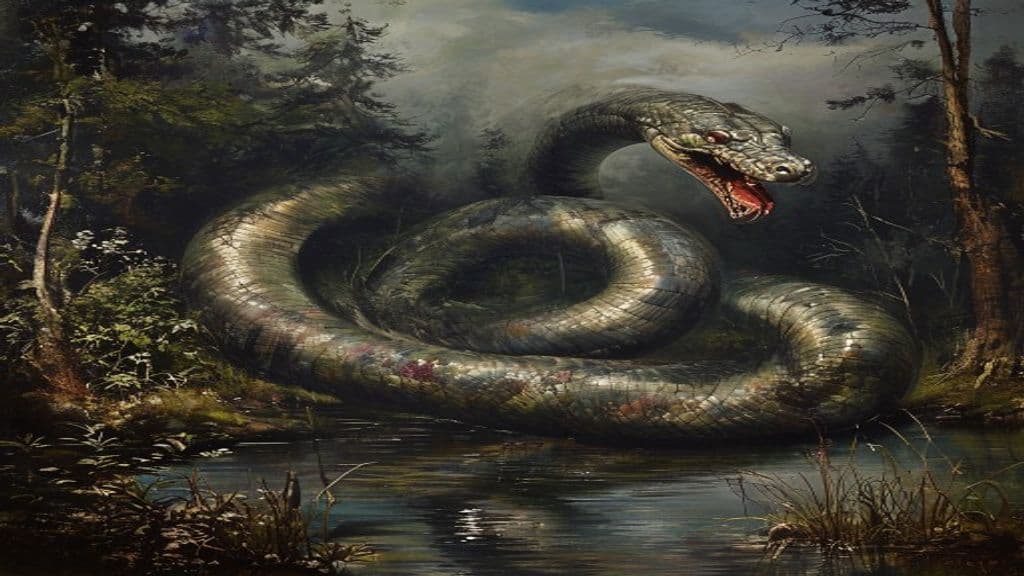
Modern narratives of Champ are grounded in a layered folkloric history rather than a single authoritative origin text. Sources cite Iroquoian (Mohawk) traditions of giant serpents (Onyare'kowa) as antecedent motifs and record European‑era and settler reports from the lake beginning in the 19th century; nineteenth‑ and twentieth‑century newspaper accounts and later popular media linked these strands to produce the named local being 'Champ' used in contemporary storytelling and tourism. The corpus does not provide a documentary lineage equating Onyare'kowa directly with the modern named creature, but treats Indigenous serpent motifs as part of the antecedent cultural material that informs the local legend (see cited reports from 1819, 1883, and later photographic and audio claims).
Descriptions vary across sources and time. Historical newspaper and eyewitness reports describe a large serpentine form: an 1819 Plattsburgh Republican account attributed to 'Capt. Crum' gives an enormously long serpentine figure with colored markings and facial details; an 1883 sheriff's report by Nathan H. Mooney estimated a 25–30 ft (7.6–9.1 m) water serpent and reported seeing round white spots inside its mouth. Modern photographic and video claims (notably Sandra Mansi's 1977 photograph and later video/drone footage) appear to show a long neck and head emerging from the water and have been interpreted by some as 'plesiosaur‑like,' but these images and their provenance are disputed (Mansi's negative was reportedly discarded and location details are uncertain) and alternative explanations such as logs or floating debris are recorded in the sources.
Reported abilities are limited to naturalistic behaviors attributed by eyewitnesses and investigators: swimming within Lake Champlain, surfacing or emerging with a long neck/head, and occasionally being followed by other fish. A 2003 project (Fauna Communications Research Institute) recorded underwater sounds described by the group as similar to beluga or dolphin vocalizations and an article suggested these might be a form of echolocation, noting the lack of known native echolocating species in the lake. The sources do not ascribe supernatural powers, maleficence, or magical agency to Champ; its influence is primarily cultural as a persistent local cryptid attracting public interest and tourism.
Abdiel
Abdiel (Hebrew עֲבְדִּיאֵל) is primarily a theophoric Hebrew personal name meaning "servant of El/servant of God," attested once in the Hebrew Bible (1 Chronicles 5:15). In later literature—most notably John Milton's Paradise Lost—Abdiel is reimagined as a faithful seraph who opposes Satan's revolt. The provided sources do not treat Abdiel as an autonomous folkloric spirit type or record rituals or wards associated with the name.
Abiel
Abiel is attested in the supplied sources only as a male given name — borne by several historical American individuals and listed as two minor biblical figures. The provided materials contain no evidence presenting Abiel as a supernatural, mythological, or folkloric entity.
Abigail
Abigail is a female figure in the Hebrew Bible portrayed in 1 Samuel 25 as the intelligent and beautiful wife of Nabal who intervenes to prevent David from committing violence; later tradition regards her as one of the Tanakh's seven female prophets and as a model of beauty and wisdom.
Accolon
Accolon is a mortal knight of the Arthurian court, presented in the Post-Vulgate Merlin tradition and Malory's Le Morte d'Arthur as Morgan le Fay's paramour and instrument in a plot to supplant King Arthur; his tale centers on enchanted weapons (Excalibur and its scabbard), love-manipulation, and a tragic duel with Arthur.
Acionna
Acionna is a local Gallo-Roman water goddess attested by a single votive inscription found at a spring in the Orléanais region. The inscription, discovered by Jollois in 1822 and datable by style to the 2nd century CE, dedicates a portico and ornaments "AUG(ustae) ACIONNAE" and was recovered from the Fontaine de l'Étuvée in Orléans; archaeological work in 2007 uncovered remains of a Gallo-Roman temple and a section of an aqueduct at the site.
Adsullata
Adsullata is attested as a Continental Celtic river goddess associated with the River Savus (modern Sava) in the Roman province of Noricum. Later traditions record her presence in Brittany as a goddess of hot springs and present her as an antecedent or origin-form of the Anglo‑Celtic sun goddess Sul.
Afaon fab Taliesin
Afaon fab Taliesin is a medieval Welsh warrior-counsellor, named as a son of the bard Taliesin and recorded among Arthur’s retinue in Welsh tradition. He appears in the Welsh Triads and in the tale Breuddwyd Rhonabwy (The Dream of Rhonabwy) as a notable martial figure and proverb-speaker rather than as a supernatural being.
Agent Liberty
Agent Liberty is a fictional human operative persona in DC Comics and its television adaptation (Arrowverse). The identity—most prominently used by Benjamin 'Benjy/Ben' Lockwood—functions as a costumed, paramilitary/enforcer role tied to political movements (Sons/Children of Liberty) or official security details, driven by ideological 'liberty' rhetoric rather than supernatural agency.
Aglovale
Aglovale (also Agloval, Aglovan, Aglovaus, Acglavael) is a human knight of Arthurian romance, presented as the eldest legitimate son of King Pellinore and a Knight of the Round Table in the Vulgate/Post‑Vulgate cycles, Malory, and later adaptations. He brings his long‑lost brother Perceval to Camelot, takes part in military actions (including slaying Agrippa in one account), and his death is related in varying ways across traditions (accidental at Gawain's hand, deliberate murder by Orkney kin, or killed during Lancelot's rescue of Guinevere).
Agolant
Agolant is a literary Saracen king who appears as a recurring antagonist in medieval and Renaissance epic cycles (Matter of France). He functions as a human royal opponent to Charlemagne and his peers, supplying martial episodes, genealogical connections, and the transfer of legendary arms and horses in chansons de geste and later Italian romances.
Agravain
Agravain is a literary knight of Arthurian romance cycles: one of the sons of King Lot of Orkney, a member of the Round Table, and a recurring figure in French and English medieval prose and verse. He is portrayed as a skilled but morally problematic courtly knight whose jealousy, malice, and intra-familial violence drive key narrative conflicts (notably the slaying of Lamorak and the exposure of Guinevere).
Agrestes
Agrestes is a legendary pagan king of Camelot appearing in accounts of the 13th‑century Arthurian Vulgate Cycle. Presented as a human antagonist to the Christian mission associated with Joseph of Arimathea (or his son Josephus), his violent persecution of converts is followed by madness, self‑destruction, and the subsequent consolidation of Christianity in Camelot.
Community Record
- [1]Champ (folklore) — Wikipedia. Wikipedia, 'Champ (folklore)'wiki
- [2]Champ | USC Digital Folklore Archives. USC Digital Folklore Archives, 'Champ'folk
- [3]Lake Champlain Monster: Champ | USC Digital Folklore Archives. USC Digital Folklore Archives, 'Lake Champlain Monster: Champ'folk
- [4]Champ (folklore) mirrored entry. Mirrored Wikipedia entry used in corpuswiki
- [5]Lake monster — Wikipedia (comparative motif). Wikipedia, 'Lake monster' (used for comparative category context)wiki
- [6]Bookmice.net — Champ summary. Popular summary and compilation of Champ reportsother