
Chthonius is not a single unified being but a name/epithet derived from the Greek root chth- meaning "earth" or "underworld." As a proper name it identifies several figures in different genealogical and mythic accounts: one of the Spartoi produced when Cadmus sowed dragon's teeth at Thebes; one of the sons of King Aegyptus who married (and was slain by) a Danaid; a son of Poseidon and the eponymous Syme credited with founding a colony on the island of Syme; a Centaur killed in the Centauromachy tradition; and one of the Gigantes. Separately, the adjective Chthonius is used as a cultic or literary epithet applied to gods in their earth- or underworld-associated aspects. The same lexical formation was later adopted as the genus name Chthonius for a group of pseudoscorpions in zoological taxonomy.
No single consistent appearance attaches to Chthonius because the label names multiple distinct figures. The Spartos Chthonius would be implicitly human and autochthonous (the Spartoi are described as men springing from the earth); the Centaur Chthonius conforms to the conventional half-human, half-horse Centaur form and is said to have been slain at the wedding of Pirithous and Hippodamia; the Gigantes-member is, by membership, a giant figure of the Gigantomachy tradition; the sons and founders (Aegyptus' son, Poseidon's son) are represented as human males in genealogical narratives. The taxonomic genus Chthonius consists of pseudoscorpions — small arachnids that superficially resemble scorpions but lack a tail or sting (modern biological characterization).
There is no single set of powers attributed to 'Chthonius' as a unitary entity in the sources: each named bearer inherits the capacities normative to its class in Greek myth (autochthony for the Spartoi; martial presence in the case of Centaurs and Gigantes; founders' agency for the Poseidon-son). As an epithet applied to gods (e.g., Hades, Hermes, Dionysus) it signals chthonic functions or aspects of those deities in cult or literature rather than a separate set of powers. The modern genus usage carries no mythic abilities.
Weaknesses
- otherNo documented weaknesses
Wards
None recorded.

Poseidon
Poseidon is a principal deity of the ancient Greek pantheon, counted among the Twelve Olympians; he presides over the sea, storms, earthquakes and horses and functions as protector of seafarers and guardian of cities and colonies.
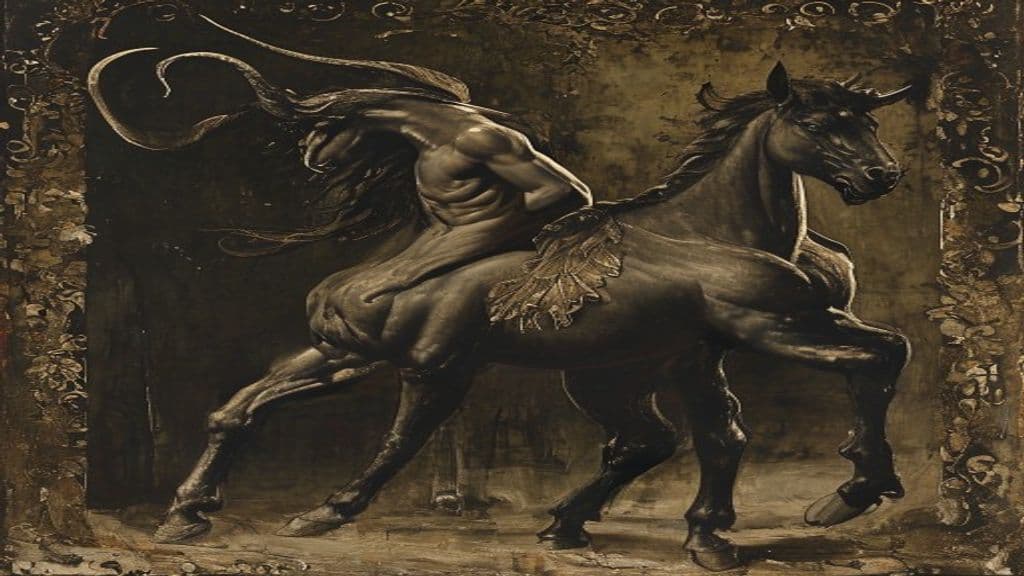
Centaur
A mythic hybrid from ancient Greek tradition with the upper body of a human and the lower body and legs of a horse. Centaurs appear as a tribal population associated with mountainous and wooded regions of Greece and embody tensions between human social order and untamed nature.
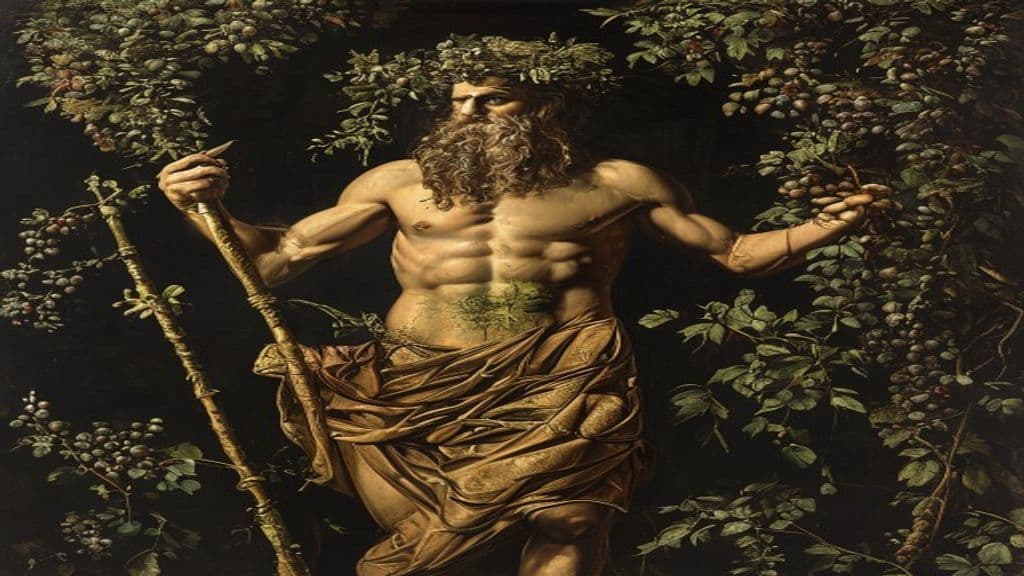
Dionysus
Dionysus (Ancient Greek: Διόνυσος) is a major ancient Greek deity associated with wine and winemaking, vegetation and fertility, festivity and theatre, ritual ecstasy and possession, and liminal links with death and the underworld. He is an epiphany-god who travels between worlds, whose cult includes ecstatic rites and mystery initiation.
*Perkʷūnos
*Perkʷūnos is the reconstructed Proto-Indo-European thunder‑god hypothesized by comparative linguistics and mythology. Scholarly reconstructions portray him as a storm or thunder figure associated with fructifying rain and as the combatant who fights a multi‑headed water‑serpent to release life‑giving waters; no direct attestations from the Proto‑Indo‑European period survive and the figure is inferred from later Indo‑European traditions.
*Péh₂usōn (reconstructed)
Péh₂usōn is a hypothetical Proto‑Indo‑European pastoral guardian reconstructed by comparative scholars from parallels in Greek and Vedic traditions. Proposed as a Graeco‑Aryan ancestor‑figure, the reconstruction describes a protector of flocks, roads, and travellers rather than an attested historical cultic personality.
3-D Man
3-D Man is a Marvel Comics superhero identity associated with a 1950s-era origin in which the body of Chuck Chandler can materialize in three-dimensional existence when activated by his brother Hal via a pair of glasses. The mantle was later assumed by Delroy Garrett (formerly Triathlon) in modern continuity.
5 Ronin
5 Ronin is a 2011 Marvel Comics five-issue limited series that reimagines five Marvel superhero archetypes as rōnin (masterless samurai) in a fictionalized post‑Sekigahara feudal Japan. The work places Wolverine, Hulk, Punisher, Psylocke, and Deadpool analogues into period roles to explore displacement, revenge, and identity in an era of political upheaval.
57 Mnemosyne
57 Mnemosyne is a large main-belt asteroid (S-type) discovered in 1859 and named after the Greek Titaness Mnemosyne. It is a non-sentient astronomical body studied for its orbital and rotational properties and has been used in dynamical measurements related to Jupiter.
A Elbereth Gilthoniel
An Elvish hymn in Sindarin addressed to Elbereth (Varda) from J. R. R. Tolkien's legendarium. Presented in The Lord of the Rings and later musical and dramatic adaptations, the hymn functions as devotional poetic language that evokes Elvish reverence for the star-kindler rather than an independent supernatural agent.
A.R.G.U.S.
A.R.G.U.S. is a fictional clandestine United States government agency in the DC Comics universe that investigates, contains, and manages superhuman, meta-human, and supernatural incidents and assets. Introduced in The New 52 continuity, it functions as an institutional actor providing intelligence, logistical support, covert task forces (notably Task Force X / the Suicide Squad), and a dedicated magic division across comics and media adaptations.
Aba (disambiguation / name-form)
Aba is a polyvalent name-form attested across many unrelated contexts (place names, personal names, animal names, and brief mythological listings). The provided sources do not support a single, coherent supernatural entity called "Aba" and offer no descriptive or ritual material for such a being.
Abaddon
In Hebrew scripture Abaddon is primarily a noun meaning 'destruction' or a section/condition of the underworld paired with Sheol; in the New Testament Book of Revelation Abaddon is personified as an angelic figure (Greek Apollyon) described as the king of an army of locusts released from the abyss during the apocalypse.
Aban Yasht
The Aban Yasht is a hymn from the Persian tradition that praises Anahita, a goddess associated with water, fertility, and wisdom. It consists of 132 stanzas and is part of the 21 Yashts collection. (Note: - Power tier should be "Primordial" or possibly "Cosmic", given that it's a hymn of great spiritual significance and associated with a goddess. - The article incorrectly states that Anahita is associa)
Abarbarea
Abarbarea is a name attested in classical Greek and Roman sources for freshwater nymphs (naiads). The name appears for at least two individual mythic figures — a naiad wife of Bucolion and a naiad counted among ancestors of the Tyrians — and Hesychius records plural forms that may indicate the name was also used as a class-name (Abarbareai / Abarbalaiai).
Abas
Abas (Ancient Greek: Ἄβας, gen.: Ἄβαντος) is not a single mythic being but a recurring personal name borne by multiple mortals and minor mythic figures in Greek epic and genealogical traditions — kings, founders, seers, warriors, attendants, a centaur, and a youth transformed by a goddess. The name is glossed in the sources as 'guileless' or 'good-hearted' and appears across Argive, Theban, Trojan, Euboean, and other local cycles.
Community Record
- [1]Chthonius — Wikipedia. Wikipedia contributors, 'Chthonius,' Wikipedia, The Free Encyclopedia.wiki
- [2]Chthonius — Wikidata entry Q10452370. Wikidata entry Q10452370 for Chthonius.wiki