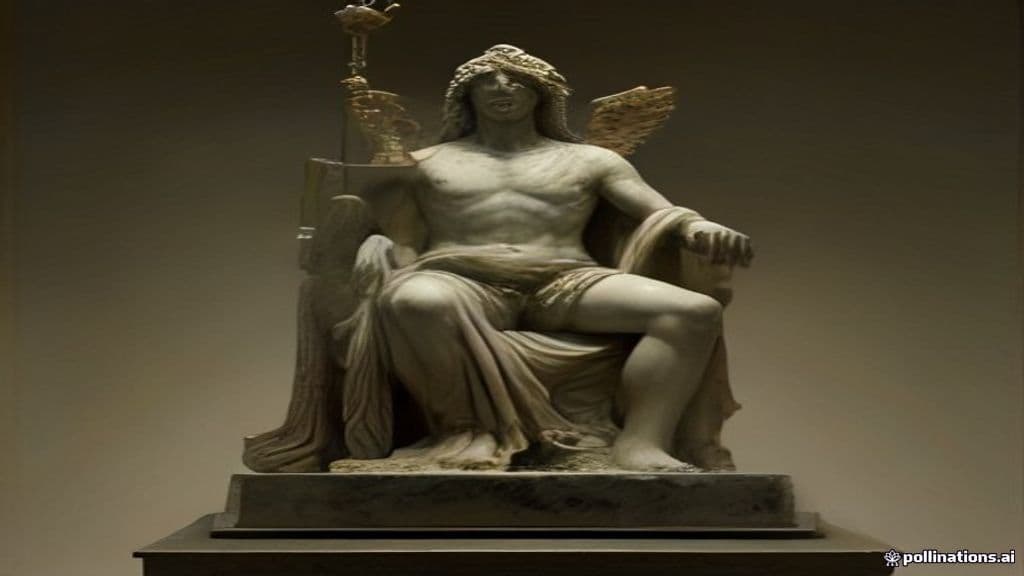
Mythic: In Greek myth Crantor is presented as a son of Amyntor who was given to Peleus and later is said to have been killed fighting alongside Peleus during the Centauromachy, situating him within the heroic cycle surrounding Peleus and the centaurs (Sources 6, 8). Historical: Crantor of Soli (Κράντωρ) was a 3rd‑century BC philosopher from Soli in Cilicia who studied in Athens in the Old Academy under Xenocrates, wrote influential ethical and exegetical works (including a consolatory treatise On Grief), and died in 276/5 BC (Sources 1, 4). Astronomical: The modern minor planet 83982 Crantor was named after the mythic figure; it orbits the Sun with a semi‑major axis of c. 19.5 AU and is characterized in dynamical studies as a transient Uranian co‑orbital (Sources 3, 7).
No systematic physical or iconographic description of the mythic or historical Crantor is preserved in the supplied sources. The mythic figure is attested only as a named mortal (son of Amyntor) and as a casualty of the Centauromachy (Sources 6, 8). The historical philosopher is described in biographical and literary terms (teacher, writings, death) but sources do not supply physical appearance or portraiture (Source 1). The astronomical Crantor is a small Solar System body whose appearance is given only by orbital elements in scientific descriptions (Sources 3, 7).
Mythic Crantor is attested as a mortal warrior companion of Peleus who fought against the centaurs and was killed in that battle; the sources present no supernatural powers (Sources 6, 8). Historical Crantor's 'abilities' are intellectual: he is credited as the first philosopher to write commentaries on Plato, authored moral literature including the popular work On Grief, and produced extensive commentaries noted by ancient biographers (Source 1). Astronomical Crantor's 'behavior' is dynamical: as 83982 Crantor it follows an eccentric orbit with a semi‑major axis of ~19.5 AU and exhibits transient co‑orbital dynamics with Uranus as described in dynamical studies (Sources 3, 7).
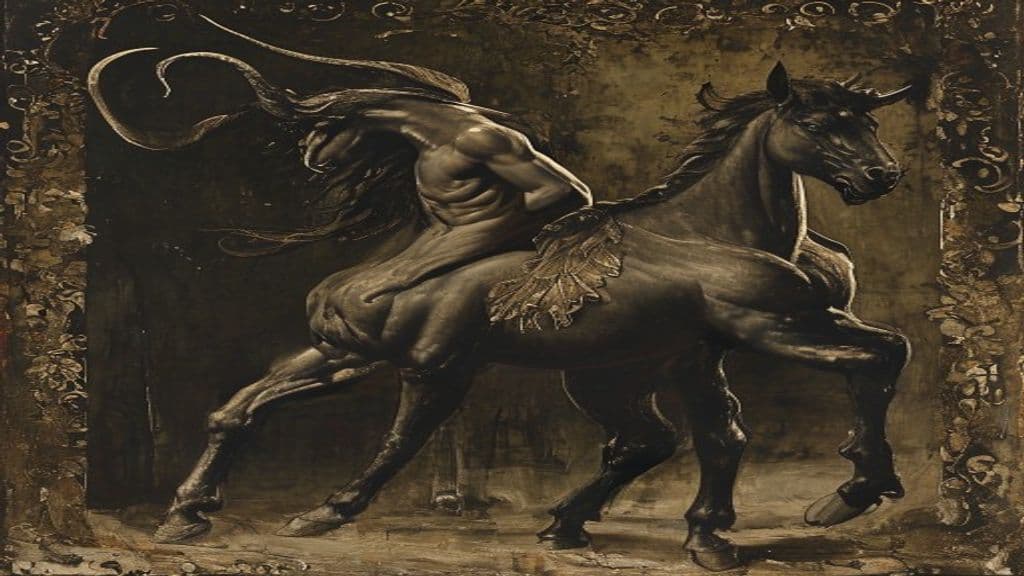
Centaur
A mythic hybrid from ancient Greek tradition with the upper body of a human and the lower body and legs of a horse. Centaurs appear as a tribal population associated with mountainous and wooded regions of Greece and embody tensions between human social order and untamed nature.

Peleus
Peleus (Ancient Greek Πηλεύς) is a mortal heroic king of the Greek heroic age—son of Aeacus and an oread, husband of the sea-nymph Thetis, and father of Achilles—figuring as a founder-ancestor and culted hero in later local practice. He is portrayed in epic narrative as a warrior-king, Argonaut, and participant in the web of marriages and purifications that link human rulership to divine beings.
*Péh₂usōn (reconstructed)
Péh₂usōn is a hypothetical Proto‑Indo‑European pastoral guardian reconstructed by comparative scholars from parallels in Greek and Vedic traditions. Proposed as a Graeco‑Aryan ancestor‑figure, the reconstruction describes a protector of flocks, roads, and travellers rather than an attested historical cultic personality.
3-D Man
3-D Man is a Marvel Comics superhero identity associated with a 1950s-era origin in which the body of Chuck Chandler can materialize in three-dimensional existence when activated by his brother Hal via a pair of glasses. The mantle was later assumed by Delroy Garrett (formerly Triathlon) in modern continuity.
5 Ronin
5 Ronin is a 2011 Marvel Comics five-issue limited series that reimagines five Marvel superhero archetypes as rōnin (masterless samurai) in a fictionalized post‑Sekigahara feudal Japan. The work places Wolverine, Hulk, Punisher, Psylocke, and Deadpool analogues into period roles to explore displacement, revenge, and identity in an era of political upheaval.
58 Concordia
58 Concordia is a fairly large main-belt asteroid orbiting the Sun, discovered in 1860 and named after the Roman goddess Concordia. Astronomical sources classify it as a C-type (carbonaceous) body with a multi-year orbital period and measurable rotation and pole orientations.
9MOTHER9HORSE9EYES9
An anonymous Reddit screen name and online persona used by the author of the Interface series, a multipart speculative-horror narrative posted in short installments across Reddit in 2016. The name functions as the signature of an authorial identity and as a focal label for a fandom that created archives, a subreddit, and a wiki documenting the story and its fictional phenomena (notably entities called "flesh interfaces").
A.R.G.U.S.
A.R.G.U.S. is a fictional clandestine United States government agency in the DC Comics universe that investigates, contains, and manages superhuman, meta-human, and supernatural incidents and assets. Introduced in The New 52 continuity, it functions as an institutional actor providing intelligence, logistical support, covert task forces (notably Task Force X / the Suicide Squad), and a dedicated magic division across comics and media adaptations.
Aba (disambiguation / name-form)
Aba is a polyvalent name-form attested across many unrelated contexts (place names, personal names, animal names, and brief mythological listings). The provided sources do not support a single, coherent supernatural entity called "Aba" and offer no descriptive or ritual material for such a being.
Abarbarea
Abarbarea is a name attested in classical Greek and Roman sources for freshwater nymphs (naiads). The name appears for at least two individual mythic figures — a naiad wife of Bucolion and a naiad counted among ancestors of the Tyrians — and Hesychius records plural forms that may indicate the name was also used as a class-name (Abarbareai / Abarbalaiai).
Abas
Abas (Ancient Greek: Ἄβας, gen.: Ἄβαντος) is not a single mythic being but a recurring personal name borne by multiple mortals and minor mythic figures in Greek epic and genealogical traditions — kings, founders, seers, warriors, attendants, a centaur, and a youth transformed by a goddess. The name is glossed in the sources as 'guileless' or 'good-hearted' and appears across Argive, Theban, Trojan, Euboean, and other local cycles.
Abderus
Abderus (Ancient Greek: Ἄβδηρος, romanized Ábdēros) is a mortal heroic figure in Greek myth closely associated with Heracles, remembered as the youth left in charge of the Mares of Diomedes who was killed by them. He functions as an eponymous local/divine-hero ancestor for the city of Abdera and received funerary commemoration and athletic agones at his tomb.
Abena Mansa
A name attested in a single contemporary Ghanaian blog anecdote as a 'mysterious being'; available sources do not establish Abena Mansa as a coherent, traditional supernatural figure or provide corroborating ethnographic detail.
Abin Sur
Abin Sur is a fictional extraterrestrial Green Lantern from the planet Ungara in DC Comics. A former history professor turned Green Lantern of Space Sector 2814, he discovered and investigated a prophecy tied to the "Blackest Night," died wounded on Earth and chose Hal Jordan as his ring-successor, and was later reanimated as a Black Lantern in the Blackest Night storyline.
Community Record
- [1]Crantor. Wikipedia, 'Crantor'wiki
- [2]Crantor (mythology). Wikipedia, 'Crantor (mythology)'wiki
- [3]83982 Crantor. Wikipedia, '83982 Crantor'wiki
- [4]Comparative orbital evolution of transient Uranian co-orbitals: exploring the role of ephemeral multibody mean motion resonances. de la Fuente Marcos & de la Fuente Marcos (arXiv): study of transient Uranian co-orbitals including 83982 Crantoracademic
- [5]The heirs of Plato : a study of the Old Academy, 347-274 B.C.. Dill, 'The Heirs of Plato' (study of the Old Academy; discusses Crantor of Soli)academic
- [6]Amyntor in Greek Mythology - Greek Legends and Myths. GreekLegendsAndMyths.com, 'Amyntor' (references Crantor as son of Amyntor)other