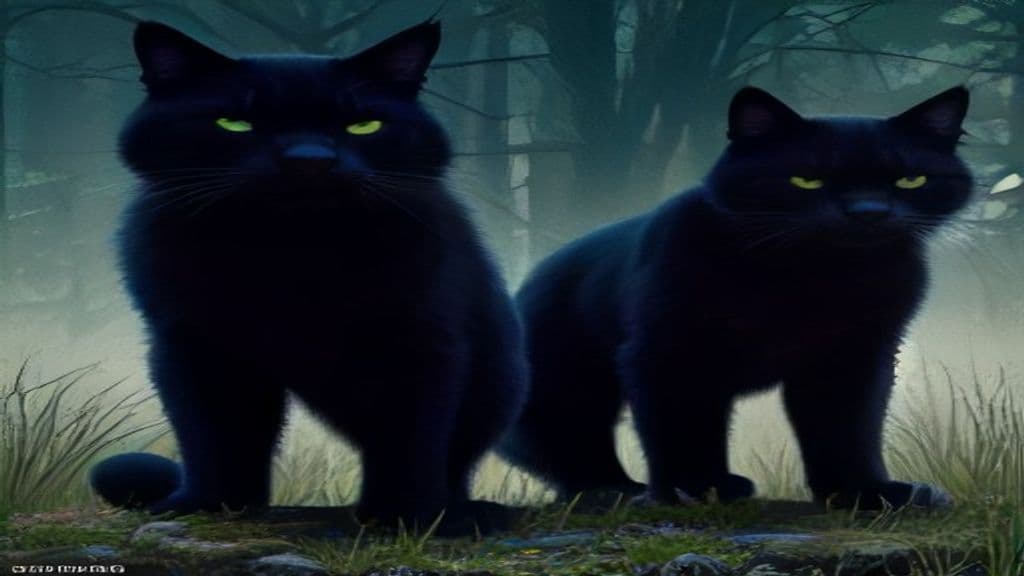
Cryptid, as a classificatory concept, arises in modern English-language contexts to name animals or beings whose existence has been suggested but is not recognized by scientific consensus. The origin is not a single mythic narrative but a taxonomic impulse within a contemporary subculture: cryptozoology and related popular media adopt the label to group together disparate reports, local legends, and anomalous sightings. Scholarly and reference sources present the term functionally — as a boundary category between verified zoology and rumor, folklore, or misidentification — rather than as a single cosmological entity (Source 1; Source 2).
Because 'cryptid' denotes a category rather than a single creature, no standardized physical description exists. Reported appearances vary by example and locality: alleged 'Black Panthers' in parts of North America are described by witnesses as large black cats, though wildlife authorities identify only the Puma as the large native cat in those regions and note no historical record of an all-black Puma (Source 3); the Mothman is treated in local legend and podcast retellings as a specific, uncanny figure associated with particular communities (Source 5); the Loveland Frog is depicted in some media as a small, roughly three-foot-tall frog-like being that appears episodically to a few witnesses (Source 9). Popular culture adaptations in films, comics, and games further diversify visual portrayals to suit narrative needs (Sources 6, 8, 11, 9).
There is no universal set of abilities attributed to 'cryptids' as a class; reported behaviors and powers are specific to individual named examples and vary widely. For many alleged cryptids—such as reported large cats—the discussion centers on identity and natural behavior rather than supernatural abilities (Source 3). Legendary figures like the Mothman are framed in media and oral retellings as anomalous or uncanny, contributing to local lore and a sense of unexplained phenomena without consistent, evidence-based powers in the sources provided (Source 5). Analysts and scientists critique cryptozoological methods for relying on anecdote and misidentification, emphasizing that many attributed behaviors may be narrative embellishment or perceptual error rather than verifiable abilities (Source 1).
3-D Man
3-D Man is a Marvel Comics superhero identity associated with a 1950s-era origin in which the body of Chuck Chandler can materialize in three-dimensional existence when activated by his brother Hal via a pair of glasses. The mantle was later assumed by Delroy Garrett (formerly Triathlon) in modern continuity.
5 Ronin
5 Ronin is a 2011 Marvel Comics five-issue limited series that reimagines five Marvel superhero archetypes as rōnin (masterless samurai) in a fictionalized post‑Sekigahara feudal Japan. The work places Wolverine, Hulk, Punisher, Psylocke, and Deadpool analogues into period roles to explore displacement, revenge, and identity in an era of political upheaval.
58 Concordia
58 Concordia is a fairly large main-belt asteroid orbiting the Sun, discovered in 1860 and named after the Roman goddess Concordia. Astronomical sources classify it as a C-type (carbonaceous) body with a multi-year orbital period and measurable rotation and pole orientations.
9MOTHER9HORSE9EYES9
An anonymous Reddit screen name and online persona used by the author of the Interface series, a multipart speculative-horror narrative posted in short installments across Reddit in 2016. The name functions as the signature of an authorial identity and as a focal label for a fandom that created archives, a subreddit, and a wiki documenting the story and its fictional phenomena (notably entities called "flesh interfaces").
A.R.G.U.S.
A.R.G.U.S. is a fictional clandestine United States government agency in the DC Comics universe that investigates, contains, and manages superhuman, meta-human, and supernatural incidents and assets. Introduced in The New 52 continuity, it functions as an institutional actor providing intelligence, logistical support, covert task forces (notably Task Force X / the Suicide Squad), and a dedicated magic division across comics and media adaptations.
Abena Mansa
A name attested in a single contemporary Ghanaian blog anecdote as a 'mysterious being'; available sources do not establish Abena Mansa as a coherent, traditional supernatural figure or provide corroborating ethnographic detail.
Abin Sur
Abin Sur is a fictional extraterrestrial Green Lantern from the planet Ungara in DC Comics. A former history professor turned Green Lantern of Space Sector 2814, he discovered and investigated a prophecy tied to the "Blackest Night," died wounded on Earth and chose Hal Jordan as his ring-successor, and was later reanimated as a Black Lantern in the Blackest Night storyline.
Abishai
Abishai is a personal name attested in several distinct sources: a biblical individual described as the eldest son of Zeruiah (sister of King David); a Semitic chief named in an inscription at Beni-Hasan in Middle Egypt; and modern cultural uses including a named monster in Dungeons & Dragons and as an artist/stage name. The supplied materials do not present Abishai as a supernatural being within a living cosmology.
Abraham Cornelius
Abraham Cornelius is a fictional human scientist in Marvel Comics, a senior Weapon X technician who helped develop the technique to bond adamantium to bone and who features in Wolverine's origin and later storylines, including Death of Wolverine.
Absorbing Man
A fictional Marvel Comics character (Carl "Crusher" Creel) whose body acquires the physical properties of materials or energies he touches. Debuting in Journey into Mystery #114 (March 1965), created by Stan Lee and Jack Kirby, he is presented as a mortal supervillain/occasional antihero who challenges heroes such as Thor, Hulk, Spider-Man, and the Avengers.
Ace Lightning
Ace Lightning is the titular playable character of the fictional in‑universe video game Ace Lightning and the Carnival of Doom. In the television series, game characters come to life in the real‑world town after a lightning strike and electrical surge; Ace functions as a superheroic 'Lightning Knight' from the Sixth Dimension who recruits a human sidekick to pursue game objectives (recovering pieces of the Amulet of Zoar) in the human world.
Ace West
Ace West (Wallace Daniel "Ace" West) is a contemporary American comic-book character in DC Comics continuity, a young speedster who channels the metaphysical Speed Force and occupies legacy-hero roles such as Kid Flash and Ace. Introduced in New 52-era stories as a biracial reinterpretation of Wally West and later retconned in DC Rebirth as a distinct Wallace West, son of Daniel West (Reverse-Flash), he appears across present-day and alternate/future timelines and participates in team and sacrifice narratives tied to the Speed Force.
Community Record
- [1]List of cryptids (Wikipedia). "Cryptids are animals or other beings whose present existence is disputed or unsubstantiated by science."wiki
- [2]Wikidata: cryptid. "creature or plant whose existence has been suggested but is not recognized by scientific consensus"wiki
- [3]Archive: 052 Unearthing Black Panthers. Discussion of reported 'Black Panthers' in North America and scientific counterpoints about Puma (Source 3).other
- [4]Archive: Episode 06 - Frenchies Kiss Real Well (Mothman). Podcast episode covering local legend of the Mothman (Source 5).other
- [5]Glorious Trainwrecks: cryptid (taxon entry). Game taxonomy entry referencing cryptid examples including Loveland Frog (Source 9).other
- [6]Cryptid (film). Film titled 'Cryptid' (2022), example of popular culture use of the term (Source 6).wiki
- [7]Cryptids (film). Anthology horror comedy film 'Cryptids' (2023), example of media adaptation (Source 8).wiki
- [8]King Cryptid (Alterna Comics). Comic titled 'King Cryptid', example of the category's use in comics (Source 11).literary
- [9]Archive: 008 Unearthing Norman, Oklahoma. Local legend and town-focused cryptid reporting, illustrating town-specific folklore (Source 4).other
- [10]Wampler Cryptid Fuzz (gearnews). Commercial product named after 'cryptid', showing cultural commercialization of the concept (Source 10).other