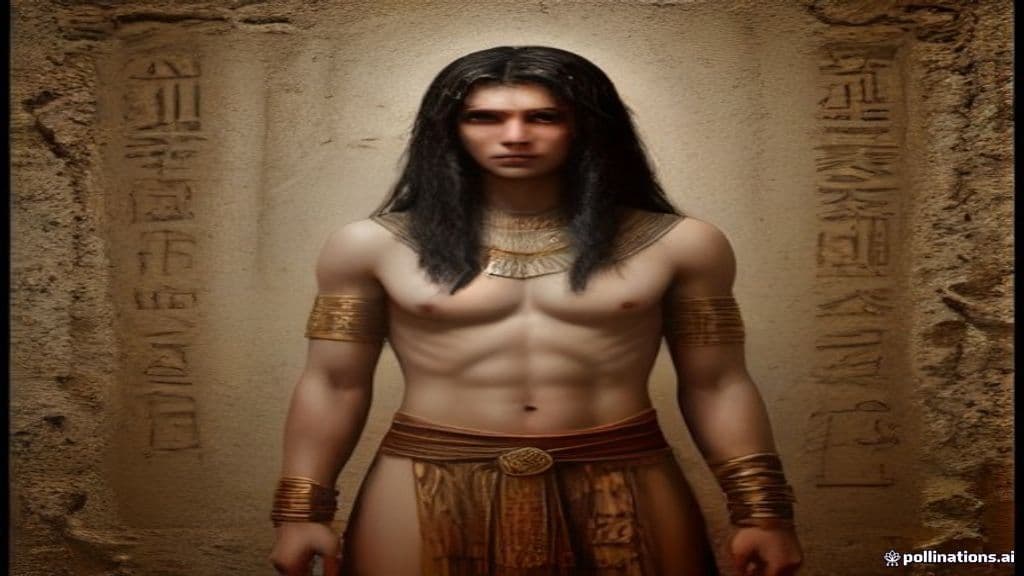
The supplied sources record multiple homonymous attestations rather than a single mythological origin. In the Hebrew Bible tradition the name appears as Abishai, identified as the eldest son of Zeruiah, sister of King David. An inscriptionary attestation in Middle Egypt (Beni-Hasan) names a Semitic chief called Abishai who offered gifts to the Lord of Beni-Hasan. In modern contexts the name has been reused as a monster type in the Dungeons & Dragons game and as a contemporary artist/stage name; these are cultural transfers of the name rather than a transmitted mythic origin described in the provided materials.
The provided materials do not supply any descriptive information about physical appearance for the biblical or epigraphic figures. The biblical reference identifies Abishai genealogically (eldest son of Zeruiah) without corporeal description. The inscriptionary attestation likewise gives no physical description. A modern Dungeons & Dragons usage is noted in the sources but no descriptive details from that game are present in the supplied excerpts.
No supernatural abilities, powers, or characteristic behaviors are attested in the supplied materials for Abishai. The biblical reference implies social/genealogical role (member of David's extended household). The Middle Egyptian inscription notes a Semitic chief offering gifts but does not ascribe any specific actions beyond that epigraphic mention. The Dungeons & Dragons referent is cited as a named monster type in modern gaming, but the provided excerpt does not supply information about that creature's abilities.
3-D Man
3-D Man is a Marvel Comics superhero identity associated with a 1950s-era origin in which the body of Chuck Chandler can materialize in three-dimensional existence when activated by his brother Hal via a pair of glasses. The mantle was later assumed by Delroy Garrett (formerly Triathlon) in modern continuity.
5 Ronin
5 Ronin is a 2011 Marvel Comics five-issue limited series that reimagines five Marvel superhero archetypes as rōnin (masterless samurai) in a fictionalized post‑Sekigahara feudal Japan. The work places Wolverine, Hulk, Punisher, Psylocke, and Deadpool analogues into period roles to explore displacement, revenge, and identity in an era of political upheaval.
58 Concordia
58 Concordia is a fairly large main-belt asteroid orbiting the Sun, discovered in 1860 and named after the Roman goddess Concordia. Astronomical sources classify it as a C-type (carbonaceous) body with a multi-year orbital period and measurable rotation and pole orientations.
9MOTHER9HORSE9EYES9
An anonymous Reddit screen name and online persona used by the author of the Interface series, a multipart speculative-horror narrative posted in short installments across Reddit in 2016. The name functions as the signature of an authorial identity and as a focal label for a fandom that created archives, a subreddit, and a wiki documenting the story and its fictional phenomena (notably entities called "flesh interfaces").
A.R.G.U.S.
A.R.G.U.S. is a fictional clandestine United States government agency in the DC Comics universe that investigates, contains, and manages superhuman, meta-human, and supernatural incidents and assets. Introduced in The New 52 continuity, it functions as an institutional actor providing intelligence, logistical support, covert task forces (notably Task Force X / the Suicide Squad), and a dedicated magic division across comics and media adaptations.
Aaron
Aaron is a central human figure in Israelite sacred literature: the elder brother of Moses, the first high priest (progenitor of the Aaronide priesthood), and a spokesman/prophet who mediates between Israel and God in Exodus–Deuteronomy narratives. His role in the texts establishes hereditary priestly authority, ritual functions (sacrifices, blessing, use of Urim and Thummim), and institutional norms for Israelite cultic life.
Abaddon
In Hebrew scripture Abaddon is primarily a noun meaning 'destruction' or a section/condition of the underworld paired with Sheol; in the New Testament Book of Revelation Abaddon is personified as an angelic figure (Greek Apollyon) described as the king of an army of locusts released from the abyss during the apocalypse.
Abadir
Abadir is a polysemous name attested in distinct cultural contexts: a legendary founding saint and clan ancestor in eastern Ethiopia (Sheikh Abadir Umar Al‑Rida / Aw Abadir), a term applied to cone‑shaped cult stones in Phoenician religious description, and a personal name of a martyr (Abadir/Apater) in the Coptic Synaxarium. The attestations are independent usages of the same name rather than a single supernatural being.
Abadiu of Antinoe
Abadiu of Antinoe was a fourth‑century bishop of Antinoe (Antinoopolis, in Roman Egypt) commemorated as a martyr and saint in the Coptic Orthodox Church, with a feast day on 26 December. Sources record that he was killed during a theological dispute with Arian opponents and reference him in collections of Egyptian martyrs.
Abagtha
Abagtha (Hebrew: אבגתא, ’Ǎḇaḡṯā) is a named human court official in the Hebrew Bible’s Book of Esther, listed among seven chamberlains who ministered before King Ahasuerus and were commanded to bring Queen Vashti before the king. He is attested only in Esther 1:10 and is presented as an institutional palace attendant rather than a supernatural being.
Abanoub
Abanoub is a 4th‑century Egyptian Christian child martyr venerated in the Coptic tradition. Remembered for his public confession of Christ, miraculous healings associated with his passion, and the translation and veneration of his relics, his feast is observed on July 31 (Epip 24) and his cult centers include Nehisa and Samanoud.
Abaskhiron the Soldier
A Coptic Orthodox martyr venerated for refusing imperial idolatry during the Diocletian persecution; reputedly healed by the Archangel Michael, preserved in monastery relics, and commemorated on 14 June (7 Paoni).
Community Record
- [1]Abishai — Wikipedia (disambiguation). Wikipedia, 'Abishai' (disambiguation page), accessed via provided research notes.wiki
- [2]Abishai — Wikidata entry Q1154317. Wikidata entry for Abishai (Q1154317), accessed via provided research notes.other
- [3]Abishai - Various Extras (VULP-0091). Archive.org, 'Abishai - Various Extras (2017)', artist/album page noting contemporary use of the name Abishai.other
- [4]Philadelphia and its environs : a guide to the city and surroundings. Archive.org item included in research notes; listed among supplied materials.other