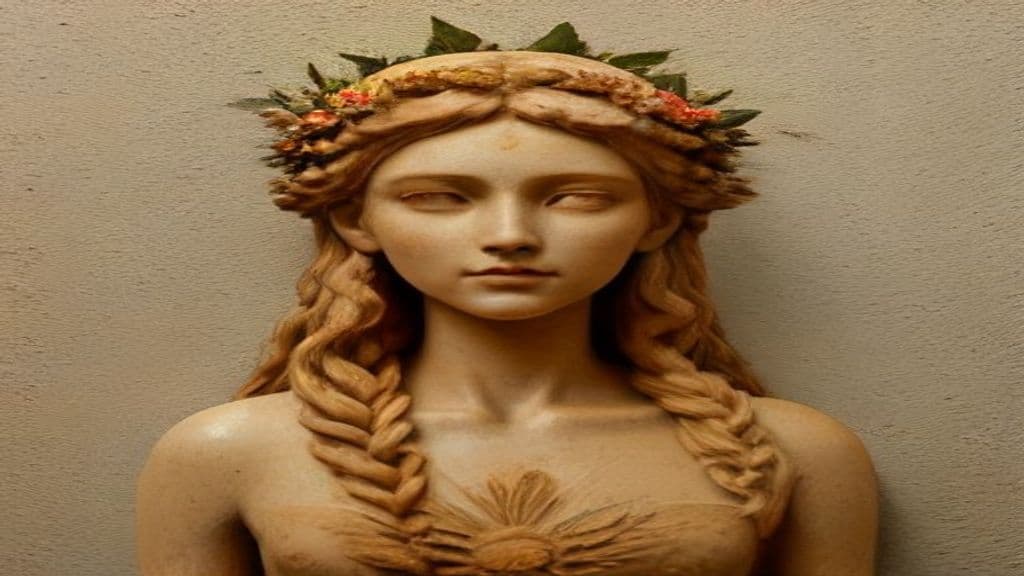
In Greek mythological genealogy, Demeter is a child of the Titans Rhea and Cronus and sister of the principal Olympian deities (Hestia, Hera, Hades, Poseidon, Zeus). Her most famous mythic narrative is preserved in the Homeric Hymn to Demeter: when Hades abducts her daughter Persephone, Demeter searches for her and, in grief and anger, withdraws her fertilizing power from the earth, producing famine; Zeus is compelled to order Persephone's partial return to resolve the crisis. Linguistic and archaeological evidence recorded in Bronze Age tablets (e.g., Linear B references like si-to-po-ti-ni-ja, 'Potnia of the Grain') and comparative etymological proposals indicate Demeter's cult has deep pre-Olympian agrarian roots and likely developed from earlier grain or earth goddesses.
Iconographically Demeter is associated with harvest imagery: flowers, fruit, and sheaves of grain or a sheaf of wheat are common attributes. She is frequently depicted alongside her daughter Persephone in cult and art. Local cult narratives record variant visual motifs, for example an Arcadian tradition in which a mourning 'Black Demeter' dresses in black and retires to a cave after being assaulted by Poseidon, at times taking animal disguise (a mare) in that regional myth. Beyond these symbolic attributes, sources do not provide a single fixed physical description.
Demeter controls agricultural fertility and the growth of crops and grains and functions as the giver of food (epithet Sito, 'she of the Grain'). Her withdrawal of favor causes the earth to fail to produce, bringing famine and death to mortals (as narrated in the Homeric Hymn to Demeter). She is also Thesmophoros ('giver of customs' or 'legislator'), indicating authority over sacred law, social customs—particularly those connected to reproduction and women's civic-religious roles—and ritual observance. Through her association with Persephone and the Eleusinian Mysteries she is implicated in beliefs about life, death, and a promised favorable afterlife for initiates.
Weaknesses
- conditionneglect of rites and cult observance
Wards
- ritualobservance of cult festivals (Thesmophoria, Eleusinian Mysteries)

*Péh₂usōn (reconstructed)
Péh₂usōn is a hypothetical Proto‑Indo‑European pastoral guardian reconstructed by comparative scholars from parallels in Greek and Vedic traditions. Proposed as a Graeco‑Aryan ancestor‑figure, the reconstruction describes a protector of flocks, roads, and travellers rather than an attested historical cultic personality.
Aba (disambiguation / name-form)
Aba is a polyvalent name-form attested across many unrelated contexts (place names, personal names, animal names, and brief mythological listings). The provided sources do not support a single, coherent supernatural entity called "Aba" and offer no descriptive or ritual material for such a being.
Abarbarea
Abarbarea is a name attested in classical Greek and Roman sources for freshwater nymphs (naiads). The name appears for at least two individual mythic figures — a naiad wife of Bucolion and a naiad counted among ancestors of the Tyrians — and Hesychius records plural forms that may indicate the name was also used as a class-name (Abarbareai / Abarbalaiai).
Abas
Abas (Ancient Greek: Ἄβας, gen.: Ἄβαντος) is not a single mythic being but a recurring personal name borne by multiple mortals and minor mythic figures in Greek epic and genealogical traditions — kings, founders, seers, warriors, attendants, a centaur, and a youth transformed by a goddess. The name is glossed in the sources as 'guileless' or 'good-hearted' and appears across Argive, Theban, Trojan, Euboean, and other local cycles.
Abderus
Abderus (Ancient Greek: Ἄβδηρος, romanized Ábdēros) is a mortal heroic figure in Greek myth closely associated with Heracles, remembered as the youth left in charge of the Mares of Diomedes who was killed by them. He functions as an eponymous local/divine-hero ancestor for the city of Abdera and received funerary commemoration and athletic agones at his tomb.
Abomination of Desolation
An apocalyptic prophetic phrase originating in the Book of Daniel designating a profaning thing or act that renders the Jerusalem Temple cult desolate; later reused in the Synoptic Gospels as an eschatological sign prompting urgent flight. The term denotes ritual/cultic impurity (Hebrew shiqquts) and is variously interpreted as pagan offerings or altar, a foreign cult statue, or (in some New Testament readings) an acting agent.
Absyrtus
Absyrtus (Ancient Greek: Ἄψυρτος) is a Colchian prince in the Greek Argonautic cycle, son of King Aeëtes and brother or half-brother of Medea. He appears in variant traditions either as a companion taken by Medea during her flight with Jason and murdered/dismembered to delay pursuit, or as a pursuer sent by Aeëtes who is overtaken and slain by Jason; his death functions as a key narrative device in the escape from Colchis.
Acacallis
Acacallis (Ancient Greek: Ἀκακαλλίς; also Acalle) is a mythological princess of Crete in Greek tradition, daughter of King Minos and Pasiphae. She functions primarily as a dynastic and etiological figure: in varying accounts she is mother, by gods such as Hermes (Mercury) or Apollo, of eponymous or founder-figures like Cydon (founder of Cydonia), Miletus, or Lydon/ Lydus.
Acacus
Acacus (Ancient Greek: Ἄκακος) is, in Arcadian Greek tradition, a mortal eponymous founder-king of Acacesium and is remembered as the foster-father who reared the infant Hermes (Mercury) in that local tradition. He is presented in genealogies as a son of Lycaon and functions as a local ancestral/onomastic figure rather than a supernatural spirit.
Academus
Academus (Greek: Akádemos / Hekádemos) is an Attic hero-eponym tied to a sacred grove (Akademeia) on the Cephissus near Athens. In myth he revealed where Helen was hidden to the Dioskouroi, an act said to have saved the city, and the place bearing his name became a long-lived sacred precinct, later the site of Plato's Academy.
Acamas
Acamas (Ancient Greek: Ἀκάμας) is a personal name recurrent in ancient Greek narrative traditions applied to multiple human characters (warriors, princes, suitors), once to a Cyclops, and once as a hound's name. Rather than a single supernatural entity, bearers of the name appear episodically across the Trojan War, Theseid, and Theban cycles as mortal actors whose deeds intersect with gods and fate.
Acantha
Acantha (Ancient Greek: Ἀκάνθα, 'thorn') is a late or secondary mythological figure known from modern retellings as a nymph transformed into the acanthus plant. The tale that she scratched Apollo and was changed into a spiny-leaved plant is not attested in surviving classical corpora and appears to be a modern compilation or invention rather than a firmly documented ancient myth.
Community Record
- [1]Demeter - Wikipedia. Wikipedia: 'Demeter' entry (various sections including etymology, myth, cult, and iconography)wiki
- [2]Demeter and Persephone – Mythoi Koinoi (Pressbooks chapter). Pressbooks chapter 'Demeter and Persephone' summarizing the Homeric Hymn to Demeter and related cultic materialliterary
- [3]Archive: Deusas Gregas - Demeter (digital archive). Archive collection material on Demeter and Greek goddesses (used for supplementary cult and epithet information)other