
Dilong is not presented in the sources as a single individualized mythic progenitor but as a lexical and conceptual category within Chinese dragon (long 龍) classification mapped onto the cosmic opposition di 地 (earth/land) versus tian 天 (heaven/sky). The earliest attested literary occurrence in the provided material appears in a mid-seventh-century historical narrative: the History of the Southern Dynasties biography of Wang Sengbian records witnesses seeing paired dragons ascend and a dilong leaving Liang territory, an action read as a portent in 550 CE. Over time the lexical unit 地龍 was extended by analogy to name earthly creatures — most notably the earthworm (qiuyin 蚯蚓), recorded in herbal literature (e.g., Bencao Gangmu) under alternate names including dilong/tulong — and later recycled into modern scientific nomenclature (for example, the dinosaur genus name Dilong and use as the Chinese name for other fossil taxa).
The supplied sources do not provide a fixed, detailed visual description unique to a mythic Dilong. In mythic taxonomy it is treated as a variety of long (龍, "dragon") and so inherits the generic dragon imagery of Chinese tradition (serpentine, scaled long forms capable of movement between realms), but is characteristically described in contrast as more earthbound than the tianlong (天龍, "heavenly dragon"). Sources explicitly note Dilong's domainal affiliation rather than a standardized morphology; concrete morphological details (size, limbs, scales, horned head, etc.) are not given in the excerpts. Separately, where 地龍 names an animal the appearance is that of the ordinary earthworm (qiuyin 蚯蚓); in materia medica the worm form (specifically the red earthworm Lumbricus rubellus in modern summaries) is the relevant physical referent.
Sources attribute to Dilong primarily a domainal/cosmological function: it is an earth-associated dragon type paired conceptually with tianlong (heavenly dragon). No distinct catalogue of supernatural powers is recorded in the provided material beyond this domainal affiliation and the implication that, unlike many Chinese dragons described as able to ascend or fly, a dilong is comparatively earthbound. A medicinal-literary belief recorded in the Bencao Gangmu (as noted by Li Shizhen) links earthworms called dilong with meteorological influence: the myth that earthworms (like dragons) can create yinqing (陰晴, "cloudy and clear; unsettled weather"). Beyond the weather-affecting attribution attached to the worm sense, the sources do not record other specific abilities (healing powers beyond medicinal use, control of rivers, speech, or agency toward humans) for a mythic Dilong.
Weaknesses
- otherno specific weaknesses recorded in sources
Wards
- otherno specific wards recorded in sources
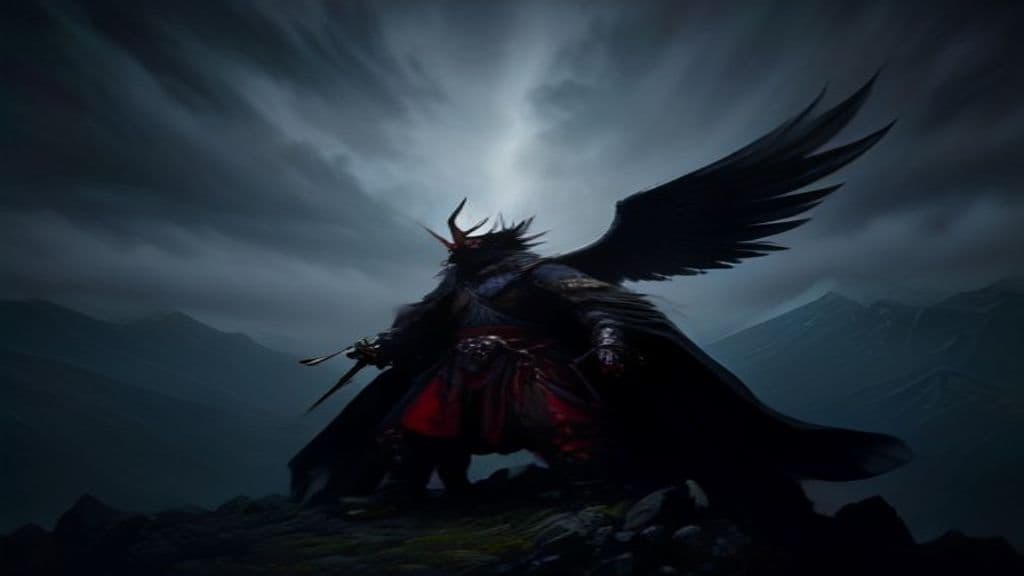
Tengu
Proud, warrior-like mountain spirits of Japan, associated with martial arts, pride, and the wild mountains. Neither fully good nor evil — they test and train warriors and monks, but punish the arrogant.

Tiamat
The primordial salt-sea dragon of Babylonian creation myth — the chaos-mother from whose slain body the universe was built, and whose blood became the first humans.

Dragon (Long)
Long (龍, "dragon") is a pervasive cultural and artistic motif that appears in Taoist sacred-geographical contexts, Chinese literature, and modern exhibitions; the provided sources treat it as part of the broader mythic imagery present around Taoist sites and ritual scenes rather than as a single, consistently described doctrinal entity.
Akshobhya
Akshobhya is a transcendent buddha of Mahāyāna and Vajrayāna Buddhism, one of the Five Wisdom (Dhyāni) Buddhas. He personifies 'mirror knowledge' (ādarśa-jñāna), is conventionally placed in the East, and is lord of the eastern Pure Land Abhirati; in esoteric texts he is associated with the eastern Vajra division and invoked in mantra/mandala ritual contexts.
Amitābha Buddha
Amitābha is a principal Mahayana Buddha who presides over the Western Pure Land (the Land of Ultimate Bliss). Devotional practices—most centrally recitation of his name and chanting of Pure Land sutras—are presented in sources as the means by which Amitābha welcomes practitioners for rebirth in his hindrance-free realm.
Anantacāritra
Anantacāritra (Sanskrit: अनन्तचारित्र) is a bodhisattva figure in the Lotus Sūtra, identified as one of the four great perfected bodhisattvas who attend Gautama Buddha. The name is glossed as "Boundless Practice" and, in Tiantai commentary, is read as representing eternity.
Ao Guang (Dragon King of the East Sea)
Ao Guang is the Dragon King (Dragon God) who presides over the East Sea (Dōng Hǎi) in Chinese mythology, literature, and folk-religion. He is presented in sources as a regional aquatic deity associated with water and weather and appears as a named supernatural figure in classical vernacular novels such as Journey to the West and Fengshen Yanyi.
Ao Kuang
Ao Kuang (also attested as Ao Guang) is the Dragon King of the East Sea in Chinese mythology and folk religion, one of a quartet of sea-dragon sovereigns associated in folklore with the cardinal seas. He appears in classical literature and later popular media as a ruler of maritime waters whose favor or displeasure is connected to tides, rain, floods and storms.
Arhat
An arhat (Sanskrit: arhat; Pāli: arahant) is in Buddhist traditions a human practitioner who has gained insight into the true nature of existence, attained nirvāṇa, and been liberated from the cycle of rebirth. The status and valuation of arhatship vary by school: some traditions equate it with full liberation, while others treat it as distinct from or inferior to the bodhisattva/buddha ideal.
Ashina Buzhen
Ashina Buzhen (Chinese: 阿史那步真) was a 7th-century member of the Ashina ruling house of the Western Turks who acted as a military and political claimant to khaganate authority on the Tang frontier. Recorded in Tang-era sources and modern summaries, he engaged in inter-elite rivalry, participated in Tang military campaigns, received an imperial-bestowed khagan title from Emperor Gaozong, and died in 667.
Ashina Helu
Ashina Helu (阿史那賀魯 / 阿史那贺鲁, āshǐnà hèlǔ) was a mid‑7th century member of the Ashina clan who claimed the title qaγan (khagan) of the Western Turkic polity. Active as a tribal shad and later self‑declared khagan, he contested Tang authority, was defeated by General Su Dingfang in 657, handed over by Chach, spared by Emperor Gaozong, and spent his remaining years in Chang'an.
Ashina Mishe
Ashina Mishe (Chinese: 阿史那彌射; ?–662) was a mid-7th century member of the Ashina clan installed and recognized by the Tang court as a khagan and frontier protector-general over portions of the former Western Turkic territories. His career illustrates Tang imperial practices of using titled Turkic elites as intermediaries to administer and pacify western protectorates; his death in 662 following an intrafamilial rivalry weakened Tang influence in the region.
Ashina Nishufu
Ashina Nishufu was a member of the Ashina clan proclaimed qaghan in a short-lived Göktürk revolt against the Tang dynasty (679–680 CE). Declared by Turkic leaders Ashide Wenfu and Ashide Fengzhi, his uprising was defeated by Tang general Pei Xingjian; he was killed by his own men and the revolt’s leaders and many Göktürks were executed in Chang'an.
Ashina She'er
Ashina She'er (阿史那社爾) is a historical Turkic prince of the Ashina house who became a Tang dynasty general in the 7th century. Chronicle summaries record his roles as claimant to parts of the Western Turkic Khaganate, his submission to Tang in 635, marriage into the imperial family, major western campaigns (including Kucha, 648), and his burial alongside Emperor Taizong.
Ashina Shibobi
Ashina Shibobi (c. 603–631), regnal name Tolis (Töles) Khagan, was a member of the Ashina clan who served as a lesser khagan and military leader of the eastern wing of the Eastern Turkic Khaganate in the early 7th century CE. He held offices such as Nipu shad and Tolis khagan, participated in raids against Tang China, suffered internal punishment after military setbacks, and ultimately submitted to Emperor Taizong of Tang in 629.
Community Record
- [1]Dilong. Wikipedia: Dilongwiki
- [2]Wikidata: Dilong. Wikidata entry Q27439other
- [3]Bencao Gangmu (compendium references summarized). Bencao Gangmu entry for qiuyin (earthworm) as cited in secondary summaries (Li Shizhen notes earthworm alternate names dilong/tulong and the weather myth)literary
- [4]History of the Southern Dynasties (Wang Sengbian biography). Mid-7th century History of the Southern Dynasties account (biography of Wang Sengbian) recording paired dragons ascending and a dilong leaving Liang territory as a portent (550 CE)literary