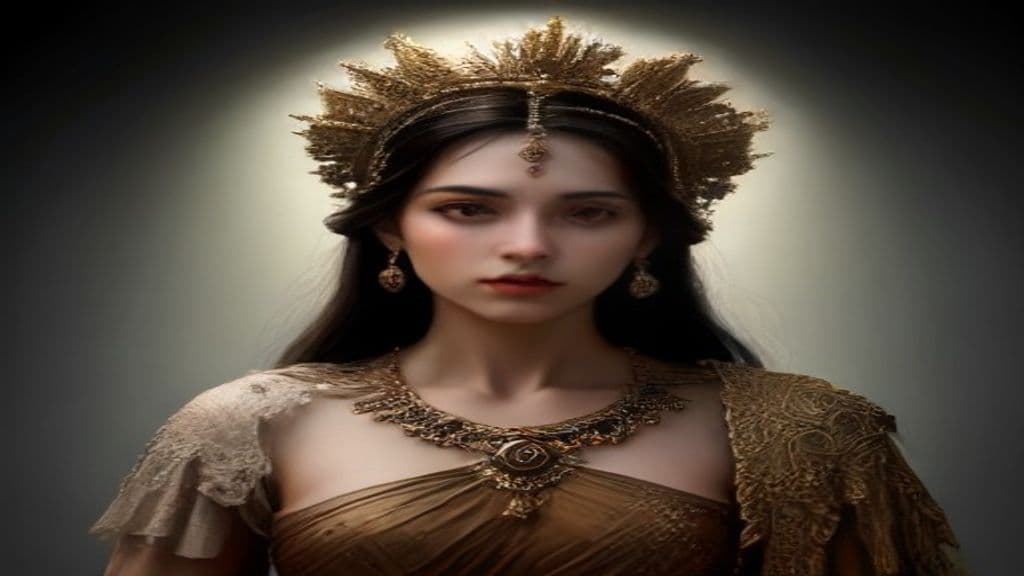
Déjanire is drawn from the classical figure Deianira of the Heracles cycle and appears in the narrative lineage of Sophocles' Trachiniae. In the modern French adaptations cited (a late-19th-century play with music and the Saint-Saëns / Louis Gallet operatic treatment), she is portrayed as the wife of Heracles whose attempt to secure her husband's fidelity leads her to accept advice from the dying centaur Nessus that his blood will restore faithfulness. Unaware that the blood is in fact poisonous, she gives a blood-soaked tunic which causes Heracles' fatal agony and eventual ascent to Olympus.
The provided sources are theatrical and bibliographic rather than iconographic; they describe Déjanire as a staged dramatic role performed in large-scale productions rather than giving a consistent physical description. Presentation details in the materials include her appearance in the massive open-air 1898 Béziers performances (with extensive choral forces and spectacle) and on the operatic stage in premieres at Monte Carlo and the Paris Opera in 1911; casting examples (e.g., Carmen Melis, Annie Fargue) indicate the role's use in conventional late-19th / early-20th-century theatre practice. Costuming and makeup vary by production and are not specified in the cited sources.
Sources describe Déjanire as a mortal character without inherent supernatural powers. Her dramatic agency is psychological and moral: jealousy, desperation, and credulity lead her to use an artefact (the tunic stained with Nessus's blood) that Nessus claimed would make an unfaithful lover return. The narrative specifies that the blood was actually poisonous; the fatal effect derives from that substance rather than from any innate magical ability of Déjanire herself.
Weaknesses
- conditionhuman fallibility (jealousy, credulity, emotional desperation)
Wards
None recorded.

Nessus
Nessus is primarily recorded in the supplied sources as a name from Greek myth — most prominently a centaur identified in modern reference works as the figure who caused the death of Heracles — and as a widely reused name in modern literature, gaming, and technical products. The provided materials constitute a disambiguation-style set rather than a single coherent supernatural tradition.

Heracles
Heracles is the greatest hero of Greek myth whose career bridges mortal hero-cult and full divinization. Celebrated for his Twelve Labours, martial prowess, and travels between the mortal world, the underworld, and Olympus, he functioned as a civic patron, ancestor of royal lines (the Heracleidae), and object of cult that treated him both as chthonic hero and as god.
*Péh₂usōn (reconstructed)
Péh₂usōn is a hypothetical Proto‑Indo‑European pastoral guardian reconstructed by comparative scholars from parallels in Greek and Vedic traditions. Proposed as a Graeco‑Aryan ancestor‑figure, the reconstruction describes a protector of flocks, roads, and travellers rather than an attested historical cultic personality.
Aba (disambiguation / name-form)
Aba is a polyvalent name-form attested across many unrelated contexts (place names, personal names, animal names, and brief mythological listings). The provided sources do not support a single, coherent supernatural entity called "Aba" and offer no descriptive or ritual material for such a being.
Abarbarea
Abarbarea is a name attested in classical Greek and Roman sources for freshwater nymphs (naiads). The name appears for at least two individual mythic figures — a naiad wife of Bucolion and a naiad counted among ancestors of the Tyrians — and Hesychius records plural forms that may indicate the name was also used as a class-name (Abarbareai / Abarbalaiai).
Abas
Abas (Ancient Greek: Ἄβας, gen.: Ἄβαντος) is not a single mythic being but a recurring personal name borne by multiple mortals and minor mythic figures in Greek epic and genealogical traditions — kings, founders, seers, warriors, attendants, a centaur, and a youth transformed by a goddess. The name is glossed in the sources as 'guileless' or 'good-hearted' and appears across Argive, Theban, Trojan, Euboean, and other local cycles.
Abderus
Abderus (Ancient Greek: Ἄβδηρος, romanized Ábdēros) is a mortal heroic figure in Greek myth closely associated with Heracles, remembered as the youth left in charge of the Mares of Diomedes who was killed by them. He functions as an eponymous local/divine-hero ancestor for the city of Abdera and received funerary commemoration and athletic agones at his tomb.
Abomination of Desolation
An apocalyptic prophetic phrase originating in the Book of Daniel designating a profaning thing or act that renders the Jerusalem Temple cult desolate; later reused in the Synoptic Gospels as an eschatological sign prompting urgent flight. The term denotes ritual/cultic impurity (Hebrew shiqquts) and is variously interpreted as pagan offerings or altar, a foreign cult statue, or (in some New Testament readings) an acting agent.
Absyrtus
Absyrtus (Ancient Greek: Ἄψυρτος) is a Colchian prince in the Greek Argonautic cycle, son of King Aeëtes and brother or half-brother of Medea. He appears in variant traditions either as a companion taken by Medea during her flight with Jason and murdered/dismembered to delay pursuit, or as a pursuer sent by Aeëtes who is overtaken and slain by Jason; his death functions as a key narrative device in the escape from Colchis.
Acacallis
Acacallis (Ancient Greek: Ἀκακαλλίς; also Acalle) is a mythological princess of Crete in Greek tradition, daughter of King Minos and Pasiphae. She functions primarily as a dynastic and etiological figure: in varying accounts she is mother, by gods such as Hermes (Mercury) or Apollo, of eponymous or founder-figures like Cydon (founder of Cydonia), Miletus, or Lydon/ Lydus.
Acacus
Acacus (Ancient Greek: Ἄκακος) is, in Arcadian Greek tradition, a mortal eponymous founder-king of Acacesium and is remembered as the foster-father who reared the infant Hermes (Mercury) in that local tradition. He is presented in genealogies as a son of Lycaon and functions as a local ancestral/onomastic figure rather than a supernatural spirit.
Academus
Academus (Greek: Akádemos / Hekádemos) is an Attic hero-eponym tied to a sacred grove (Akademeia) on the Cephissus near Athens. In myth he revealed where Helen was hidden to the Dioskouroi, an act said to have saved the city, and the place bearing his name became a long-lived sacred precinct, later the site of Plato's Academy.
Acamas
Acamas (Ancient Greek: Ἀκάμας) is a personal name recurrent in ancient Greek narrative traditions applied to multiple human characters (warriors, princes, suitors), once to a Cyclops, and once as a hound's name. Rather than a single supernatural entity, bearers of the name appear episodically across the Trojan War, Theseid, and Theban cycles as mortal actors whose deeds intersect with gods and fate.
Acantha
Acantha (Ancient Greek: Ἀκάνθα, 'thorn') is a late or secondary mythological figure known from modern retellings as a nymph transformed into the acanthus plant. The tale that she scratched Apollo and was changed into a spiny-leaved plant is not attested in surviving classical corpora and appears to be a modern compilation or invention rather than a firmly documented ancient myth.
Community Record
- [1]Déjanire — Wikipedia. Wikipedia article 'Déjanire' (synopsis and performance history, including Nessus's blood and Béziers/1911 premieres)wiki
- [2]Déjanire — Wikidata. Wikidata entry for Déjanire (linked data record for the theatrical/literary figure)other
- [3]ReType Foundry — Dejanire (font family notes). ReType foundry page noting the font takes its name from Deianira, a Calydonian princess in Greek mythologyother
- [4]Dejanire Text Fonts — Explore the Family. Typographic material using the name Déjanire, documenting modern cultural reuse of the nameother
- [5]Goldoni - La Locandiera - 1957 (cast listing referencing Déjanire as a stage name). Archive recording listing Annie Fargue as Déjanire in a 1957 production, showing the name's theatrical reuseother
- [6]Dejanire Sans | Adobe Fonts. Commercial font family named 'Dejanire Sans,' evidencing the character's name in typographic cultureother