
The sources present the Dragon King as the continuation and syncretic adaptation of long-standing serpent/dragon imagery in Asia. Serpent-like creatures appear in Neolithic material culture (dated in the sources to ca. 7000–5000 BCE) and later religious systems folded these motifs into roles as rulers of waters and weather. In Chinese cosmology this developed into an ordered system (the Dragon Kings of the Four Seas 四海龍王), while Indian subcontinental Nāga kings (Nāgarāja) provided a related serpent-royal model that spread through South and Southeast Asia and was incorporated into Buddhist and local village practices. Regional names (lóng, Ryū, Yongwang, Nāgarāja) reflect local linguistic and ritual variations of a shared aquatic-royal concept. (Sources: Wikipedia: Dragon King; summary material in research notes.)
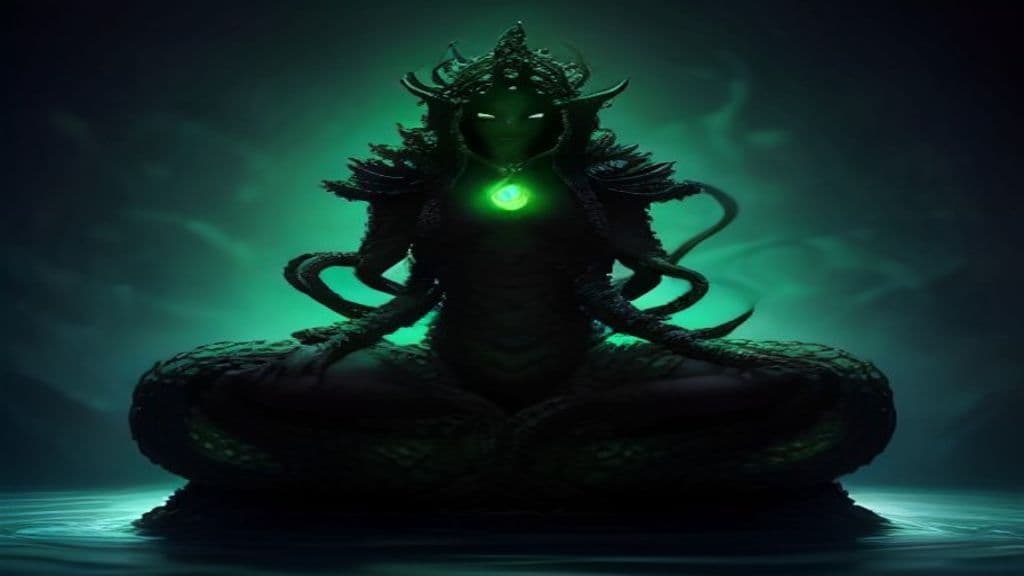
Source material emphasizes a serpent-like or dragon form without a single consistent anthropomorphic description. Representations vary by region and medium: stylized Chinese lóng and royal dragon imagery, Japanese Ryū depictions, Indian and Southeast Asian nāga serpents, and architectural motifs (for example, carved nāga railings on temple stairways and dragon heads on roofs). The Dragon King is commonly pictured in art and temple iconography as a dragon or nāga figure guarding thresholds or occupying underwater palatial scenes, but textual descriptions in the surveyed sources do not provide a uniform, detailed bodily description. (Sources: Wikipedia; research notes referencing temple imagery and archaeological continuity.)
Culturally attributed powers include control over water and weather (bringing rain, influencing storms, and regulating aquatic domains), territorial authority over seas, rivers, lakes, wells and springs, and rulership expressed as an underwater palace and court. The Dragon King functions ritually as a dispenser of rain and fertility and as a protector or tutelary presence for locales and sacred precincts (e.g., guardians of the Dharma in Southeast Asian Buddhist contexts). These are ritual and cosmological attributions recorded across Chinese, Japanese, Korean, South and Southeast Asian sources rather than experimentally demonstrated abilities. (Sources: Wikipedia: Dragon King; research notes.)
Weaknesses
None recorded.
Wards
- ritualmaintenance of local Dragon King shrines and seasonal rites
- ritualhousehold tablet ritual (Changli County): place a yellow paper tablet inscribed 'The position of the Dragon King of the Four Seas 四海龍王之位, Five Lakes, Eight Rivers and Nine Streams', sprinkle with water using willow withes, and burn incense next to it
- ritualnāga/dragon offerings (South and Southeast Asia): offerings of incense, milk, turmeric, and flowers at nāga shrines or stones
- ritualJapanese amagoi (雨乞い) rainmaking ceremonies: Shinto and Buddhist prayers, offerings and symbolic actions during drought
- ritualKorean Giuje (祈雨祭) rainmaking rites: community rites involving officials, Buddhist monks and female shamans
5 Ronin
5 Ronin is a 2011 Marvel Comics five-issue limited series that reimagines five Marvel superhero archetypes as rōnin (masterless samurai) in a fictionalized post‑Sekigahara feudal Japan. The work places Wolverine, Hulk, Punisher, Psylocke, and Deadpool analogues into period roles to explore displacement, revenge, and identity in an era of political upheaval.
Abumi-guchi
A Japanese yōkai classed as a tsukumogami: an animated stirrup (abumi) depicted in Sekien Toriyama's Gazu Hyakki Tsurezure Bukuro. Traditional accounts say it is formed from a stirrup that belonged to a soldier who fell in battle and that it waits where the stirrup lies for its dead owner to return.
Abura-akago
An Edo-period yōkai depicted as an oil‑licking infant or a ball of flame. First recorded in illustrated compendia (notably Toriyama Sekien's Konjaku Gazu Zoku Hyakki), the Abura-akago is tied to tales of oil‑stealing fires and functions in part as an etiological warning about wasting or stealing oil.
Abura-sumashi
A yōkai spirit from the Amakusa region of Kumamoto Prefecture, Japan, said to inhabit mountain passes. Traditionally explained as the ghost of a person who stole oil, it appears to surprise travelers and is represented in modern media with a straw-coat body and a potato- or stone-like head.
Aburabō / Abura-bōzu / Aosaginohi (traditions)
Two distinct Japanese traditions appear under related flame imagery: Aosaginohi/Aosagibi is presented as a will-o'-the-wisp type luminous night phenomenon interpreted as reflections from herons; aburabōzu (abura bōzu, "oil monk") appears in a separate anecdote as a reported fire-breathing apparition in a 12th-century Yasaka Shrine tale. The sources treat them as separate portrayals rather than a single unified being.
Acala
Acala (Sanskrit: अचल, 'The Immovable') is a wrathful protective deity (dharmapala) in Vajrayāna and East Asian esoteric Buddhism, classed among the Wisdom Kings (Vidyārāja). He functions as a ritual focus for visualization and mantra practice intended to remove obstacles and bind or destroy hostile forces.
Acalanātha (Acala / Achala)
Acalanātha (also Acala or Achala) is a wrathful deity and dharmapāla — a protector of the Dharma — prominent in Vajrayana and East Asian Mahayana Buddhist contexts. Presented as a fierce, non‑human or semi‑divine protector-figure, Acalanātha functions to defend the teaching and practitioners by removing obstacles and confronting threats to the transmission and practice of Buddhism.
Agaru
Agaru (attested historically as Agarum) appears in the supplied sources as a Bronze Age Near Eastern toponym—often identified with Failaka Island—and as a modern personal or media name. The provided material contains no evidence that Agaru is a supernatural being in any traditional cosmology.
Agni
Agni is the Vedic personification of fire in Hindu tradition: a sacred, mediating principle that manifests as terrestrial fire, atmospheric lightning, and celestial sun, and that receives and conveys sacrificial offerings. Prominent in the Rigvedic corpus, Agni functions as sanctifier, witness of rites of passage, and a transformational inner principle in later Upanishadic literature.
Aizen Myō-ō (Rāgarāja)
Aizen Myō-ō corresponds to the deity Rāgarāja, a wrathful/transformation-oriented figure venerated in Esoteric and Vajrayāna Buddhist traditions. The figure is especially revered in Chinese Esoteric Buddhism in Chinese communities and in the Japanese Esoteric schools Shingon and Tendai.
Ajisukitakahikone
Ajisukitakahikone is a kami in Japanese mythic literature (Kojiki/Nihon Shoki). He appears in the transfer-of-rule cycle between heaven and earth, is described as a son of Ōkuninushi, associated with the Kamo cult (called Kamo no ōmikami in some modern museum/catalog entries), and features in narratives that explain landscape formation and meteorological genealogy.
Aka Manto
Aka Manto (赤マント, "Red Cloak") is a Japanese urban legend and schoolyard ghost-story about a masked, cloaked figure who appears in public or school toilet stalls and forces occupants to choose between colored toilet paper; each choice in the tale produces a violent supernatural consequence. The legend is part of modern popular folklore recorded in school contexts from the 1930s onward rather than a formal religious myth.
Community Record
- [1]Dragon King. Wikipedia: 'Dragon King' article (accessed as provided in research notes)wiki