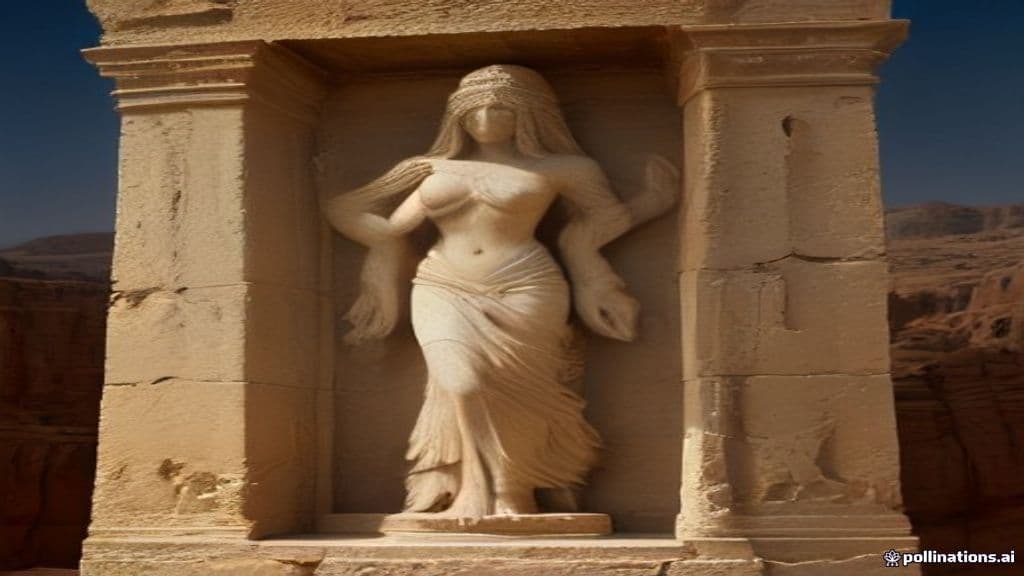
Epigraphic and classical sources place Dushara within the Nabataean/Canaanite-shaped divine network rather than as an isolated spirit. Safaitic inscriptions imply familial ties—specifically that Dushara is a son of the goddess Allāt—and attest that he appears assembled with other deities. Medieval ethnographic tradition recorded by Ibn al-Kalbī (in Kitāb al-Asnām) gives an etymological reading Ḏū l-Šarā ('the one of the Shara'), linking the name to the Shara mountain range; modern scholarship treats that reading as influential in later medieval accounts but not definitively settled for the original Nabataean form.
In Nabataean practice Dushara was commonly represented aniconically by standing stone blocks or obelisks rather than a fixed anthropomorphic cult statue; such stone cult-symbols are attested in Petra and other Nabataean sites. Classical and later syncretic imagery sometimes depicted him in the guise of Hellenic deities (reflecting identification with Zeus or Dionysus in Greco-Roman sources). Some modern interpretive accounts suggest animal symbolism such as the bull, but such animal associations are not strongly attested in the primary epigraphic materials cited here.
Sources describe Dushara's functions in social-religious terms: as a civic/patron deity of cities like Hegra and Petra he was petitioned by worshipers for justice and a range of services. Safaitic inscriptions record animal sacrifices made to Dushara asking for help, indicating a petitionary, intercessory role rather than descriptions of cosmically coercive powers. Classical authors' identification of Dushara with Zeus and Dionysus shows that his attributed functions could be reinterpreted in cross-cultural contexts.

*Perkʷūnos
*Perkʷūnos is the reconstructed Proto-Indo-European thunder‑god hypothesized by comparative linguistics and mythology. Scholarly reconstructions portray him as a storm or thunder figure associated with fructifying rain and as the combatant who fights a multi‑headed water‑serpent to release life‑giving waters; no direct attestations from the Proto‑Indo‑European period survive and the figure is inferred from later Indo‑European traditions.
*Péh₂usōn (reconstructed)
Péh₂usōn is a hypothetical Proto‑Indo‑European pastoral guardian reconstructed by comparative scholars from parallels in Greek and Vedic traditions. Proposed as a Graeco‑Aryan ancestor‑figure, the reconstruction describes a protector of flocks, roads, and travellers rather than an attested historical cultic personality.
57 Mnemosyne
57 Mnemosyne is a large main-belt asteroid (S-type) discovered in 1859 and named after the Greek Titaness Mnemosyne. It is a non-sentient astronomical body studied for its orbital and rotational properties and has been used in dynamical measurements related to Jupiter.
A'ra
No reliable sources in the supplied material establish A'ra as a distinct supernatural entity. The token "A'ra" appears in the dataset as (a) part of general references to pre-Islamic Arabian deities, (b) a modern Korean female given name (A-ra/아라), and (c) an Arabic toponym (A'ra, one village merged into Ar'ara).
Aba (disambiguation / name-form)
Aba is a polyvalent name-form attested across many unrelated contexts (place names, personal names, animal names, and brief mythological listings). The provided sources do not support a single, coherent supernatural entity called "Aba" and offer no descriptive or ritual material for such a being.
Abaddon
In Hebrew scripture Abaddon is primarily a noun meaning 'destruction' or a section/condition of the underworld paired with Sheol; in the New Testament Book of Revelation Abaddon is personified as an angelic figure (Greek Apollyon) described as the king of an army of locusts released from the abyss during the apocalypse.
Aban Yasht
The Aban Yasht is a hymn from the Persian tradition that praises Anahita, a goddess associated with water, fertility, and wisdom. It consists of 132 stanzas and is part of the 21 Yashts collection. (Note: - Power tier should be "Primordial" or possibly "Cosmic", given that it's a hymn of great spiritual significance and associated with a goddess. - The article incorrectly states that Anahita is associa)
Abarbarea
Abarbarea is a name attested in classical Greek and Roman sources for freshwater nymphs (naiads). The name appears for at least two individual mythic figures — a naiad wife of Bucolion and a naiad counted among ancestors of the Tyrians — and Hesychius records plural forms that may indicate the name was also used as a class-name (Abarbareai / Abarbalaiai).
Abas
Abas (Ancient Greek: Ἄβας, gen.: Ἄβαντος) is not a single mythic being but a recurring personal name borne by multiple mortals and minor mythic figures in Greek epic and genealogical traditions — kings, founders, seers, warriors, attendants, a centaur, and a youth transformed by a goddess. The name is glossed in the sources as 'guileless' or 'good-hearted' and appears across Argive, Theban, Trojan, Euboean, and other local cycles.
Abath
No corroborated folkloric entity named "Abath" is documented in the provided sources. The string appears in the supplied material only as a surname/personal name in Aruban/Dutch-Caribbean archival records and as an unrelated taxonomic or encyclopedic hit; no mythic attributes, origin stories, rituals, or apotropaic practices for an entity called Abath are present in the documents reviewed.
Abatur
Abatur is an uthra (celestial emanation) in Mandaeism described as the 'father of the Uthras' and called the Ancient (ʿattīqā). He resides on the boundary between the World of Light and lower regions, functions as a judge who weighs souls (Abatur Muzania), and supplies instructions and materials to the demiurgic uthra Ptahil in accounts from the Diwan (Scroll) of Abatur.
Abatwa (Twa / Batwa)
Abatwa (also recorded as Twa, Batwa, Mutwa; singular forms Barhwa or Murhwa in some transcriptions) are indigenous hunter‑gatherer peoples of the Great Lakes region of Central Africa, historically identified as some of the earliest inhabitants of the area. The available sources treat them as human ethnic groups whose livelihoods, lands, and populations have been severely affected by conservation policies and modern violence.
Community Record
- [1]Dushara (Wikipedia). Wikipedia, article 'Dushara' (summary of epigraphic, classical, and medieval attestations)wiki
- [2]Book of Idols (as cited by Ibn al-Kalbī in summaries). Ibn al-Kalbī, Kitāb al-Asnām (as summarized in secondary sources; cited for the Ḏū l-Šarā reading and tribal idol lists)literary
- [3]Archive items (search references). Archive item 4811 (referenced in research notes as part of collected materials)other
- [4]Archive items (search references). Archive item 4823 (filename suggests ritual-text materials but content not quoted in supplied notes)other
- [5]The Gods of Pre-Islamic Arabia (archive collection). Archive collection cited in research notes for regional deity comparisons and archaeological contextother