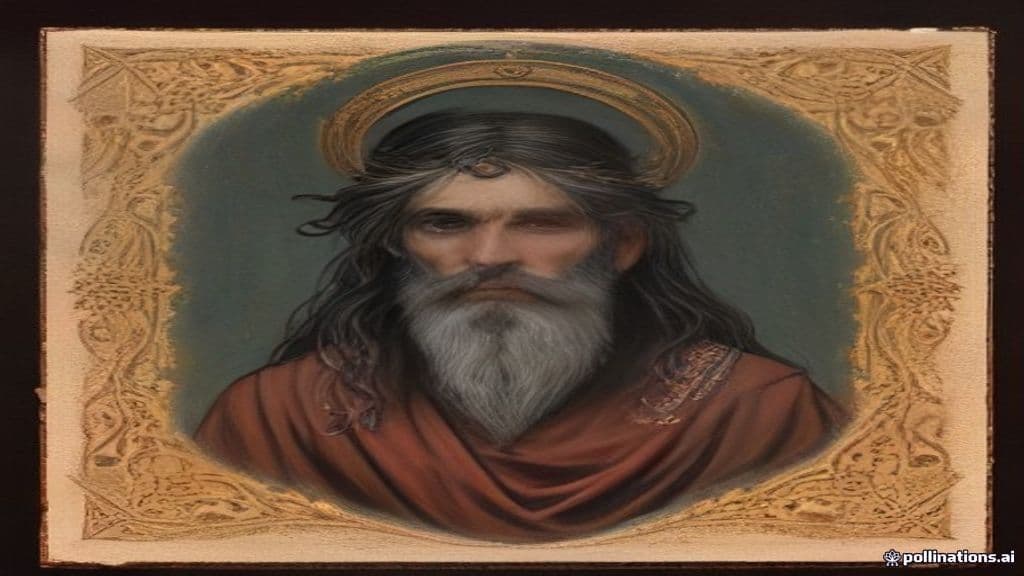
Homeric and scholiastic traditions present Echetus as a fearsome king of the mainland (epeiros) opposite Ithaca; he appears in the Odyssey's mythic-historical world without an elaborate cosmogonic origin. Scholia and later summaries give variant names tied to his family (the provided source set mentions him in relation to Homeric narrative episodes) but do not supply a sustained genealogical or creation myth. Modern commentators treat him either as a didactic/mythic exemplar used to frighten or, speculatively and without evidentiary support, as a possible remembered historical cruel ruler.
Primary Homeric passages and the provided scholia/summaries do not supply a detailed physical portrait of Echetus. The emphasis in the sources is on his actions and reputation as a maimer or destroyer rather than on bodily description. Modern speculative accounts sometimes suggest deformity or cannibalistic madness, but these conjectures are presented in the sources as lacking firm evidence.
Sources attribute to Echetus human but extreme capacities for punitive violence: maiming, mutilation, imprisonment, blinding, and brutal execution of those who offend him. In Odyssey-related summaries he is said to amputate noses and ears (threat to Irus), to have blinded his daughter by piercing her eyes with bronze needles and confined her while assigning an impossible task (grinding grains of bronze into flour), and (in scholiastic variants) to have mutilated the daughter's lover. Later mythic summaries report tales of madness and self-consumption, but such elaborations are treated in the provided materials as part of later mythic accretion rather than primary Homeric description. There is no presentation in the cited materials of supernatural powers or cosmological functions—his force is reputational and humanly brutal.
*Péh₂usōn (reconstructed)
Péh₂usōn is a hypothetical Proto‑Indo‑European pastoral guardian reconstructed by comparative scholars from parallels in Greek and Vedic traditions. Proposed as a Graeco‑Aryan ancestor‑figure, the reconstruction describes a protector of flocks, roads, and travellers rather than an attested historical cultic personality.
3-D Man
3-D Man is a Marvel Comics superhero identity associated with a 1950s-era origin in which the body of Chuck Chandler can materialize in three-dimensional existence when activated by his brother Hal via a pair of glasses. The mantle was later assumed by Delroy Garrett (formerly Triathlon) in modern continuity.
5 Ronin
5 Ronin is a 2011 Marvel Comics five-issue limited series that reimagines five Marvel superhero archetypes as rōnin (masterless samurai) in a fictionalized post‑Sekigahara feudal Japan. The work places Wolverine, Hulk, Punisher, Psylocke, and Deadpool analogues into period roles to explore displacement, revenge, and identity in an era of political upheaval.
58 Concordia
58 Concordia is a fairly large main-belt asteroid orbiting the Sun, discovered in 1860 and named after the Roman goddess Concordia. Astronomical sources classify it as a C-type (carbonaceous) body with a multi-year orbital period and measurable rotation and pole orientations.
9MOTHER9HORSE9EYES9
An anonymous Reddit screen name and online persona used by the author of the Interface series, a multipart speculative-horror narrative posted in short installments across Reddit in 2016. The name functions as the signature of an authorial identity and as a focal label for a fandom that created archives, a subreddit, and a wiki documenting the story and its fictional phenomena (notably entities called "flesh interfaces").
A.R.G.U.S.
A.R.G.U.S. is a fictional clandestine United States government agency in the DC Comics universe that investigates, contains, and manages superhuman, meta-human, and supernatural incidents and assets. Introduced in The New 52 continuity, it functions as an institutional actor providing intelligence, logistical support, covert task forces (notably Task Force X / the Suicide Squad), and a dedicated magic division across comics and media adaptations.
Aba (disambiguation / name-form)
Aba is a polyvalent name-form attested across many unrelated contexts (place names, personal names, animal names, and brief mythological listings). The provided sources do not support a single, coherent supernatural entity called "Aba" and offer no descriptive or ritual material for such a being.
Abarbarea
Abarbarea is a name attested in classical Greek and Roman sources for freshwater nymphs (naiads). The name appears for at least two individual mythic figures — a naiad wife of Bucolion and a naiad counted among ancestors of the Tyrians — and Hesychius records plural forms that may indicate the name was also used as a class-name (Abarbareai / Abarbalaiai).
Abas
Abas (Ancient Greek: Ἄβας, gen.: Ἄβαντος) is not a single mythic being but a recurring personal name borne by multiple mortals and minor mythic figures in Greek epic and genealogical traditions — kings, founders, seers, warriors, attendants, a centaur, and a youth transformed by a goddess. The name is glossed in the sources as 'guileless' or 'good-hearted' and appears across Argive, Theban, Trojan, Euboean, and other local cycles.
Abderus
Abderus (Ancient Greek: Ἄβδηρος, romanized Ábdēros) is a mortal heroic figure in Greek myth closely associated with Heracles, remembered as the youth left in charge of the Mares of Diomedes who was killed by them. He functions as an eponymous local/divine-hero ancestor for the city of Abdera and received funerary commemoration and athletic agones at his tomb.
Abena Mansa
A name attested in a single contemporary Ghanaian blog anecdote as a 'mysterious being'; available sources do not establish Abena Mansa as a coherent, traditional supernatural figure or provide corroborating ethnographic detail.
Abin Sur
Abin Sur is a fictional extraterrestrial Green Lantern from the planet Ungara in DC Comics. A former history professor turned Green Lantern of Space Sector 2814, he discovered and investigated a prophecy tied to the "Blackest Night," died wounded on Earth and chose Hal Jordan as his ring-successor, and was later reanimated as a Black Lantern in the Blackest Night storyline.
Community Record
- [1]Echetus - Wikipedia. Wikipedia, entry 'Echetus'.wiki
- [2]The Odyssey by Homer, Book 18 (summary/translations). Homer, Odyssey (Book 18) translations and summaries as cited in source set.literary
- [3]The Odyssey Book 18 - Summary. Summary of Odyssey Book 18 (used in source set to document threats invoking Echetus).literary
- [4]Pantheon: Echetus | Facts, Information, and Mythology. Encylopedic summary of Echetus (cited in the provided materials).other
- [5]The Odyssey (public summaries and commentaries cited). References to Odyssey plot use in source set (threat to Irus; daughter's punishment reported in scholia summaries).literary
- [6]After the War – Mythoi Koinoi (post-Trojan War mythic context). Contextual material on Homeric post-war mythic landscape (cited in provided research notes).academic
- [7]Lamb, The Adventures of Ulysses (retelling/reference). Modern retelling/summary used among the provided source set to document reception of Odyssey episodes.other