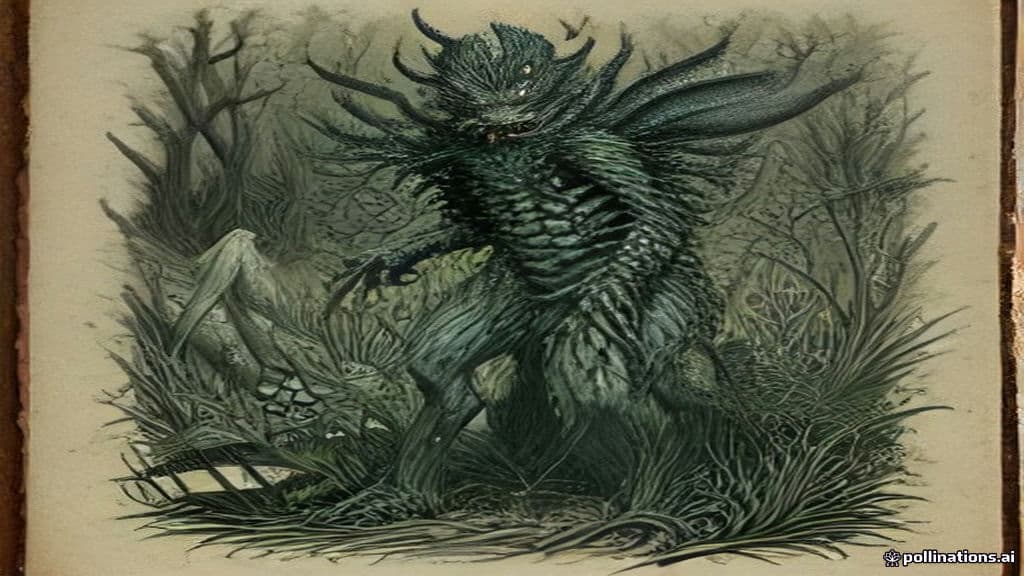
Fearsome critters is a monster in North American Folk folklore, from North America. A miscellaneous corpus of tall-tale creatures from North American logging-camp oral tradition, especially the Great Lakes lumberwoods. Presented primarily as storytelling stock—often comic, absurd, or biomechanically exaggerated—used by loggers to entertain, haze newcomers, and explain odd occurrences in the forest.
The corpus developed as part of turn-of-the-twentieth-century logging-camp oral culture in the North American lumberwoods. Traveling lumberjacks and woodsmen exchanged tall tales at camps and while moving between work sites; these stories functioned as entertainment, explanation for strange occurrences in the woods, and as hazing devices for newcomers. Early compendia and collectors (notably William T. Cox's 1910 compendium and Henry H. Tryon's 1939 collections) historicized and circulated many of these items in print, preserving fragments of a largely ephemeral oral tradition.
Appearance varies widely across the corpus and is often secondary to behavior. Some critters receive vivid, fanciful anatomies—e.g., the snoligoster described in early compendia as a limbless reptilian swamp-monster propelled by a propeller‑tipped tail—while others are mainly described by odd locomotory or behavioral traits (hugag, sidehill gouger) or by comic personifications of animals (flittericks, Goofus bird). Certain items (e.g., the squonk) are treated in later retellings with distinctive traits, but no single canonical morphology unites the corpus.
Abilities are narrative and performative rather than consistently supernatural: many critters embody exaggerated or biomechanically impossible behaviors used to explain real-world phenomena (the hidebehind as an explanation for missing loggers; treesqueak/teakettler accounting for strange forest noises) or to create comic effect. Tales emphasize behavioral motifs—odd locomotion, propulsive appendages, dissolving bodies, or inverted ecology—and performers often collaborate to present convincing, humorous accounts as a form of practical joking. The sources do not present a coherent system of powers or metaphysical rules across the corpus.
Weaknesses
- otherNo consistent weaknesses recorded in available sources
Wards
- otherNo systematic protective rituals or wards documented in the cited sources
3-D Man
3-D Man is a Marvel Comics superhero identity associated with a 1950s-era origin in which the body of Chuck Chandler can materialize in three-dimensional existence when activated by his brother Hal via a pair of glasses. The mantle was later assumed by Delroy Garrett (formerly Triathlon) in modern continuity.
5 Ronin
5 Ronin is a 2011 Marvel Comics five-issue limited series that reimagines five Marvel superhero archetypes as rōnin (masterless samurai) in a fictionalized post‑Sekigahara feudal Japan. The work places Wolverine, Hulk, Punisher, Psylocke, and Deadpool analogues into period roles to explore displacement, revenge, and identity in an era of political upheaval.
58 Concordia
58 Concordia is a fairly large main-belt asteroid orbiting the Sun, discovered in 1860 and named after the Roman goddess Concordia. Astronomical sources classify it as a C-type (carbonaceous) body with a multi-year orbital period and measurable rotation and pole orientations.
9MOTHER9HORSE9EYES9
An anonymous Reddit screen name and online persona used by the author of the Interface series, a multipart speculative-horror narrative posted in short installments across Reddit in 2016. The name functions as the signature of an authorial identity and as a focal label for a fandom that created archives, a subreddit, and a wiki documenting the story and its fictional phenomena (notably entities called "flesh interfaces").
A Elbereth Gilthoniel
An Elvish hymn in Sindarin addressed to Elbereth (Varda) from J. R. R. Tolkien's legendarium. Presented in The Lord of the Rings and later musical and dramatic adaptations, the hymn functions as devotional poetic language that evokes Elvish reverence for the star-kindler rather than an independent supernatural agent.
A.R.G.U.S.
A.R.G.U.S. is a fictional clandestine United States government agency in the DC Comics universe that investigates, contains, and manages superhuman, meta-human, and supernatural incidents and assets. Introduced in The New 52 continuity, it functions as an institutional actor providing intelligence, logistical support, covert task forces (notably Task Force X / the Suicide Squad), and a dedicated magic division across comics and media adaptations.
Abena Mansa
A name attested in a single contemporary Ghanaian blog anecdote as a 'mysterious being'; available sources do not establish Abena Mansa as a coherent, traditional supernatural figure or provide corroborating ethnographic detail.
Abin Sur
Abin Sur is a fictional extraterrestrial Green Lantern from the planet Ungara in DC Comics. A former history professor turned Green Lantern of Space Sector 2814, he discovered and investigated a prophecy tied to the "Blackest Night," died wounded on Earth and chose Hal Jordan as his ring-successor, and was later reanimated as a Black Lantern in the Blackest Night storyline.
Abishai
Abishai is a personal name attested in several distinct sources: a biblical individual described as the eldest son of Zeruiah (sister of King David); a Semitic chief named in an inscription at Beni-Hasan in Middle Egypt; and modern cultural uses including a named monster in Dungeons & Dragons and as an artist/stage name. The supplied materials do not present Abishai as a supernatural being within a living cosmology.
Abraham Cornelius
Abraham Cornelius is a fictional human scientist in Marvel Comics, a senior Weapon X technician who helped develop the technique to bond adamantium to bone and who features in Wolverine's origin and later storylines, including Death of Wolverine.
Absolute Green Lantern (tradition)
A modern comic-book reinterpretation in DC's Absolute Universe in which a giant green lantern-shaped vessel appears above Evergreen, Nevada, generates an impenetrable green dome, judges townspeople and sends the judged into the Lantern to await further adjudication in OA (Omega‑Alpha). The story reframes Green Lantern mythos as cosmic/religious horror with an "Enlightenment Spectrum" of flames (Qard, Rao, Sur, Aur) stewarded by Oans such as Abin Sur.
Absorbing Man
A fictional Marvel Comics character (Carl "Crusher" Creel) whose body acquires the physical properties of materials or energies he touches. Debuting in Journey into Mystery #114 (March 1965), created by Stan Lee and Jack Kirby, he is presented as a mortal supervillain/occasional antihero who challenges heroes such as Thor, Hulk, Spider-Man, and the Avengers.
All North American Folk entities →
Community Record
- [1]Fearsome critters - Wikipedia. Wikipedia, entry 'Fearsome critters' (summary of Cox, Tryon, and other collectors)wiki
- [2]Wikidata: fearsome critter. Wikidata item for 'fearsome critter'wiki
- [3]Fearsome Creatures of the Lumberwoods (LibriVox description / archive). LibriVox recording and archive entry for William T. Cox, Fearsome Creatures of the Lumberwoods (public-domain compendium summaries)literary
- [4]Kickle Snifters and Other Fearsome Creatures (archive). Archive copy of a compendium of fearsome critters and related tall talesliterary
- [5]Fearsome Critters — Wind Repertory Project. Online folkloric summary and list of named critters and motifsother
- [6]Fearsome Critters — Spirits podcast episode. Podcast discussion of fearsome critters and their role in lumbercamp folkloreother
- [7]Various modern summaries and anthologies (selection). Contemporary blog/anthology summarizing named critters and their traitsother