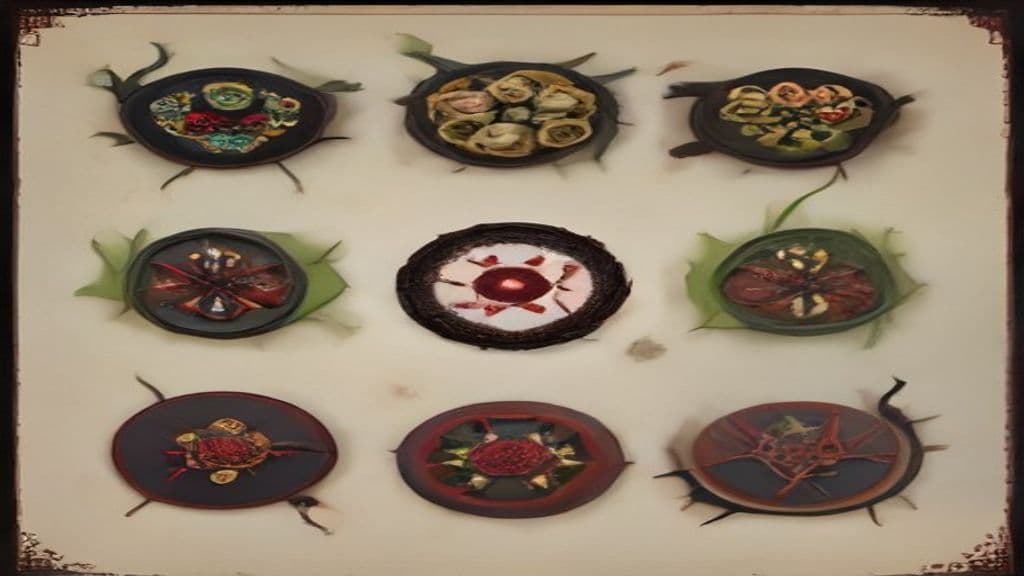
The Five Poisons is not an origin-story of a single being but a ritual/folk classification: in premodern popular cosmology the fifth day of the fifth lunar month (Duanwu, the 'Double 5 day') marked the coming of summer heat, a time when heat-related illness and noxious animals were believed to increase. To meet this seasonal hazard people bundled several locally dangerous animals under the label 'five poisons' (wǔ dú) and developed household prophylactic and talismanic practices to protect family members, especially children. The phrase was later repurposed in modern political discourse as a metaphorical list of perceived threats to state stability.
Because the Five Poisons are a set rather than a single creature, appearance is given as lists of species commonly counted among them: snakes, scorpions, centipedes, toads, and spiders. Variant lists exist in which a Jin Chan (money toad) or even a tiger may substitute for the toad in some traditions; the tiger substitution is reported as arising from associative/phonetic and symbolic logic in some accounts. The emphasis in sources is that 'poison' here names dangerous animals rather than chemical toxins.
Described attributes are the natural harms associated with the listed animals: venomous bites and stings, ability to inflict bodily injury, and association with disease and nuisance. Folk belief emphasizes a seasonal increase in their appearance and activity around the start of summer heat (Duanwu), creating an elevated risk environment that calls for talismanic and prophylactic responses rather than narratives of a single supernatural agency.
Weaknesses
- otherNot a single entity (category of animals rather than a sentient monster)
Wards
- substanceRealgar wine (arsenic sulfide mixed into wine) — consumed on Duanwu as a prophylactic
- substanceCinnabar / mercurial preparations (recorded in folk remedies and symbolic practices)
- symbolZhong Kui pictures — hung as protective images against malevolent forces
- ritualFive-poison amulets (五毒錢) — small charms depicting the five animals worn by children
- substanceMugwort pouches — small sachets of mugwort worn around the neck
- ritualWudu cakes — sets of five cakes with animal designs eaten at Duanwu as talismanic food
Akshobhya
Akshobhya is a transcendent buddha of Mahāyāna and Vajrayāna Buddhism, one of the Five Wisdom (Dhyāni) Buddhas. He personifies 'mirror knowledge' (ādarśa-jñāna), is conventionally placed in the East, and is lord of the eastern Pure Land Abhirati; in esoteric texts he is associated with the eastern Vajra division and invoked in mantra/mandala ritual contexts.
Amitābha Buddha
Amitābha is a principal Mahayana Buddha who presides over the Western Pure Land (the Land of Ultimate Bliss). Devotional practices—most centrally recitation of his name and chanting of Pure Land sutras—are presented in sources as the means by which Amitābha welcomes practitioners for rebirth in his hindrance-free realm.
Anantacāritra
Anantacāritra (Sanskrit: अनन्तचारित्र) is a bodhisattva figure in the Lotus Sūtra, identified as one of the four great perfected bodhisattvas who attend Gautama Buddha. The name is glossed as "Boundless Practice" and, in Tiantai commentary, is read as representing eternity.
Ao Guang (Dragon King of the East Sea)
Ao Guang is the Dragon King (Dragon God) who presides over the East Sea (Dōng Hǎi) in Chinese mythology, literature, and folk-religion. He is presented in sources as a regional aquatic deity associated with water and weather and appears as a named supernatural figure in classical vernacular novels such as Journey to the West and Fengshen Yanyi.
Ao Kuang
Ao Kuang (also attested as Ao Guang) is the Dragon King of the East Sea in Chinese mythology and folk religion, one of a quartet of sea-dragon sovereigns associated in folklore with the cardinal seas. He appears in classical literature and later popular media as a ruler of maritime waters whose favor or displeasure is connected to tides, rain, floods and storms.
Arhat
An arhat (Sanskrit: arhat; Pāli: arahant) is in Buddhist traditions a human practitioner who has gained insight into the true nature of existence, attained nirvāṇa, and been liberated from the cycle of rebirth. The status and valuation of arhatship vary by school: some traditions equate it with full liberation, while others treat it as distinct from or inferior to the bodhisattva/buddha ideal.
Ashina Buzhen
Ashina Buzhen (Chinese: 阿史那步真) was a 7th-century member of the Ashina ruling house of the Western Turks who acted as a military and political claimant to khaganate authority on the Tang frontier. Recorded in Tang-era sources and modern summaries, he engaged in inter-elite rivalry, participated in Tang military campaigns, received an imperial-bestowed khagan title from Emperor Gaozong, and died in 667.
Ashina Helu
Ashina Helu (阿史那賀魯 / 阿史那贺鲁, āshǐnà hèlǔ) was a mid‑7th century member of the Ashina clan who claimed the title qaγan (khagan) of the Western Turkic polity. Active as a tribal shad and later self‑declared khagan, he contested Tang authority, was defeated by General Su Dingfang in 657, handed over by Chach, spared by Emperor Gaozong, and spent his remaining years in Chang'an.
Ashina Mishe
Ashina Mishe (Chinese: 阿史那彌射; ?–662) was a mid-7th century member of the Ashina clan installed and recognized by the Tang court as a khagan and frontier protector-general over portions of the former Western Turkic territories. His career illustrates Tang imperial practices of using titled Turkic elites as intermediaries to administer and pacify western protectorates; his death in 662 following an intrafamilial rivalry weakened Tang influence in the region.
Ashina Nishufu
Ashina Nishufu was a member of the Ashina clan proclaimed qaghan in a short-lived Göktürk revolt against the Tang dynasty (679–680 CE). Declared by Turkic leaders Ashide Wenfu and Ashide Fengzhi, his uprising was defeated by Tang general Pei Xingjian; he was killed by his own men and the revolt’s leaders and many Göktürks were executed in Chang'an.
Ashina She'er
Ashina She'er (阿史那社爾) is a historical Turkic prince of the Ashina house who became a Tang dynasty general in the 7th century. Chronicle summaries record his roles as claimant to parts of the Western Turkic Khaganate, his submission to Tang in 635, marriage into the imperial family, major western campaigns (including Kucha, 648), and his burial alongside Emperor Taizong.
Ashina Shibobi
Ashina Shibobi (c. 603–631), regnal name Tolis (Töles) Khagan, was a member of the Ashina clan who served as a lesser khagan and military leader of the eastern wing of the Eastern Turkic Khaganate in the early 7th century CE. He held offices such as Nipu shad and Tolis khagan, participated in raids against Tang China, suffered internal punishment after military setbacks, and ultimately submitted to Emperor Taizong of Tang in 629.
Community Record
- [1]Five Poisons. Wikipedia, 'Five Poisons' (accessed source material summarizing Duanwu customs, listed animals, and modern political usage)wiki
- [2]Five Poisons (Wikidata). Wikidata entry summarizing the term as an ancient Chinese set of poisonous or hazardous animalsother
- [3]China targeting ‘Five Poisons’ that give its rulers sleepless nights. Tibetan Review article describing the modern political usage of 'Five Poisons' and the groups listed as perceived threatsother
- [4]Hi-Fructose: Beware 'The Five Poisons!'. Hi-Fructose commentary citing the cultural motif and artwork related to the Five Poisons (supplementary cultural-material reference)other