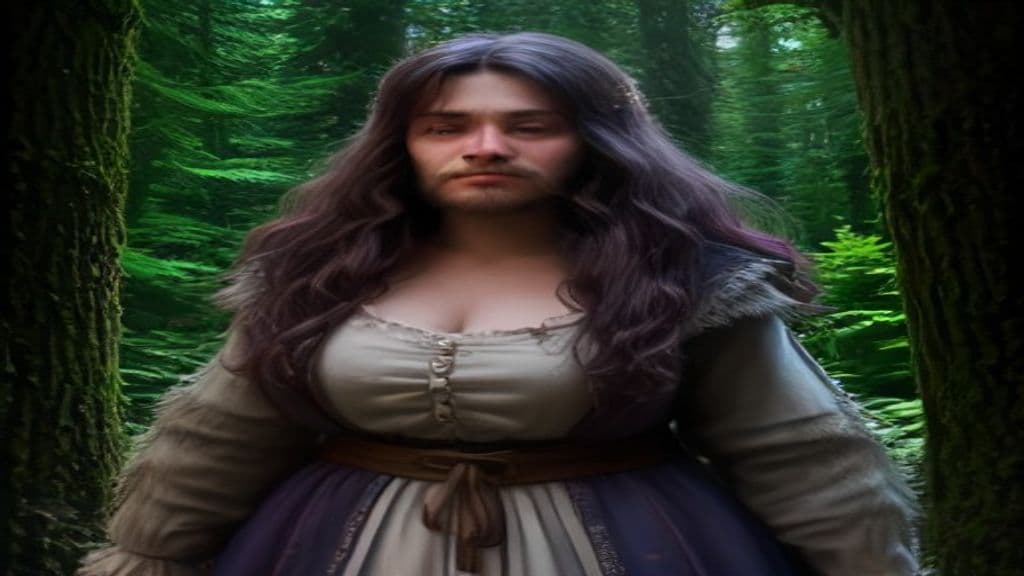
In the ethnographic and folkloric accounts summarized by Mannhardt and later compilers, Fänggen belong to a wider class of 'wilde Leute' or forest-spirits. Mannhardt frames these beings as arising from an older conception in which individual trees were seen as ensouled; over time these tree-psychē were reimagined in many locales as independent forest-personalities whose lives remained tied to the trees. Folktales and regional reports thus present some Fänggen as personified tree-mothers whose existence depends on particular trees, while other variants preserve them as free-roaming wild women or smaller wood-dwellers.
Descriptions vary by region. In Tyrol and parts of the Bavarian Alps Fänggen are said to appear as hideous giantesses as tall as trees: wholly hairy or bristled bodies, coarse hair and beard-lichen in the hair, a gaping mouth described as reaching 'from ear to ear,' deep male-like voices, and black eyes sometimes said to flash like lightning. They are described wearing bark-like jackets or skirts/aprons of animal pelts and often moss- or lichen-covered. Swiss and Vorarlberg variants (Waldfänken, Waldfänken/Waldfänken mannli) are reported as thicker, shorter, hair-covered mannikins; Fankerl in some Upper Palatinate reports appears as a bearded dwarf with flashing red eyes.
Sources attribute to Fänggen a life-force tied to particular large or old trees such that felling or death of the tree causes the corresponding Fangga to die or vanish. They are portrayed as physically formidable—giant size or superhuman strength is explicitly noted in several regional accounts (Waldfänken described with superhuman strength). In behavior they are dangerous to humans: many accounts call them man-eaters with a particular preference for children; they are also reported to steal newborns (with unnamed newborns/unbaptized infants vulnerable to exchange for changelings) and to take women who have just given birth. Some traditions record that Fängge-daughters are farmed out as maids to human households but remain outside Christian rites and will return to the forest on hearing of kin deaths.
Weaknesses
- conditionLife bound to a particular tree (felling or death of that tree causes the corresponding Fangga to die or vanish)
- conditionIntegration of infants into Christian sacrament (baptism) reduces vulnerability to being exchanged as changelings (attested in Swiss German recensions)
Wards
- ritualBaptism (Christian)
- otherAvoidance behavior (keeping children indoors in the evening)

Wild Hunt
A fearsome spectral cavalcade of the dead sweeping through the winter sky — those who see it risk being carried off or killed, and its passage foretells war, plague, or catastrophe.
Wild Hunt
A fearsome spectral cavalcade of the dead sweeping through the winter sky — those who see it risk being carried off or killed, and its passage foretells war, plague, or catastrophe.
Abraun
Abraun is an attested name in German-language plant-legend scholarship (Der abraun, ein beitrag zur pflanzensagenkunde, 1916) and a short database entry (Wikidata) labels it as a spirit from German mythology. Surviving accessible documentation is extremely limited: the principal academic treatment is a 1916 contribution to pflanzensagenkunde (plant-saga studies), but the excerpts available here contain only bibliographic metadata and do not record tales, descriptions, or rituals.
Adils
Adils (Old Norse Aðils; also Eadgils, Adillus, Athisl, Adhel) is a semi‑legendary sixth‑century Swedish king attested in Old Norse saga material and later medieval traditions. He appears in saga episodes as a storied royal figure involved in warfare, court acts, and marriage suits rather than as a supernatural being.
Agilaz (Egil)
Agilaz (reconstructed Proto-Germanic) — commonly recorded in medieval sources as Egil or Ægil — is a legendary archer attested in Germanic heroic tradition. He appears as the brother of Völund (Wayland/Weland) in the Old Norse poem Völundarkviða and in the Thidreks saga, and his name is also inscribed on early medieval objects (Franks Casket, Pforzen buckle). The attested material presents him as a named heroic human archer within saga and inscriptional contexts rather than as a recurrent supernatural species.
Alaisiagae
A group of Germanic female deities attested in Roman Britain, worshipped by continental auxiliary troops at a shrine near Vercovicium (Housesteads) on Hadrian's Wall. Epigraphic evidence records dedications to named members (Beda, Fimmilena, and in other lists Baudihillia and Friagabis) alongside Mars Thincsus and the numen of the emperor; modern scholarship interprets them variously as war/victory goddesses, as goddesses associated with assembly/justice, or as part of Matronae‑type fertility/ancestor cults.
Alberich
In Germanic heroic legend, Alberich is a dwarf associated with elven qualities and power. (Note: 1. Power tier: Reduce to Ancient as Alberich's abilities are not described beyond being a dwarf with elven qualities. 2. Origin story: Clarify that Alberich is mentioned in multiple Germanic texts, bu)
Alcis
A pair of youthful brother-deities worshipped by the Naharvali, attested only in Tacitus' Germania (c. 98 CE). They were venerated in a sacred grove under the care of a priest in female attire and are compared by Roman ethnography to the Graeco‑Roman Dioscuri (Castor and Pollux).
Alf and Alfhild
Alf and Alfhild are legendary human figures from Old Norse/early Scandinavian narrative tradition preserved principally in Saxo Grammaticus' Gesta Danorum. The tale presents Alf as a Danish prince and Alfhild as a Geatish princess who becomes a shieldmaiden and leader of a fleet of female raiders; their story includes combat, recognition, marriage, and later dynastic conflict.
Allerleirauh
Allerleirauh is the eponymous heroine of a Brothers Grimm fairy tale (Grimm no. 65; ATU 510B) who flees an enforced-marriage crisis by disguising herself in a mantle of many furs, takes menial service in another court, and later reveals her identity through three magnificent dresses and token objects to secure recognition and marriage.
Alp
A German-speaking folkloric figure associated with nocturnal disturbance of sleepers. Historically tied to the broader Germanic family of 'elves' and treated variously as an eerie nature-being in medieval glosses and as a male nocturnal spirit in later folk accounts that sits on sleepers' chests and causes nightmares (Alptraum) and 'elf-pressure' (Alpdruck).
Alraune
Alraune is the German folkloric figure identified with the humanoid-shaped mandrake (Mandragora officinarum) and the eponymous female character in Hanns Heinz Ewers's 1911 novel. In folklore the mandrake/Alraune is associated with love philtres, fertility, and a medieval gallows-origin legend; in literature the name labels a woman artificially conceived from a criminal's semen, whose emotional life and actions dramatize the folk moral about such origins.
Altgermanische Religionsgeschichte
A historical survey of Germanic religious history, providing an overview of the pantheon of gods and goddesses. (Note: - Power tier is not applicable to historical surveys - The article should reflect that it's a historical survey, not an entity with abilities or appearance - Consider adding information on the signifi)
Amleth
Amleth (Old Norse: Amlóði; Latinized Amlethus) is a legendary medieval Scandinavian prince and saga-hero best known from Saxo Grammaticus' Gesta Danorum. He is a human protagonist whose story centers on feigned madness, cunning survival, exile to Britain, marriage, wealth-gathering, and eventual vengeance against his father's murderer; the tale later inspired the character of Shakespeare's Hamlet and numerous adaptations.
Community Record
- [1]Fänggen. Wikipedia, 'Fänggen' (accessed source material summarized in research notes)wiki
- [2]Die Waldgeister und ihre Sippe. Wilhelm Mannhardt, Die Waldgeister und ihre Sippe (archive.org edition), chapters and introduction discussing tree-spirits, 'Wildleute in Tirol: Fanggen' and 'Wildleute in Graubünden: Waldfänken'.academic