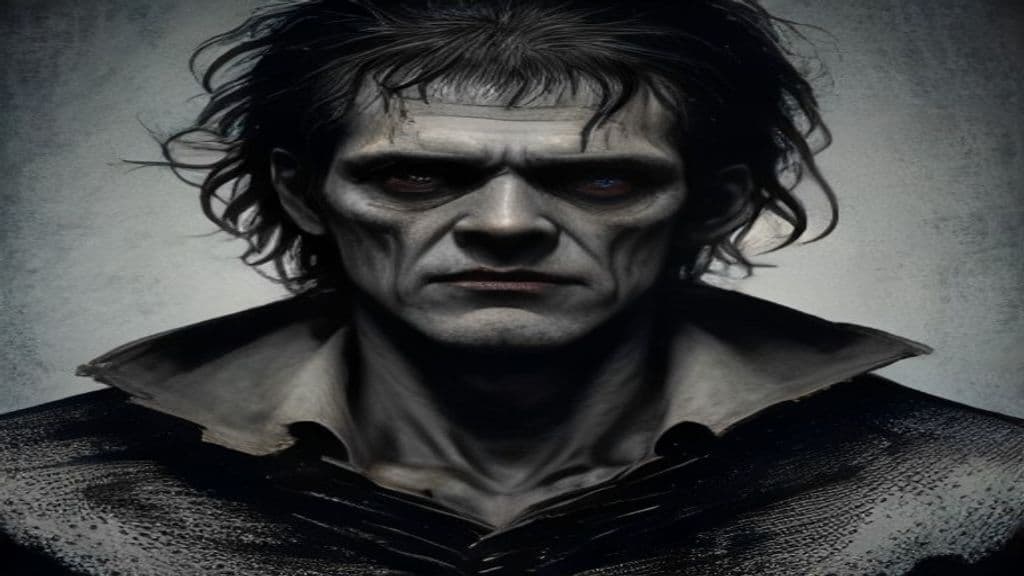
In Mary Wollstonecraft Shelley's 1818 novel Frankenstein; or, The Modern Prometheus, Victor Frankenstein, a student at Ingolstadt, assembles human corpses and animates them by means of an unorthodox scientific experiment (framed in the novel against contemporary discourse on chemistry and galvanism). The created being is newly conscious and sentient; the narrative frames the event as a consequence of scientific hubris and evokes the Prometheus myth as thematic context. The novel emphasizes that the parts were taken from death (charnel houses and graves are mentioned in sources summarizing the text) and that the creation raises moral questions about responsibility of a maker toward its creation. Over time popular culture has often conflated the creator's surname 'Frankenstein' with the creature itself.
Shelley's novel repeatedly describes the being as a large, grotesque humanoid assembled from disparate human parts. Textual summaries stress that the creature is humanoid, constructed from corpses, and perceived by other characters as frightening; later film and stage adaptations developed additional iconic imagery, but the primary text limits description to a physically imposing and unsettling man-like composite.
In the novel the creature is sapient: it becomes newly conscious, learns language by observing a family, reads literature (notably Paradise Lost), and communicates fluently. It demonstrates human-like learning, moral awareness, and the capacity for self-reflection and grief. The creature is physically capable of rescuing a drowning child and also of lethal violence: it murders Victor's brother William, indirectly causes Justine's execution, kills Henry Clerval, and murders Elizabeth in revenge when Victor refuses to create a companion. The creature articulates demands, reasons about its condition, and plans future action (including an expressed intention to destroy itself at the end of the narrative).
Weaknesses
- conditionsocial rejection and loneliness
- conditiondependence on creator for companionship (requests a female companion)
- othermoral anguish and capacity for remorse (affects decisions and final self-destructive intention)
Wards
- conditionavoidance and concealment by humans (flight, hiding)
- otherarmed civilian or mob response (shooting / violent repulsion observed in incidents)
3-D Man
3-D Man is a Marvel Comics superhero identity associated with a 1950s-era origin in which the body of Chuck Chandler can materialize in three-dimensional existence when activated by his brother Hal via a pair of glasses. The mantle was later assumed by Delroy Garrett (formerly Triathlon) in modern continuity.
5 Ronin
5 Ronin is a 2011 Marvel Comics five-issue limited series that reimagines five Marvel superhero archetypes as rōnin (masterless samurai) in a fictionalized post‑Sekigahara feudal Japan. The work places Wolverine, Hulk, Punisher, Psylocke, and Deadpool analogues into period roles to explore displacement, revenge, and identity in an era of political upheaval.
58 Concordia
58 Concordia is a fairly large main-belt asteroid orbiting the Sun, discovered in 1860 and named after the Roman goddess Concordia. Astronomical sources classify it as a C-type (carbonaceous) body with a multi-year orbital period and measurable rotation and pole orientations.
9MOTHER9HORSE9EYES9
An anonymous Reddit screen name and online persona used by the author of the Interface series, a multipart speculative-horror narrative posted in short installments across Reddit in 2016. The name functions as the signature of an authorial identity and as a focal label for a fandom that created archives, a subreddit, and a wiki documenting the story and its fictional phenomena (notably entities called "flesh interfaces").
A Elbereth Gilthoniel
An Elvish hymn in Sindarin addressed to Elbereth (Varda) from J. R. R. Tolkien's legendarium. Presented in The Lord of the Rings and later musical and dramatic adaptations, the hymn functions as devotional poetic language that evokes Elvish reverence for the star-kindler rather than an independent supernatural agent.
A.R.G.U.S.
A.R.G.U.S. is a fictional clandestine United States government agency in the DC Comics universe that investigates, contains, and manages superhuman, meta-human, and supernatural incidents and assets. Introduced in The New 52 continuity, it functions as an institutional actor providing intelligence, logistical support, covert task forces (notably Task Force X / the Suicide Squad), and a dedicated magic division across comics and media adaptations.
Abdiel
Abdiel (Hebrew עֲבְדִּיאֵל) is primarily a theophoric Hebrew personal name meaning "servant of El/servant of God," attested once in the Hebrew Bible (1 Chronicles 5:15). In later literature—most notably John Milton's Paradise Lost—Abdiel is reimagined as a faithful seraph who opposes Satan's revolt. The provided sources do not treat Abdiel as an autonomous folkloric spirit type or record rituals or wards associated with the name.
Abena Mansa
A name attested in a single contemporary Ghanaian blog anecdote as a 'mysterious being'; available sources do not establish Abena Mansa as a coherent, traditional supernatural figure or provide corroborating ethnographic detail.
Abiel
Abiel is attested in the supplied sources only as a male given name — borne by several historical American individuals and listed as two minor biblical figures. The provided materials contain no evidence presenting Abiel as a supernatural, mythological, or folkloric entity.
Abigail
Abigail is a female figure in the Hebrew Bible portrayed in 1 Samuel 25 as the intelligent and beautiful wife of Nabal who intervenes to prevent David from committing violence; later tradition regards her as one of the Tanakh's seven female prophets and as a model of beauty and wisdom.
Abin Sur
Abin Sur is a fictional extraterrestrial Green Lantern from the planet Ungara in DC Comics. A former history professor turned Green Lantern of Space Sector 2814, he discovered and investigated a prophecy tied to the "Blackest Night," died wounded on Earth and chose Hal Jordan as his ring-successor, and was later reanimated as a Black Lantern in the Blackest Night storyline.
Abishai
Abishai is a personal name attested in several distinct sources: a biblical individual described as the eldest son of Zeruiah (sister of King David); a Semitic chief named in an inscription at Beni-Hasan in Middle Egypt; and modern cultural uses including a named monster in Dungeons & Dragons and as an artist/stage name. The supplied materials do not present Abishai as a supernatural being within a living cosmology.
Community Record
- [1]Frankenstein; or, The Modern Prometheus (Project Gutenberg, Mary Wollstonecraft Shelley, 1818). Mary Wollstonecraft Shelley, Frankenstein; or, The Modern Prometheus (1818). Project Gutenberg edition.literary
- [2]Frankenstein — Wikipedia. Frankenstein — Wikipedia article summarizing the novel, its themes, and cultural reception.wiki
- [3]Frankenstein (1931 film) — Wikipedia. Wikipedia entry on the 1931 Universal Pictures film, cited in sources as an example of later cultural representation.wiki
- [4]Frankenstein — Forgotten Futures / game page. Summary and notes on Frankenstein and related adaptations; cited among secondary sources on reception.other