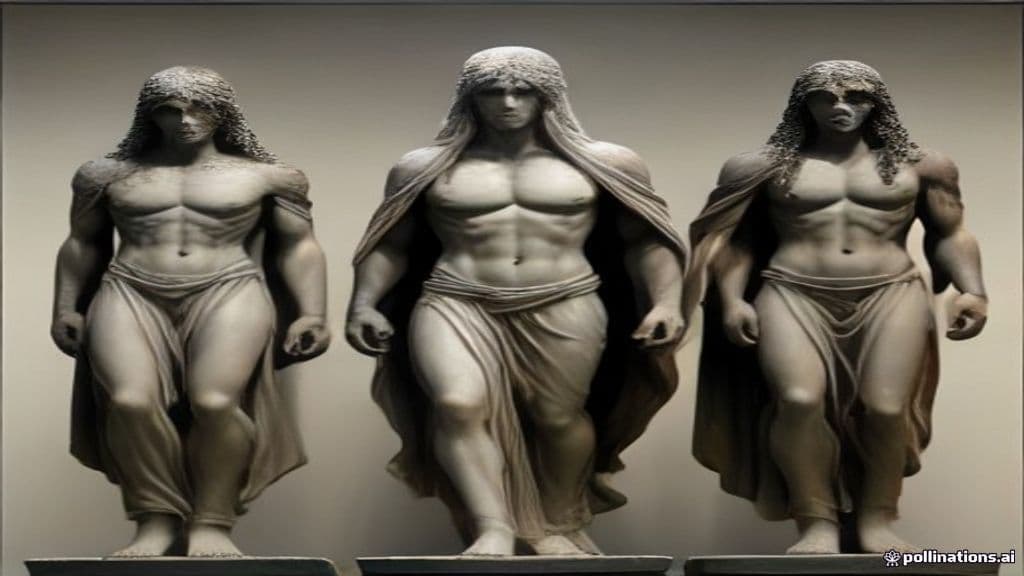
In Greek mythic geography Geryon inhabits the island Erytheia at the western edge of the world, a liminal locale associated by some later Greeks with Tartessos in southern Iberia. Genealogical traditions place him as a descendant of the Gorgon line (son of Chrysaor and Callirrhoe in some accounts), and he functions within the heroic-age narrative cycle as the owner and guardian of a magnificent herd of red cattle. Primary classical encounters with Geryon center on Heracles' Tenth Labour; later literary receptions (for example Dante) repurpose the figure as an allegorical composite rather than preserve the original mythic setting.
Sources vary. Hesiod (as summarized) describes Geryon as having one body and three heads; Aeschylus' tradition records three bodies; a fragmentary Stesichorus tradition and mid-6th-century Chalcidian vase imagery represent him as winged and as having six hands and six feet. Other versions describe three bodies joined to a single pair of legs or note six legs. Generally he is otherwise humanoid and is commonly pictured armed as a warrior (shields, spears, helmets). He is accompanied by the two-headed hound Orthrus and the herdsman Eurytion.
Classical accounts present Geryon primarily as a powerful, martial guardian: he defends his cattle and confronts intruders while equipped with arms and armour (one account describes him carrying three shields, three spears, and wearing three helmets). He functions as a narrative obstacle in the Heracles cycle and is vulnerable to heroic violence: the Pseudo-Apollodorus tradition recounts Heracles killing Orthrus and Eurytion and then slaying Geryon with an arrow dipped in the Lernaean Hydra's venom. Later receptions (notably Dante's Inferno) recast Geryon as an allegorical, composite monster used to personify Fraud; that medieval figure's attributes are a literary transformation and not descriptions from the classical mythic corpus.
Weaknesses
- substancearrow dipped in the venomous blood of the Lernaean Hydra
- conditiondefeatable by heroic martial violence (Heracles' expedition)
Wards
- otherNo traditional magical wards recorded in the supplied sources

*Péh₂usōn (reconstructed)
Péh₂usōn is a hypothetical Proto‑Indo‑European pastoral guardian reconstructed by comparative scholars from parallels in Greek and Vedic traditions. Proposed as a Graeco‑Aryan ancestor‑figure, the reconstruction describes a protector of flocks, roads, and travellers rather than an attested historical cultic personality.
3-D Man
3-D Man is a Marvel Comics superhero identity associated with a 1950s-era origin in which the body of Chuck Chandler can materialize in three-dimensional existence when activated by his brother Hal via a pair of glasses. The mantle was later assumed by Delroy Garrett (formerly Triathlon) in modern continuity.
5 Ronin
5 Ronin is a 2011 Marvel Comics five-issue limited series that reimagines five Marvel superhero archetypes as rōnin (masterless samurai) in a fictionalized post‑Sekigahara feudal Japan. The work places Wolverine, Hulk, Punisher, Psylocke, and Deadpool analogues into period roles to explore displacement, revenge, and identity in an era of political upheaval.
A Elbereth Gilthoniel
An Elvish hymn in Sindarin addressed to Elbereth (Varda) from J. R. R. Tolkien's legendarium. Presented in The Lord of the Rings and later musical and dramatic adaptations, the hymn functions as devotional poetic language that evokes Elvish reverence for the star-kindler rather than an independent supernatural agent.
A.R.G.U.S.
A.R.G.U.S. is a fictional clandestine United States government agency in the DC Comics universe that investigates, contains, and manages superhuman, meta-human, and supernatural incidents and assets. Introduced in The New 52 continuity, it functions as an institutional actor providing intelligence, logistical support, covert task forces (notably Task Force X / the Suicide Squad), and a dedicated magic division across comics and media adaptations.
Aba (disambiguation / name-form)
Aba is a polyvalent name-form attested across many unrelated contexts (place names, personal names, animal names, and brief mythological listings). The provided sources do not support a single, coherent supernatural entity called "Aba" and offer no descriptive or ritual material for such a being.
Abaddon
In Hebrew scripture Abaddon is primarily a noun meaning 'destruction' or a section/condition of the underworld paired with Sheol; in the New Testament Book of Revelation Abaddon is personified as an angelic figure (Greek Apollyon) described as the king of an army of locusts released from the abyss during the apocalypse.
Abadir
Abadir is a polysemous name attested in distinct cultural contexts: a legendary founding saint and clan ancestor in eastern Ethiopia (Sheikh Abadir Umar Al‑Rida / Aw Abadir), a term applied to cone‑shaped cult stones in Phoenician religious description, and a personal name of a martyr (Abadir/Apater) in the Coptic Synaxarium. The attestations are independent usages of the same name rather than a single supernatural being.
Abadiu of Antinoe
Abadiu of Antinoe was a fourth‑century bishop of Antinoe (Antinoopolis, in Roman Egypt) commemorated as a martyr and saint in the Coptic Orthodox Church, with a feast day on 26 December. Sources record that he was killed during a theological dispute with Arian opponents and reference him in collections of Egyptian martyrs.
Abagtha
Abagtha (Hebrew: אבגתא, ’Ǎḇaḡṯā) is a named human court official in the Hebrew Bible’s Book of Esther, listed among seven chamberlains who ministered before King Ahasuerus and were commanded to bring Queen Vashti before the king. He is attested only in Esther 1:10 and is presented as an institutional palace attendant rather than a supernatural being.
Abanoub
Abanoub is a 4th‑century Egyptian Christian child martyr venerated in the Coptic tradition. Remembered for his public confession of Christ, miraculous healings associated with his passion, and the translation and veneration of his relics, his feast is observed on July 31 (Epip 24) and his cult centers include Nehisa and Samanoud.
Abarbarea
Abarbarea is a name attested in classical Greek and Roman sources for freshwater nymphs (naiads). The name appears for at least two individual mythic figures — a naiad wife of Bucolion and a naiad counted among ancestors of the Tyrians — and Hesychius records plural forms that may indicate the name was also used as a class-name (Abarbareai / Abarbalaiai).
Community Record
- [1]Geryon - Wikipedia. Geryon. Wikipedia. Accessed via provided research notes.wiki
- [2]Geryon - Wikidata. Wikidata entry for Geryon. Accessed via provided research notes.other
- [3]Black-Figure Oinochoe (Wine Jug): Hercle (Herakles) and Pholos; Cattle (of Geryon?). Museum/archive catalogue entry documenting mid-6th-century vase imagery linked to Geryon.other
- [4]Strong stuff : Herakles and his labors. Modern book collecting and discussing Heracles' labours and their reception; cited in research notes for narrative context.other
- [5]Alchetron: Geryon. Online encyclopedia summary cited in research notes.wiki
- [6]Marvunapp: Geryon (Hercules foe). Modern compilation of mythic summaries referenced in research notes.other