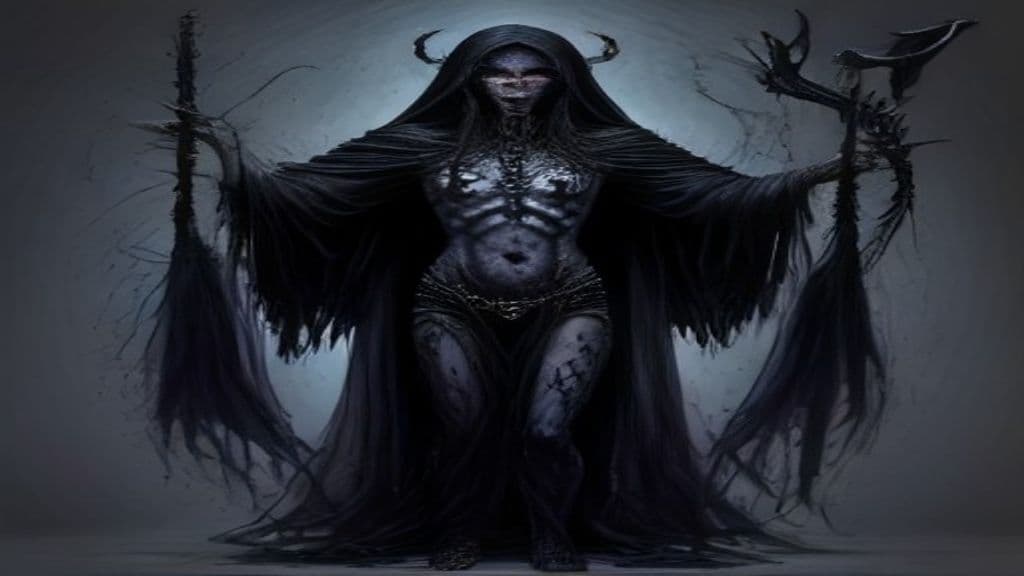
According to the concise folkloric summary in the supplied materials, the ghoul concept originated in pre-Islamic Arabian religion and later became part of broader folklore. Source 1 frames the ghoul as a figure of the unseen world connected to death, fixation on graveyards, and corporeal violation through eating human flesh. Over time the term and motif were secularized and adapted into modern fiction—appearing as a named monster type in literature, games, comics, and other media—while the core folkloric notion (graveyard-associated, flesh-eating monstrous humanoid) remains the primary traditional element cited in the available sources.
The provided folkloric description characterizes the ghoul as a 'demon-like being or monstrous humanoid,' implying a humanoid form rendered monstrous rather than a precise anatomical type (Source 1). The supplied materials do not record a single canonical physical description from original folklore; instead, modern visualizations vary widely across video games, comics, virtual photography, and other creative works that reuse the ghoul motif. The folkloric record excerpted emphasizes monstrous humanoid aspect without detailed, uniform physical traits.
In the traditional material cited, the ghoul's defining behavior is its association with graveyards and its consumption of human flesh (Source 1). Beyond this core trait, the supplied corpus mixes folkloric summary with many modern fictional reuses that attribute diverse, inconsistent powers (combatant enemy in games; varied superhuman abilities in comics). Those later adaptations represent creative expansions rather than stable elements of the traditional ghoul as presented in the provided folkloric source.
3-D Man
3-D Man is a Marvel Comics superhero identity associated with a 1950s-era origin in which the body of Chuck Chandler can materialize in three-dimensional existence when activated by his brother Hal via a pair of glasses. The mantle was later assumed by Delroy Garrett (formerly Triathlon) in modern continuity.
5 Ronin
5 Ronin is a 2011 Marvel Comics five-issue limited series that reimagines five Marvel superhero archetypes as rōnin (masterless samurai) in a fictionalized post‑Sekigahara feudal Japan. The work places Wolverine, Hulk, Punisher, Psylocke, and Deadpool analogues into period roles to explore displacement, revenge, and identity in an era of political upheaval.
58 Concordia
58 Concordia is a fairly large main-belt asteroid orbiting the Sun, discovered in 1860 and named after the Roman goddess Concordia. Astronomical sources classify it as a C-type (carbonaceous) body with a multi-year orbital period and measurable rotation and pole orientations.
9MOTHER9HORSE9EYES9
An anonymous Reddit screen name and online persona used by the author of the Interface series, a multipart speculative-horror narrative posted in short installments across Reddit in 2016. The name functions as the signature of an authorial identity and as a focal label for a fandom that created archives, a subreddit, and a wiki documenting the story and its fictional phenomena (notably entities called "flesh interfaces").
A Elbereth Gilthoniel
An Elvish hymn in Sindarin addressed to Elbereth (Varda) from J. R. R. Tolkien's legendarium. Presented in The Lord of the Rings and later musical and dramatic adaptations, the hymn functions as devotional poetic language that evokes Elvish reverence for the star-kindler rather than an independent supernatural agent.
A'ra
No reliable sources in the supplied material establish A'ra as a distinct supernatural entity. The token "A'ra" appears in the dataset as (a) part of general references to pre-Islamic Arabian deities, (b) a modern Korean female given name (A-ra/아라), and (c) an Arabic toponym (A'ra, one village merged into Ar'ara).
A.R.G.U.S.
A.R.G.U.S. is a fictional clandestine United States government agency in the DC Comics universe that investigates, contains, and manages superhuman, meta-human, and supernatural incidents and assets. Introduced in The New 52 continuity, it functions as an institutional actor providing intelligence, logistical support, covert task forces (notably Task Force X / the Suicide Squad), and a dedicated magic division across comics and media adaptations.
Abena Mansa
A name attested in a single contemporary Ghanaian blog anecdote as a 'mysterious being'; available sources do not establish Abena Mansa as a coherent, traditional supernatural figure or provide corroborating ethnographic detail.
Abgal
Abgal (Arabic: أبغال) is a pre‑Islamic local tutelary figure attested in the Palmyrene cultural sphere (c. 154–270 AD), primarily venerated by nomadic Arab groups in the Syrian desert. He appears in inscriptions and reliefs as one of a constellation of armed, mounted protective deities associated with caravan and nomadic protection, though no ritual texts survive in the cited sources.
Abin Sur
Abin Sur is a fictional extraterrestrial Green Lantern from the planet Ungara in DC Comics. A former history professor turned Green Lantern of Space Sector 2814, he discovered and investigated a prophecy tied to the "Blackest Night," died wounded on Earth and chose Hal Jordan as his ring-successor, and was later reanimated as a Black Lantern in the Blackest Night storyline.
Abishai
Abishai is a personal name attested in several distinct sources: a biblical individual described as the eldest son of Zeruiah (sister of King David); a Semitic chief named in an inscription at Beni-Hasan in Middle Egypt; and modern cultural uses including a named monster in Dungeons & Dragons and as an artist/stage name. The supplied materials do not present Abishai as a supernatural being within a living cosmology.
Abraham Cornelius
Abraham Cornelius is a fictional human scientist in Marvel Comics, a senior Weapon X technician who helped develop the technique to bond adamantium to bone and who features in Wolverine's origin and later storylines, including Death of Wolverine.
Community Record
- [1]Ghouls. Wikipedia, 'Ghouls' (summary stating ghoul as a demon-like being associated with graveyards and flesh consumption and noting origin in pre-Islamic Arabian religion).wiki
- [2]Ghouls 'n Ghosts. Wikipedia entry for the video game franchise illustrating modern popular-culture reuse of the ghoul motif in games.wiki
- [3]Ghouls in a cave (virtual photography). Archive item titled 'Ghouls in a cave' demonstrating modern visual usages and artistic representations that reuse the ghoul label.other
- [4]Burmese Ghouls. Wikipedia article showing regional adaptations and use of the ghoul term in various contexts within popular culture and folkloric discussions.wiki
- [5]#405: Ghouls. Column entry discussing ghouls as folkloric or monstrous figures and how the term is used across sources.other
- [6]Ghoul (Mr. Fixit (Hulk) foe). Marvunapp entry documenting a comic-book character named Ghoul, illustrating modern fictional character-specific uses distinct from the traditional folklore.other
- [7]Ghoul (Ultraverse, Ultraforce, Exiles). Marvunapp entry for another comic-book character named Ghoul, showing variant modern powers and portrayals that are adaptations rather than folkloric constants.other
- [8]One Thousand and One Nights. The Arabian Nights (Burton, Richard F., trans.). 1885. The Book of the Thousand Nights and a Night. Burton Club.literary
- [9]Jinn, Angels and Supernatural Beings in Islam. El-Zein, Amira. 2009. Islam, Arabs, and the Intelligent World of the Jinn. Syracuse University Press.academic