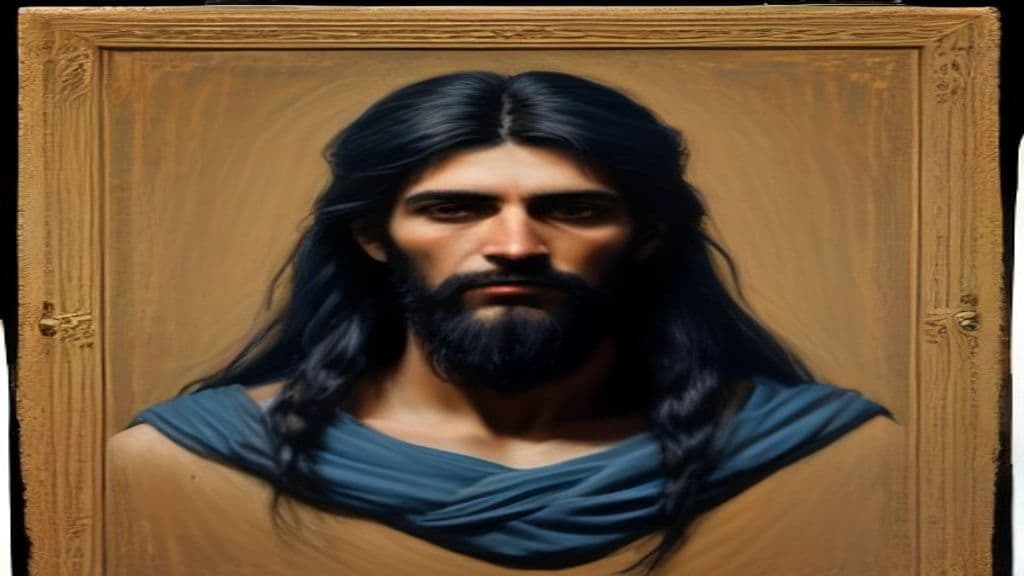
Hector is presented in the Homeric tradition as the son of King Priam and Queen Hecuba of Troy and the leading defender of Troy during the ten‑year siege by the Achaeans. The name itself is ancient (Greek Ἕκτωρ, Hektōr), an agent noun derived from the verb ἔχειν (ékhein, 'to have, to hold') and attested in Linear B (E‑ko‑to), giving the name connotations of 'holder' or 'possessor.' Scholarly proposals noted in the sources suggest layers of tradition and possible earlier local hero cults or transfers of mythic narratives, but within the primary epic account Hector is a mortal prince whose status and actions embody duties of household and city rather than a supernatural origin.
Ancient descriptions of Hector vary across sources. In Homer he is described with hair termed κυάνεος (kuaneos), often rendered blue‑black or dark. Later accounts preserve differing portraits: John Malalas calls him dark‑skinned, tall, stoutly built, wooly‑haired with beard and a speech defect; the account attributed to Dares Phrygius describes fair complexion, curly hair, an attractive blinking of the eyes and a slight lisp. These variant descriptions reflect divergent traditions rather than a single canonical physiognomy.
Hector is characterized as the chief military commander and greatest fighter for Troy in the Iliad: a bold, steadfast warrior who leads troops, fights in single combat, and kills many Greek warriors (including Patroclus). He is depicted as peace‑loving and thoughtful in domestic roles while resolute in battlefield duty. His successes and failures occur within a cosmos of divine intervention — for example, Apollo aids him during the chase with Achilles, while Athena later deceives him by assuming the form of his brother Deiphobus — but Hector himself is portrayed as a mortal exemplar of skill and leadership rather than possessing inherent supernatural powers.
Weaknesses
- conditionmortal vulnerability and fate
- conditionsusceptibility to divine deception and intervention
- otherhonor and sense of duty (choices to stand and fight)
Wards
None recorded.

*Péh₂usōn (reconstructed)
Péh₂usōn is a hypothetical Proto‑Indo‑European pastoral guardian reconstructed by comparative scholars from parallels in Greek and Vedic traditions. Proposed as a Graeco‑Aryan ancestor‑figure, the reconstruction describes a protector of flocks, roads, and travellers rather than an attested historical cultic personality.
3-D Man
3-D Man is a Marvel Comics superhero identity associated with a 1950s-era origin in which the body of Chuck Chandler can materialize in three-dimensional existence when activated by his brother Hal via a pair of glasses. The mantle was later assumed by Delroy Garrett (formerly Triathlon) in modern continuity.
5 Ronin
5 Ronin is a 2011 Marvel Comics five-issue limited series that reimagines five Marvel superhero archetypes as rōnin (masterless samurai) in a fictionalized post‑Sekigahara feudal Japan. The work places Wolverine, Hulk, Punisher, Psylocke, and Deadpool analogues into period roles to explore displacement, revenge, and identity in an era of political upheaval.
A Elbereth Gilthoniel
An Elvish hymn in Sindarin addressed to Elbereth (Varda) from J. R. R. Tolkien's legendarium. Presented in The Lord of the Rings and later musical and dramatic adaptations, the hymn functions as devotional poetic language that evokes Elvish reverence for the star-kindler rather than an independent supernatural agent.
A.R.G.U.S.
A.R.G.U.S. is a fictional clandestine United States government agency in the DC Comics universe that investigates, contains, and manages superhuman, meta-human, and supernatural incidents and assets. Introduced in The New 52 continuity, it functions as an institutional actor providing intelligence, logistical support, covert task forces (notably Task Force X / the Suicide Squad), and a dedicated magic division across comics and media adaptations.
Aba (disambiguation / name-form)
Aba is a polyvalent name-form attested across many unrelated contexts (place names, personal names, animal names, and brief mythological listings). The provided sources do not support a single, coherent supernatural entity called "Aba" and offer no descriptive or ritual material for such a being.
Abarbarea
Abarbarea is a name attested in classical Greek and Roman sources for freshwater nymphs (naiads). The name appears for at least two individual mythic figures — a naiad wife of Bucolion and a naiad counted among ancestors of the Tyrians — and Hesychius records plural forms that may indicate the name was also used as a class-name (Abarbareai / Abarbalaiai).
Abas
Abas (Ancient Greek: Ἄβας, gen.: Ἄβαντος) is not a single mythic being but a recurring personal name borne by multiple mortals and minor mythic figures in Greek epic and genealogical traditions — kings, founders, seers, warriors, attendants, a centaur, and a youth transformed by a goddess. The name is glossed in the sources as 'guileless' or 'good-hearted' and appears across Argive, Theban, Trojan, Euboean, and other local cycles.
Abderus
Abderus (Ancient Greek: Ἄβδηρος, romanized Ábdēros) is a mortal heroic figure in Greek myth closely associated with Heracles, remembered as the youth left in charge of the Mares of Diomedes who was killed by them. He functions as an eponymous local/divine-hero ancestor for the city of Abdera and received funerary commemoration and athletic agones at his tomb.
Abin Sur
Abin Sur is a fictional extraterrestrial Green Lantern from the planet Ungara in DC Comics. A former history professor turned Green Lantern of Space Sector 2814, he discovered and investigated a prophecy tied to the "Blackest Night," died wounded on Earth and chose Hal Jordan as his ring-successor, and was later reanimated as a Black Lantern in the Blackest Night storyline.
Abomination of Desolation
An apocalyptic prophetic phrase originating in the Book of Daniel designating a profaning thing or act that renders the Jerusalem Temple cult desolate; later reused in the Synoptic Gospels as an eschatological sign prompting urgent flight. The term denotes ritual/cultic impurity (Hebrew shiqquts) and is variously interpreted as pagan offerings or altar, a foreign cult statue, or (in some New Testament readings) an acting agent.
Absolute Green Lantern (tradition)
A modern comic-book reinterpretation in DC's Absolute Universe in which a giant green lantern-shaped vessel appears above Evergreen, Nevada, generates an impenetrable green dome, judges townspeople and sends the judged into the Lantern to await further adjudication in OA (Omega‑Alpha). The story reframes Green Lantern mythos as cosmic/religious horror with an "Enlightenment Spectrum" of flames (Qard, Rao, Sur, Aur) stewarded by Oans such as Abin Sur.
Community Record
- [1]Hector — Wikipedia. Wikipedia contributors, 'Hector,' Wikipedia, The Free Encyclopediawiki
- [2]Wikidata: Hector (Q1811874). Wikidata entry Q1811874other
- [3]Hector Graeme — Project Gutenberg. Evelyn Brentwood, Hector Graeme, Project Gutenberg editionliterary
- [4]Hector's Inheritance — Project Gutenberg. Horatio Alger Jr., Hector's Inheritance, Project Gutenberg editionliterary
- [5]Troilus and Cressida — William Shakespeare (online edition). William Shakespeare, Troilus and Cressida, act 4 scene 5literary
- [6]Troilus and Cressida — William Shakespeare (online edition). William Shakespeare, Troilus and Cressida, act 1 scene 2literary