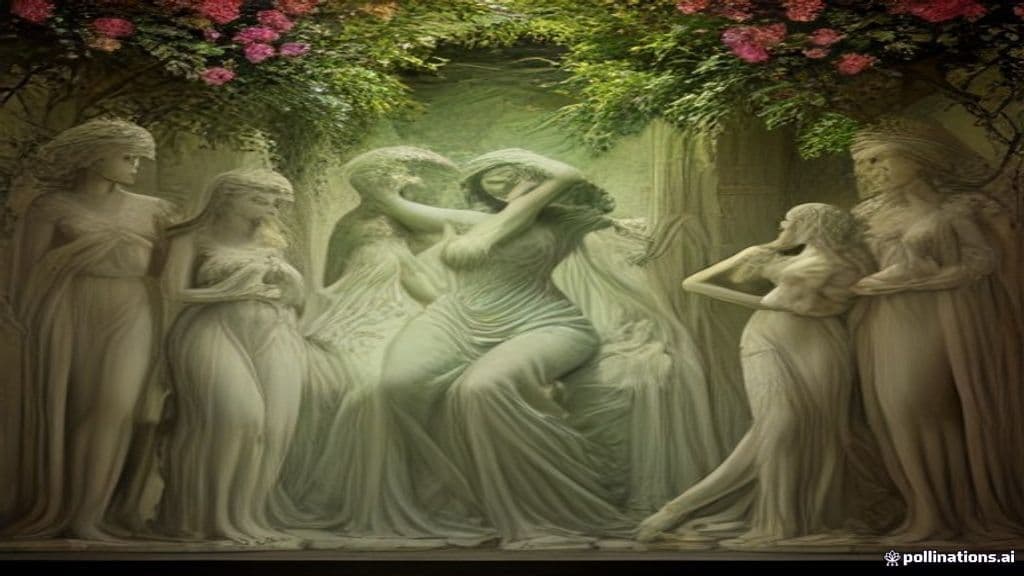
In Greek mythic accounts summarized in the sources, the golden-apple trees were a divine gift (Gaia's gift to Hera at her wedding) placed in Hera's western garden. Hera entrusted the care of that sacred orchard to a band of nymphs called the Hesperides—sometimes called Atlantides when they are described as daughters of Atlas—who were given the task of tending and guarding the trees. The narrative function of that origin is custodial and etiological: it explains the presence of a guarded, world-significant grove at the mythic western margin and sets the scene for later mythic episodes in which the apples and the garden play decisive roles (for example, the theft of an apple by Eris and Heracles' expedition to obtain apples as a labour). The sources emphasize variability in parentage, number, and names across authors, indicating the Hesperides function as a mobile mythic motif rather than a fixed clan.
Ancient literary and pictorial sources summarized in the provided material do not fix a single canonical visual type for the Hesperides. They are broadly represented as maidens or nymphs associated with a garden context—female figures depicted in vase-paintings and inscriptions engaged with plant life—and are described in literature as youthful attendants who tend Hera's orchard. Euripides and other ancient authors refer to them in terms that emphasize song and maidenhood (for example, 'minstrel maids'), and vase imagery places named female figures among fruit and trees. Because lists of names and the number of Hesperides vary between authors and artists, no standardized costume, attributes, or bodily description is attested in the supplied summaries beyond their role as garden-tending women and singers.
The Hesperides' primary role is custodial: they tend the sacred apple trees that bear golden fruit in Hera's garden, a locus of divine property and mythic consequence. A prominent attribute recorded in the sources is their gift for song—Euripides calls them 'minstrel maids' and emphasizes that they 'possess the power of sweet song'—so they are represented as singers in addition to gardeners. They function as guardians in a mediated sense: while they maintain and watch over the orchard, the trees are also protected by an independent guardian, the immortal, never‑sleeping, hundred‑headed dragon Ladon, whom Hera set to guard the apples. Mythically the garden is a source of potent objects (the golden apples) and events (Eris obtaining an apple that leads to the Trojan War; Heracles' labour to fetch the apples), which gives the Hesperides an indirect but significant role in world-shaping narratives. Sources also situate them at the liminal western horizon and associate them etymologically with evening and the evening star (Hesperos), linking their function to temporal and geographic liminality.

*Péh₂usōn (reconstructed)
Péh₂usōn is a hypothetical Proto‑Indo‑European pastoral guardian reconstructed by comparative scholars from parallels in Greek and Vedic traditions. Proposed as a Graeco‑Aryan ancestor‑figure, the reconstruction describes a protector of flocks, roads, and travellers rather than an attested historical cultic personality.
Aba (disambiguation / name-form)
Aba is a polyvalent name-form attested across many unrelated contexts (place names, personal names, animal names, and brief mythological listings). The provided sources do not support a single, coherent supernatural entity called "Aba" and offer no descriptive or ritual material for such a being.
Abarbarea
Abarbarea is a name attested in classical Greek and Roman sources for freshwater nymphs (naiads). The name appears for at least two individual mythic figures — a naiad wife of Bucolion and a naiad counted among ancestors of the Tyrians — and Hesychius records plural forms that may indicate the name was also used as a class-name (Abarbareai / Abarbalaiai).
Abas
Abas (Ancient Greek: Ἄβας, gen.: Ἄβαντος) is not a single mythic being but a recurring personal name borne by multiple mortals and minor mythic figures in Greek epic and genealogical traditions — kings, founders, seers, warriors, attendants, a centaur, and a youth transformed by a goddess. The name is glossed in the sources as 'guileless' or 'good-hearted' and appears across Argive, Theban, Trojan, Euboean, and other local cycles.
Abderus
Abderus (Ancient Greek: Ἄβδηρος, romanized Ábdēros) is a mortal heroic figure in Greek myth closely associated with Heracles, remembered as the youth left in charge of the Mares of Diomedes who was killed by them. He functions as an eponymous local/divine-hero ancestor for the city of Abdera and received funerary commemoration and athletic agones at his tomb.
Abomination of Desolation
An apocalyptic prophetic phrase originating in the Book of Daniel designating a profaning thing or act that renders the Jerusalem Temple cult desolate; later reused in the Synoptic Gospels as an eschatological sign prompting urgent flight. The term denotes ritual/cultic impurity (Hebrew shiqquts) and is variously interpreted as pagan offerings or altar, a foreign cult statue, or (in some New Testament readings) an acting agent.
Absyrtus
Absyrtus (Ancient Greek: Ἄψυρτος) is a Colchian prince in the Greek Argonautic cycle, son of King Aeëtes and brother or half-brother of Medea. He appears in variant traditions either as a companion taken by Medea during her flight with Jason and murdered/dismembered to delay pursuit, or as a pursuer sent by Aeëtes who is overtaken and slain by Jason; his death functions as a key narrative device in the escape from Colchis.
Acacallis
Acacallis (Ancient Greek: Ἀκακαλλίς; also Acalle) is a mythological princess of Crete in Greek tradition, daughter of King Minos and Pasiphae. She functions primarily as a dynastic and etiological figure: in varying accounts she is mother, by gods such as Hermes (Mercury) or Apollo, of eponymous or founder-figures like Cydon (founder of Cydonia), Miletus, or Lydon/ Lydus.
Acacus
Acacus (Ancient Greek: Ἄκακος) is, in Arcadian Greek tradition, a mortal eponymous founder-king of Acacesium and is remembered as the foster-father who reared the infant Hermes (Mercury) in that local tradition. He is presented in genealogies as a son of Lycaon and functions as a local ancestral/onomastic figure rather than a supernatural spirit.
Academus
Academus (Greek: Akádemos / Hekádemos) is an Attic hero-eponym tied to a sacred grove (Akademeia) on the Cephissus near Athens. In myth he revealed where Helen was hidden to the Dioskouroi, an act said to have saved the city, and the place bearing his name became a long-lived sacred precinct, later the site of Plato's Academy.
Acamas
Acamas (Ancient Greek: Ἀκάμας) is a personal name recurrent in ancient Greek narrative traditions applied to multiple human characters (warriors, princes, suitors), once to a Cyclops, and once as a hound's name. Rather than a single supernatural entity, bearers of the name appear episodically across the Trojan War, Theseid, and Theban cycles as mortal actors whose deeds intersect with gods and fate.
Acantha
Acantha (Ancient Greek: Ἀκάνθα, 'thorn') is a late or secondary mythological figure known from modern retellings as a nymph transformed into the acanthus plant. The tale that she scratched Apollo and was changed into a spiny-leaved plant is not attested in surviving classical corpora and appears to be a modern compilation or invention rather than a firmly documented ancient myth.
Community Record
- [1]Hesperides. Wikipedia contributors, 'Hesperides', Wikipedia, The Free Encyclopediawiki
- [2]Hesperides (Wikidata). Wikidata entry Q165938, 'Hesperides'other
- [3]Semion Krivenko-Adamov - Games of the Gods (album). Archive.org item 'Games of the Gods' (uses Hesperides as cultural reference)other
- [4]The graveyard of the Hesperides (novel entry). Archive.org item 'The graveyard of the Hesperides' (modern literary use)literary