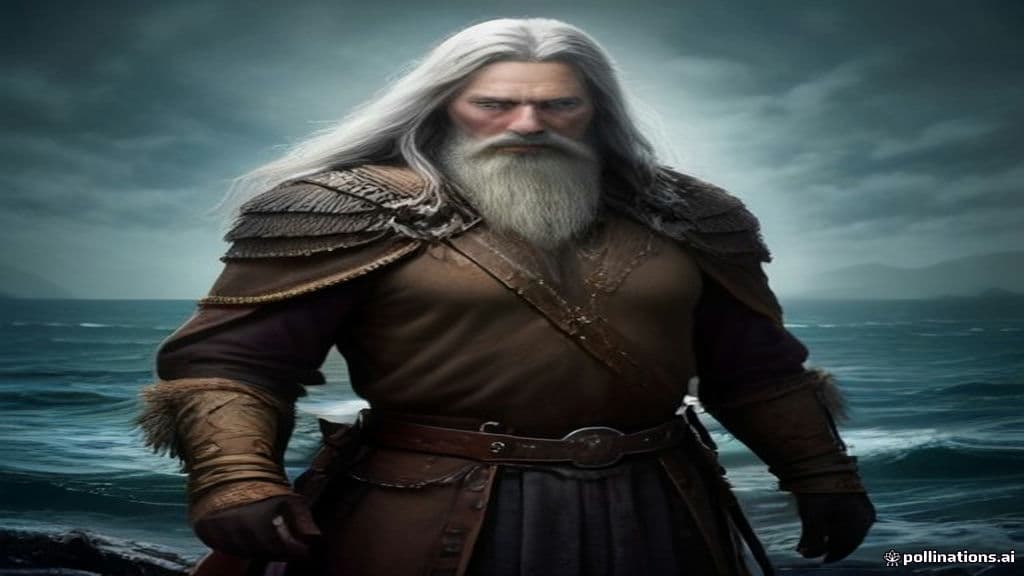
Horwendill is a legendary human (non-supernatural) in Norse folklore, from Jutland. Horwendill (also Horwendillus, Ørvendil) is a legendary Jutish chieftain/king attested in medieval Scandinavian tradition (not a spirit). The name is cognate with the mythic Germanic name-group (Aurvandill/Ēarendel/Aurendil) found in poetic myth, but in the cited sources Horwendill himself is presented as a mortal figure in saga-historical narratives (not a supernatural being).
In the saga-historical tradition preserved by Saxo Grammaticus (Gesta Danorum) Horwendillus/Horwendill is a Jutish chieftain or former king of Jutland who appears in dynastic and revenge-themed narratives. In Saxo's account and related summaries he becomes embroiled in inter-chieftain rivalry (notably with figures named Koller and Feng), is said in some retellings to have turned to piracy, and is murdered in the course of these political conflicts; his son Amleth (Amblothe) survives by feigning madness. Separately, the same name-root appears in Norse mythic-poetic material as Aurvandill (whose frozen toe is cast into the heavens by Thor as a star), indicating a widespread medieval Germanic name-tradition shared across Old Norse, Old English (Ēarendel), Old High German (Aurendil), Lombardic (Auriwandalo) and possibly Gothic (auzandil). The cited sources treat the Saxo Horwendillus material as legendary-historical narrative and the Aurvandill account as a distinct mythic-poetic episode linked by name-cognacy.
The cited sources portray Horwendill as a human chieftain/king rather than a supernatural form; no sustained supernatural physical description is given. Attested contextual details emphasize his status as a ruler or sea-roving leader (one summary notes he "turned to piracy"). The Aurvandill myth (a cognate name) contains a striking corporeal image — a frozen toe cast into the sky by Thor to become the star Aurvandils-tá — but that image belongs to the mythic Aurvandill strand and is not described as part of Saxo's Horwendillus portrayal.
Sources do not ascribe supernatural powers to Horwendill. His notable capabilities and behaviours are political and martial: leadership as a chieftain/king of Jutland, participation in naval engagements or piracy, and involvement in dynastic rivalry and blood-feuds. Narrative outcomes recorded in Saxo and summaries show him vulnerable to assassination and usurpation (killed by the jealous Feng or opposed by rivals such as King Koller), and as the father of Amleth he functions as a catalysing victim in a revenge-saga sequence. The only extraordinary motif linked to the name-group is the Aurvandill mythic episode (the frozen toe/star) which is part of a separate poetic-mythic tradition.
Weaknesses
- conditionpolitical rivalry and murder (killed by rival Feng / vulnerable to usurpation)
Wards
None recorded.

Aurvandill
Aurvandill is a figure attested in medieval Germanic onomastics and Norse narrative, most famously remembered in an Old Norse tale where Thor carries him across icy rivers and his frozen toe is cast into the sky as the star called Aurvandils-tá. Comparative linguistic study reconstructs a Common Germanic name associated with dawn or the morning star.

Amleth
Amleth (Old Norse: Amlóði; Latinized Amlethus) is a legendary medieval Scandinavian prince and saga-hero best known from Saxo Grammaticus' Gesta Danorum. He is a human protagonist whose story centers on feigned madness, cunning survival, exile to Britain, marriage, wealth-gathering, and eventual vengeance against his father's murderer; the tale later inspired the character of Shakespeare's Hamlet and numerous adaptations.
3-D Man
3-D Man is a Marvel Comics superhero identity associated with a 1950s-era origin in which the body of Chuck Chandler can materialize in three-dimensional existence when activated by his brother Hal via a pair of glasses. The mantle was later assumed by Delroy Garrett (formerly Triathlon) in modern continuity.
5 Ronin
5 Ronin is a 2011 Marvel Comics five-issue limited series that reimagines five Marvel superhero archetypes as rōnin (masterless samurai) in a fictionalized post‑Sekigahara feudal Japan. The work places Wolverine, Hulk, Punisher, Psylocke, and Deadpool analogues into period roles to explore displacement, revenge, and identity in an era of political upheaval.
A Elbereth Gilthoniel
An Elvish hymn in Sindarin addressed to Elbereth (Varda) from J. R. R. Tolkien's legendarium. Presented in The Lord of the Rings and later musical and dramatic adaptations, the hymn functions as devotional poetic language that evokes Elvish reverence for the star-kindler rather than an independent supernatural agent.
A.R.G.U.S.
A.R.G.U.S. is a fictional clandestine United States government agency in the DC Comics universe that investigates, contains, and manages superhuman, meta-human, and supernatural incidents and assets. Introduced in The New 52 continuity, it functions as an institutional actor providing intelligence, logistical support, covert task forces (notably Task Force X / the Suicide Squad), and a dedicated magic division across comics and media adaptations.
Abin Sur
Abin Sur is a fictional extraterrestrial Green Lantern from the planet Ungara in DC Comics. A former history professor turned Green Lantern of Space Sector 2814, he discovered and investigated a prophecy tied to the "Blackest Night," died wounded on Earth and chose Hal Jordan as his ring-successor, and was later reanimated as a Black Lantern in the Blackest Night storyline.
Abraun
Abraun is an attested name in German-language plant-legend scholarship (Der abraun, ein beitrag zur pflanzensagenkunde, 1916) and a short database entry (Wikidata) labels it as a spirit from German mythology. Surviving accessible documentation is extremely limited: the principal academic treatment is a 1916 contribution to pflanzensagenkunde (plant-saga studies), but the excerpts available here contain only bibliographic metadata and do not record tales, descriptions, or rituals.
Absolute Green Lantern (tradition)
A modern comic-book reinterpretation in DC's Absolute Universe in which a giant green lantern-shaped vessel appears above Evergreen, Nevada, generates an impenetrable green dome, judges townspeople and sends the judged into the Lantern to await further adjudication in OA (Omega‑Alpha). The story reframes Green Lantern mythos as cosmic/religious horror with an "Enlightenment Spectrum" of flames (Qard, Rao, Sur, Aur) stewarded by Oans such as Abin Sur.
Absorbing Man
A fictional Marvel Comics character (Carl "Crusher" Creel) whose body acquires the physical properties of materials or energies he touches. Debuting in Journey into Mystery #114 (March 1965), created by Stan Lee and Jack Kirby, he is presented as a mortal supervillain/occasional antihero who challenges heroes such as Thor, Hulk, Spider-Man, and the Avengers.
Ace West
Ace West (Wallace Daniel "Ace" West) is a contemporary American comic-book character in DC Comics continuity, a young speedster who channels the metaphysical Speed Force and occupies legacy-hero roles such as Kid Flash and Ace. Introduced in New 52-era stories as a biracial reinterpretation of Wally West and later retconned in DC Rebirth as a distinct Wallace West, son of Daniel West (Reverse-Flash), he appears across present-day and alternate/future timelines and participates in team and sacrifice narratives tied to the Speed Force.
Acheron
Acheron is a mythological river of the Ancient Greek Underworld, portrayed in classical literature as a boundary or entrance to Hades across which the dead are conveyed. It is also a real river in Epirus whose landscape and nearby cult sites (notably a Necromanteion) were mapped onto the literary river; later Western authors use Acheron metonymically for Hell or the infernal realm.
Achilles and Patroclus
A central heroic dyad in the Homeric Trojan War tradition: two mortal Greek warriors whose close bond—portrayed as deep companionship in the Iliad—drives key events of the epic when Patroclus' death provokes Achilles' rage, return to battle, and the slaying of Hector.
Acoetes
Acoetes is a proper name applied to multiple mortal figures in classical Greco‑Roman mythic narratives. Most famously, an Acoetes is a fisherman who recognizes and testifies to the divinity of Bacchus/Dionysus and recounts how blasphemous sailors were transformed into dolphins; other bearers of the name appear as a Trojan genealogical figure (father of Laocoön), an aged former squire of Evander, and a frightened soldier in Statius' Thebaid.
Community Record
- [1]Aurvandill. Wikipedia: Aurvandill (entry summarising Aurvandill/Aurendil/Ēarendel name-group and mythic toe-star episode)wiki
- [2]Feng (chieftain). Wikipedia: Feng (chieftain) (summary noting Feng killed Horwendill and took his wife; Amblothe/Amleth narrative)wiki
- [3]Princess Sela. Wikipedia: Princess Sela (summary referencing Horwendill as former King of Jutland who turned to piracy and conflict with King Koller)wiki
- [4]Wikidata: Horwendill (Q644262). Wikidata entry for Horwendillwiki
- [5]Saxo Grammaticus, Gesta Danorum (online editions). The Danish History by Saxo Grammaticus (Gesta Danorum) — primary saga-historical source for Horwendillus as father of Amlethliterary
- [6]The Danish History, Books I-IX. Full-text archive edition of Saxo's Danish history (relevant saga-historical material)literary
- [7]Mystery Monday: Orendil | Dictionary of Medieval Names from European Sources. Dictionary of Medieval Names entry discussing name-variants and medieval attestations (Aurvandill/Ēarendel/Aurendil etc.)other
- [8]The Spookiest Ghosts of World Literature (blog). Modern popular summary noting reception history linking Saxo's Horwendillus to later Hamlet tradition (contextual reception; not a primary source)other