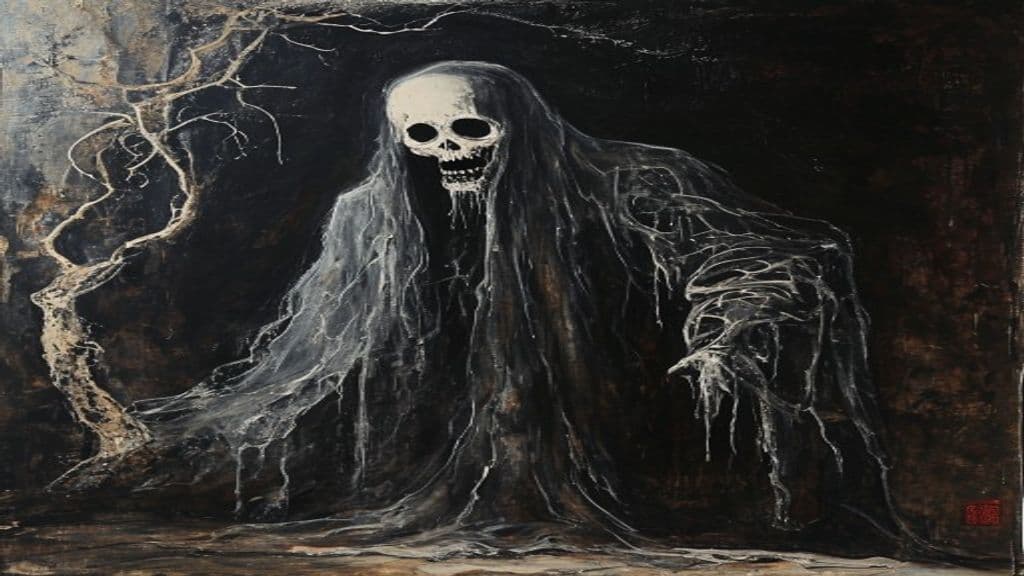
The hungry-ghost concept derives from the Buddhist Sanskrit term preta and is elaborated in Indian and Chinese Buddhist literature (e.g., Avadānaśataka, Huayen Sutra). Sources associate rebirth as a hungry ghost with specific moral causes in a prior life — notably greed/avarice (mātsarya), denying sustenance to others (including monks), killing, stealing, sexual misconduct and other malign or mean deeds. Some Taoist and popular accounts also link violent or unhappy deaths and the neglect or desertion of ancestors to the emergence of hungry ghosts.
Traditional Buddhist and Chinese imagery commonly depicts hungry ghosts as beings suffering from extreme hunger: small mouths and throats paired with bloated bellies or distended stomachs and thin necks that prevent them from consuming food, imagery used to symbolize insatiable craving and frustration. Sources emphasize their psychological/emotional condition (ever-discontent, anguished, driven by animalistic needs) and note variants in imaginings — some traditions place them in the bowels of the earth, others depict them as living unnoticed among humans — rather than a single standardized corporeal form.
Hungry ghosts are described chiefly by their persistent, unfulfilled craving and compulsive seeking of nourishment; this condition is the direct expression of karmic consequences rather than a set of aggressive supernatural powers. Traditional ritual practice assumes that communal offerings (food) and presentation of Dharma (Buddhist teachings and precepts) can be summoned and given to egui to relieve their suffering and, by ritual efficacy and merit-transfer, improve their state. Legends in Avadānaśataka and related texts describe how specific unethical behaviors in life produced the hungry-ghost condition.
Acala
Acala (Sanskrit: अचल, 'The Immovable') is a wrathful protective deity (dharmapala) in Vajrayāna and East Asian esoteric Buddhism, classed among the Wisdom Kings (Vidyārāja). He functions as a ritual focus for visualization and mantra practice intended to remove obstacles and bind or destroy hostile forces.
Acalanātha (Acala / Achala)
Acalanātha (also Acala or Achala) is a wrathful deity and dharmapāla — a protector of the Dharma — prominent in Vajrayana and East Asian Mahayana Buddhist contexts. Presented as a fierce, non‑human or semi‑divine protector-figure, Acalanātha functions to defend the teaching and practitioners by removing obstacles and confronting threats to the transmission and practice of Buddhism.
Agni
Agni is the Vedic personification of fire in Hindu tradition: a sacred, mediating principle that manifests as terrestrial fire, atmospheric lightning, and celestial sun, and that receives and conveys sacrificial offerings. Prominent in the Rigvedic corpus, Agni functions as sanctifier, witness of rites of passage, and a transformational inner principle in later Upanishadic literature.
Aizen Myō-ō (Rāgarāja)
Aizen Myō-ō corresponds to the deity Rāgarāja, a wrathful/transformation-oriented figure venerated in Esoteric and Vajrayāna Buddhist traditions. The figure is especially revered in Chinese Esoteric Buddhism in Chinese communities and in the Japanese Esoteric schools Shingon and Tendai.
Akhu Tönpa
A Tibetan trickster figure, sent by Chenrezig to teach the art of being shrewd and witty, while championing the common man against social hierarchies. (Note: - Power tier should be Lesser or Minor Spirit, not Ancient, as it's more aligned with local spirit level of trickster figures. - The ability to outwit those in positions of power suggests Greater or P)
Akshobhya
Akshobhya is a transcendent buddha of Mahāyāna and Vajrayāna Buddhism, one of the Five Wisdom (Dhyāni) Buddhas. He personifies 'mirror knowledge' (ādarśa-jñāna), is conventionally placed in the East, and is lord of the eastern Pure Land Abhirati; in esoteric texts he is associated with the eastern Vajra division and invoked in mantra/mandala ritual contexts.
Akuma
Akuma (悪魔/あくま) in Japanese sources is an evil spirit, devil, or demon associated with misfortune and mental disturbance. The term appears in Buddhist texts and Heian-period literature and was later used to translate the Christian figure of Satan, as well as the Buddhist Mara.
Amanojaku
Amanojaku (天邪鬼 / あまのじゃく) is a Japanese yōkai-type being portrayed as a contrarian, heart-reading trickster. Treated in different contexts as a small ogre (ko-oni), a wicked demon (jaki) in Buddhist iconography, and a folkloric spirit that provokes human vice, it appears across regional tales with variable roles from malicious kidnapper to household oddity.
Amida Nyorai
Amida Nyorai (Amitābha / Amitāyus) is a principal Mahayana Buddha venerated across East Asia as the embodiment of Infinite Light and Infinite Life who presides over a Western Pure Land and is invoked as the savior who receives the dying into rebirth there.
Amitābha
Amitābha is a central celestial Buddha of Mahayana Buddhism who presides over the western Pure Land called Sukhāvatī. Devotional practices invoking his 'measureless' light and life (nianfo/nembutsu) are presented in Pure Land traditions as a path by which beings may be reborn in his buddhafield and quickly attain Buddhahood.
Amitābha Buddha
Amitābha is a principal Mahayana Buddha who presides over the Western Pure Land (the Land of Ultimate Bliss). Devotional practices—most centrally recitation of his name and chanting of Pure Land sutras—are presented in sources as the means by which Amitābha welcomes practitioners for rebirth in his hindrance-free realm.
Amoghapāśa
Amoghapāśa is recorded in the supplied sources as a named manifestation or form of the bodhisattva Avalokiteśvara/Lokeśvara attested in Mahāyāna and Vajrayāna contexts. The evidence in the provided material is archival and bibliographic (sūtra/dhāraṇī/maṇḍala filenames and database entries) rather than descriptive narrative or doctrinal exposition.
Community Record
- [1]List of supernatural beings in Chinese folklore. Wikipedia. "List of supernatural beings in Chinese folklore." (entry includes 'hungry ghost (e.g., E gui)').wiki
- [2]Dealing with Childbirth in Medieval Chinese Buddhism: Discourses and Practices. Hsin-Yi Lin, excerpt noting medieval Buddhist monks' ritual involvement in reproduction (provided excerpt).academic
- [3]Archive: github.com-Lissy93-awesome-privacy_-_2022-07-29_04-34-08. Archive collection included in supplied materials (no direct hungry-ghost content in excerpts).other
- [4]Archive: github.com-Lissy93-awesome-privacy_-_2022-07-27_17-53-37. Archive collection included in supplied materials (no direct hungry-ghost content in excerpts).other
- [5]Archive: github.com-Lissy93-awesome-privacy_-_2022-07-26_19-35-39. Archive collection included in supplied materials (no direct hungry-ghost content in excerpts).other
- [6]The Truth about spontaneous Chi Kung ( Jinns / Demonic Possession ). Website included in supplied materials (no direct hungry-ghost content in excerpts).other
- [7]Ogres and their maces: Images of Oni from Onmyodo doctrines and medieval traditions. Essay on Japanese oni included in supplied materials (no direct connection to Chinese hungry ghosts in provided excerpts).other
- [8]The electronic Journal of East and Central Asian Religions (issue download). Journal issue included in supplied materials (no direct hungry-ghost content in provided excerpts).academic
- [9]Various web archives and pages provided in source list. Additional URLs listed among provided materials; none supply further details about hungry ghosts in the provided excerpts.other
- [10]Hungry ghost. Wikipedia: 'A hungry ghost in Buddhism and Chinese traditional religion is a being who is driven by intense emotional needs in an animalistic way.'; entries on egui, preta, rituals, Avadānaśataka, Huayen Sutra.wiki
- [11]Wikidata: Hungry Ghost. Wikidata entry for Hungry Ghost (linked data record).other