
Accounts vary by community. In several Lakota strands Iktómi appears among the earliest divine genealogies: one tradition names him as the first-born son of Inyan (the Rock), while some Oglala and other accounts present Iktómi as a later or degenerate manifestation of Ksa (the spirit or god of wisdom) after a sequence of mimicry and confusion involving figures called Gnaski/Ksapela. These variant narratives place Iktómi among primordial beings who shape language, stories and social technologies rather than as a single unified origin across all sources.
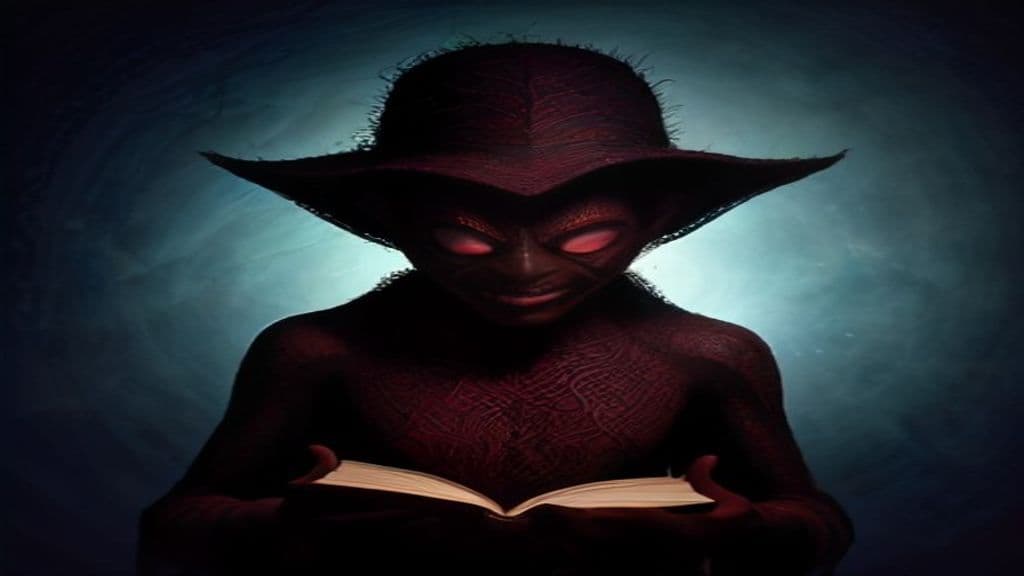
Iktómi's primary form is that of a spider; many stories explicitly describe his appearance as a spider. He is also a shapeshifter and is said to take human form on occasion; when described as human he is reported to wear red, yellow and white paint with black rings around his eyes. Narrative descriptions attribute spider-associated traits to him in stories (weaving, strings, puppetry) though sources indicate these are motifs in tales rather than a fixed physical trait of every human guise.
Stories portray Iktómi as a trickster-teacher who invents or transmits cultural goods (stories, names, games, and language in some strands) and as a being whose cunning both instructs and misleads. He is a shapeshifter, can use strings to control humans like puppets according to tale motifs, and in some accounts is said to make potions that can change gods or gain control over people. He alternately aids people with protective knowledge and brings harm; many tales emphasize that his intricate schemes often backfire, underlining his ambivalent moral valence.
Weaknesses
- conditionschemes often backfire
- conditionavoidance of his gaze (cultural precaution)
Wards
- othercaution/avoidance of his gaze (cultural precaution)
- othertransmission of trickster tales and moral teaching (social-protective practice)
Aba (disambiguation / name-form)
Aba is a polyvalent name-form attested across many unrelated contexts (place names, personal names, animal names, and brief mythological listings). The provided sources do not support a single, coherent supernatural entity called "Aba" and offer no descriptive or ritual material for such a being.
Angak (Angak'china)
Angak, or Angak'china, is a male Hopi kachina spirit represented both by spirit dancers in village ceremonies and by carved kachina dolls. He is a rain‑bringing, fertility, healing, and protective figure whose songs and slow dances are intended to bring rain and flowers to Hopi villages.
Anog Ite
In Lakota mythology, Anog Ite is a complex entity associated with emotional pain and chaos. She is punished for attempting to disrupt balance. (Note: 1. Power tier should be revised based on the entity's abilities described in the source material (Primordial=cosmic, Ancient=deity-level, Greater=powerful regional, Lesser=local spirit, Minor Spirit=w)
Canotila
Canotila (Lakota: čanotila) are small tree‑dwelling forest spirits in Lakota (Sioux) tradition, described as little tree dwellers who function as messengers from the spirit world and are reported to appear to people in dreams.
Devils Tower (Lakota Tradition)
A spiritual site with significant cultural and historical importance to the Lakota people, considered a 'bear lodge' for vision quests. (Note: * Power tier: should be Primordial (cosmic in scope), as it's a significant and culturally important site for the Lakota people. * Summary: while accurate, it could be more detailed to reflect the cul)
Ghost Shirt (Lakota Tradition)
A spiritualized object imbued with powers to protect its wearer from harm or possession by malevolent spirits. (Note: 1. Power tier: Primordial (given its association with spiritual visions from the founder, it's reasonable to assume a higher power level) 2. Abilities: The source material doesn't explicitly mention p)
Gitche Manitou
A term from Algonquian-language traditions referring to the 'Great Spirit' or supreme spiritual principle; used both for a highest or collective spiritual force that underlies many individual spirits (manitous) and as a name applied to a creator or giver of life in Anishinaabe contexts.
Great Spirit
A supreme, often-immanent life force or creator-being present in the traditional spiritual beliefs of many Indigenous peoples of what is today Canada and the United States; concepts and names vary by nation and may refer to a single creator, a pervasive sacred power, or a collective of mysterious sacred forces.
Happy Hunting Ground (Lakota Tradition)
In the Lakota tradition, the Happy Hunting Ground is a peaceful afterlife realm where the spirits of the deceased live out their lives in happiness and abundance. (Note: - Power tier: Primordial (not Minor Spirit, as it's a cosmic realm) - Summary: Inaccurate - the article describes the Happy Hunting Ground as a peaceful afterlife realm, but doesn't mention its abunda)
Heyókȟa (Heyoka)
A sacred contrarian figure and ceremonial role in Lakota and Dakota (Sioux) traditions, the heyókȟa functions as a sanctioned 'sacred clown' whose deliberate inversion of social norms, satire, and ritualized shame help heal emotional pain and test communal values. Cosmologically the role is tied to visions of the thunder beings (Wakíŋyaŋ) and is sometimes represented in myth as a thunder or lightning spirit.
Horned Serpent
A recurring mythic serpent-being attested across multiple cultures, typically depicted as a large horned snake associated with water, storms, fertility/regeneration, and sacred crystalline or iridescent bodily accoutrements that serve as ritual power-objects.
Iya
A malevolent storm-monster from Lakota mythology, consuming villages and living beings. (Note: 1. Power tier: Downgrade to Ancient (deity-level) - Iya's abilities are not primordial or cosmic in scale. 2. Origin story: Remove "born from the same cosmic energies as his brother Iktomi" - there is)
Community Record
- [1]Iktomi (Wikipedia). Wikipedia: "Iktomi" entry (summary of myths, appearance, abilities, interpretations, and cultural notes).wiki
- [2]Iktomi (Wikidata Q767795). Wikidata entry Q767795 (concise descriptor).wiki
- [3]Iktomi and the boulder : a Plains Indian story (Paul Goble collection). Archive.org: Paul Goble retellings and Iktomi stories (used to illustrate narrative motifs and child-oriented retellings).folk
- [4]Legend of the Dream Catcher (Lakota vision excerpt). Legend of the Dream Catcher (excerpt describing a vision in which Iktomi appears to a spiritual leader; linked to origin of dreamcatcher story).folk
- [5]Iktomi references in archive and secondary lists. Archive: American local color writing and related secondary references cited in the research notes (contextual corroboration).other