
Sources present the Horned Serpent not as a single origin myth but as a recurring mythic figure embedded in local cosmologies. In North American traditions it appears as an ancient aquatic or underworld-associated being that figures in ritual life and in stories of encounter (Cherokee Uktena, Sioux Unhcegila, Muscogee estakwvnayv). In Eurasian/Celtic contexts the ram‑horned serpent appears as a cult image paired with antlered nature deities (e.g., Cernunnos) and is interpreted as a symbol of fertility and regeneration. The provided materials do not contain a single unified origin account; rather they show the motif recurring as an indigenous spirit-being and as a ritual/cult image across separate cultural histories.
Generally described as a large serpent with horns (horn forms vary from stag-like antlers to ram-like horns). Muscogee descriptions emphasize an underwater serpent covered with iridescent, crystalline scales and a single large forehead crystal; Cherokee Uktena is described (Mooney) as as large as a tree trunk, with horns, a bright blazing crest or diamond on its forehead (Ulun'suti), scales that glow like sparks of fire, and rings or spots of color along its length. Eurasian iconography shows ram-horned serpents often paired with horned/nature gods in stylized art.
Across sources the Horned Serpent is associated with water, storms, thunder and lightning, and with fertility/regenerative power. Muscogee accounts attribute iridescent/crystalline scales and a forehead crystal prized for divination and ritual power; the horns (chitto gab-by) are reported as used in medicine. The Muscogee informant Jackson Lewis describes a benign form that exerts a 'magnetic power over game.' Cherokee Uktena traditions (Mooney) attribute deadly properties to the being: a pestilential breath that can kill, and the peril that merely seeing the sleeping Uktena brings death to a hunter's family; the Uktena’s life is said to be accessible only by a precise wound (the seventh spot from the head). Sioux Unhcegila traditions present reptilian water monsters of ancient times that were destroyed by Thunderbirds, indicating cosmological interactions among powerful beings. Iconographic contexts link the serpent to concentrated sacred potency rather than ordinary zoology.
Weaknesses
- conditionSeventh spot from the head (Cherokee/Uktena vulnerability)
- conditionDestruction by Thunderbirds (Sioux/Unhcegila cosmological defeat)
Wards
- ritualYuchi effigy-making (deerhide effigies painted blue with antlers painted yellow)
- ritualYuchi Big Turtle Dance (ceremony honoring the Horned Serpent's spirit)
- otherUse of material parts by specialists (horns 'chitto gab-by' used in medicine; scales/crystals kept as divinatory/medicinal objects)

Unk Cekula
Unk Cekula is a serpentoid supernatural creature in Lakota mythology identified as responsible for many unexplained disappearances and deaths; a male counterpart is named Unk Tehi. Sources classify the figure as a mythological serpent within Lakota narrative material and note a possible relation to broader North American 'horned serpent' traditions.
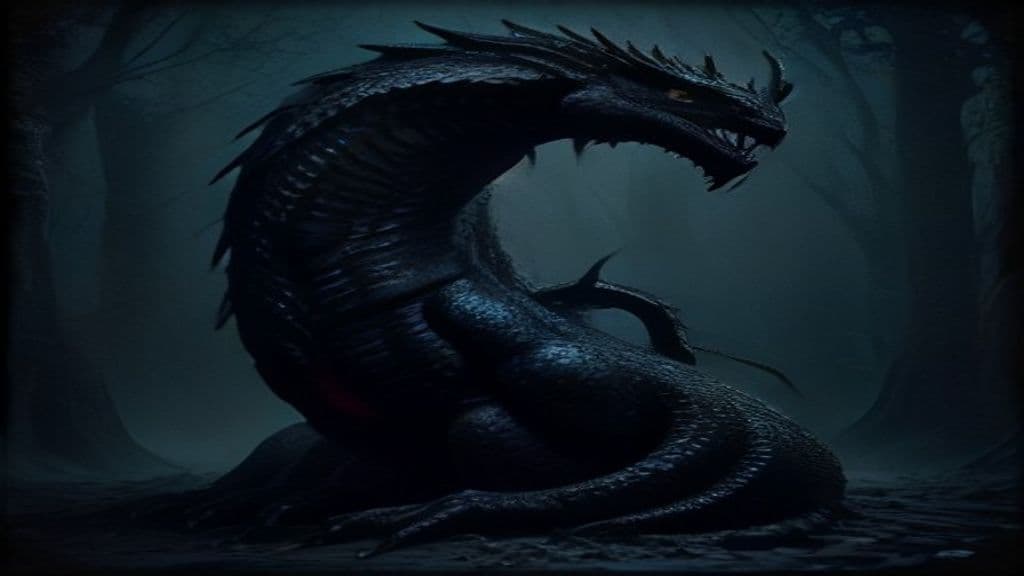
Níðhöggr
The corpse-gnawing dragon coiled around the roots of Yggdrasil, ceaselessly chewing the World Tree — and destined to survive Ragnarök and carry the dead on its wings.

Cerberus
The three-headed hound of Hades, guardian of the underworld's gates — welcoming the dead in but allowing no shade to leave and no living mortal to enter uninvited.
*Perkʷūnos
*Perkʷūnos is the reconstructed Proto-Indo-European thunder‑god hypothesized by comparative linguistics and mythology. Scholarly reconstructions portray him as a storm or thunder figure associated with fructifying rain and as the combatant who fights a multi‑headed water‑serpent to release life‑giving waters; no direct attestations from the Proto‑Indo‑European period survive and the figure is inferred from later Indo‑European traditions.
*Péh₂usōn (reconstructed)
Péh₂usōn is a hypothetical Proto‑Indo‑European pastoral guardian reconstructed by comparative scholars from parallels in Greek and Vedic traditions. Proposed as a Graeco‑Aryan ancestor‑figure, the reconstruction describes a protector of flocks, roads, and travellers rather than an attested historical cultic personality.
57 Mnemosyne
57 Mnemosyne is a large main-belt asteroid (S-type) discovered in 1859 and named after the Greek Titaness Mnemosyne. It is a non-sentient astronomical body studied for its orbital and rotational properties and has been used in dynamical measurements related to Jupiter.
Aba (disambiguation / name-form)
Aba is a polyvalent name-form attested across many unrelated contexts (place names, personal names, animal names, and brief mythological listings). The provided sources do not support a single, coherent supernatural entity called "Aba" and offer no descriptive or ritual material for such a being.
Abaddon
In Hebrew scripture Abaddon is primarily a noun meaning 'destruction' or a section/condition of the underworld paired with Sheol; in the New Testament Book of Revelation Abaddon is personified as an angelic figure (Greek Apollyon) described as the king of an army of locusts released from the abyss during the apocalypse.
Aban Yasht
The Aban Yasht is a hymn from the Persian tradition that praises Anahita, a goddess associated with water, fertility, and wisdom. It consists of 132 stanzas and is part of the 21 Yashts collection. (Note: - Power tier should be "Primordial" or possibly "Cosmic", given that it's a hymn of great spiritual significance and associated with a goddess. - The article incorrectly states that Anahita is associa)
Abath
No corroborated folkloric entity named "Abath" is documented in the provided sources. The string appears in the supplied material only as a surname/personal name in Aruban/Dutch-Caribbean archival records and as an unrelated taxonomic or encyclopedic hit; no mythic attributes, origin stories, rituals, or apotropaic practices for an entity called Abath are present in the documents reviewed.
Abatur
Abatur is an uthra (celestial emanation) in Mandaeism described as the 'father of the Uthras' and called the Ancient (ʿattīqā). He resides on the boundary between the World of Light and lower regions, functions as a judge who weighs souls (Abatur Muzania), and supplies instructions and materials to the demiurgic uthra Ptahil in accounts from the Diwan (Scroll) of Abatur.
Abatwa (Twa / Batwa)
Abatwa (also recorded as Twa, Batwa, Mutwa; singular forms Barhwa or Murhwa in some transcriptions) are indigenous hunter‑gatherer peoples of the Great Lakes region of Central Africa, historically identified as some of the earliest inhabitants of the area. The available sources treat them as human ethnic groups whose livelihoods, lands, and populations have been severely affected by conservation policies and modern violence.
Abellio
Abellio is a theonym attested in Roman‑period inscriptions from the Comminges area of the Pyrenees and reported as worshipped in the Garonne Valley of ancient Gallia Aquitania. Surviving evidence is limited to a small number of inscriptions; scholars have variously hypothesized solar or arboreal associations and compared the name to forms of Apollo or to Celtic Belenus, but the deity's precise role in local cosmology remains uncertain.
Abraham
Abraham (originally Abram) is the foundational patriarchal ancestor in the Hebrew Bible whose life establishes a covenantal relationship between his family/people and God. He functions as an exemplar of faith, the progenitor of promised descendants, and a narrative anchor for claims of land, blessing, and communal identity in later religious traditions.
Abraun
Abraun is an attested name in German-language plant-legend scholarship (Der abraun, ein beitrag zur pflanzensagenkunde, 1916) and a short database entry (Wikidata) labels it as a spirit from German mythology. Surviving accessible documentation is extremely limited: the principal academic treatment is a 1916 contribution to pflanzensagenkunde (plant-saga studies), but the excerpts available here contain only bibliographic metadata and do not record tales, descriptions, or rituals.
Community Record
- [1]Horned Serpent - Wikipedia. Wikipedia contributors, 'Horned Serpent', Wikipedia, The Free Encyclopedia.wiki
- [2]The Horned Serpent of Tepozán and the agricultural cults in the rock art of Aguascalientes. Arte, Imagen y Sonido: 'The Horned Serpent of Tepozán and the agricultural cults in the rock art of Aguascalientes' (abstract/article).academic
- [3]Horned Serpents and Petroglyphs: Lake Monsters in Michigan. Fate Magazine blog post on horned-serpent petroglyph motifs.other
- [4]Raised by Wolves: The Horned Serpent - Nick Bythrow. Substack essay 'Raised by Wolves: The Horned Serpent' by Nick Bythrow (popular synthesis/commentary).other
- [5]Old European culture: Horned serpent. Blog post discussing ram-horned serpent imagery in Old European/Celtic contexts.other
- [6]Archive: Merciless Onslaught for January 10, 2023. Archive.org item included among supplied materials (used only to note motif's presence in popular culture references).other
- [7]Archive: Belstler Hans Du Stehst Im Volk 1943 54 S.. Archive.org item included among supplied materials (not ethnographic on the serpent; cited as part of supplied links).other
- [8]Archive: Bible side-lights from the mound of Gezer. Archive.org item included among supplied materials (not ethnographic on the serpent; cited as part of supplied links).other
- [9]Additional web references and blog posts supplied with dataset. Various supplied web links and blog posts referenced in research notes (used to contextualize motif distribution; primary ethnographic claims are drawn from the Wikipedia summary and cited Mooney/Yuchi/Muscogee/Sioux descriptions therein).other