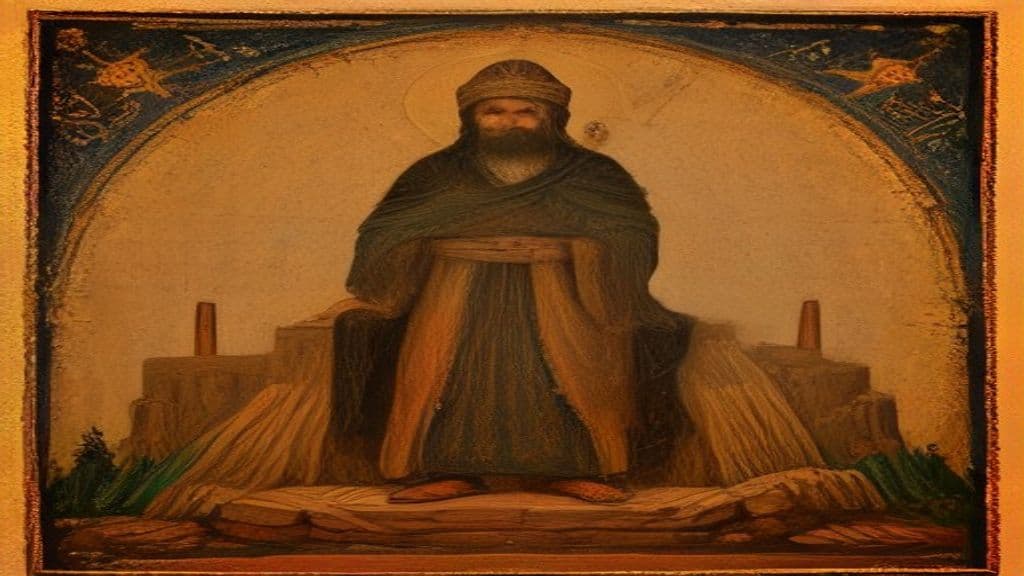
The narrative cycle centered on Abram/Abraham (Genesis 11:27–Genesis 25:11) presents him as the son of Terah who departs Haran at age 75 in response to God's call to go to a land that will be given to his descendants. Over a series of episodes the text relates God's promises of progeny, land, and blessing to Abram and traces the formation of a covenantal lineage through his family (including Sarah/Sarai, Lot, Ishmael, and Isaac). Modern scholarly summaries in the sources describe these patriarchal narratives as literary constructions used to organize promissory theology and communal identity.
The supplied sources do not provide physical description or iconographic detail of Abraham. The biblical accounts emphasized in the sources concentrate on his actions, age at key moments (for example, departing Haran at 75), family relations, ritual acts (such as building altars), and legal-ritual deeds (such as purchasing a burial site) rather than on bodily or visual features.
The sources portray Abraham not as a supernatural being but as a human patriarch whose significance is covenantal and exemplary. Scriptural episodes summarized in the sources record that he responds to a divine summons (leaves his father's house), establishes rites of worship by building altars at Shechem, between Bethel and Ai, and at Mamre, manages a large household and herds, negotiates amicably with Lot to separate their camps, sojourns in Egypt during famine (including an episode where he instructs Sarai to present herself as his sister and God intervenes), and purchases the Cave of the Patriarchs in Hebron to bury Sarah, thereby establishing a lawful ancestral burial place.
*Perkʷūnos
*Perkʷūnos is the reconstructed Proto-Indo-European thunder‑god hypothesized by comparative linguistics and mythology. Scholarly reconstructions portray him as a storm or thunder figure associated with fructifying rain and as the combatant who fights a multi‑headed water‑serpent to release life‑giving waters; no direct attestations from the Proto‑Indo‑European period survive and the figure is inferred from later Indo‑European traditions.
*Péh₂usōn (reconstructed)
Péh₂usōn is a hypothetical Proto‑Indo‑European pastoral guardian reconstructed by comparative scholars from parallels in Greek and Vedic traditions. Proposed as a Graeco‑Aryan ancestor‑figure, the reconstruction describes a protector of flocks, roads, and travellers rather than an attested historical cultic personality.
57 Mnemosyne
57 Mnemosyne is a large main-belt asteroid (S-type) discovered in 1859 and named after the Greek Titaness Mnemosyne. It is a non-sentient astronomical body studied for its orbital and rotational properties and has been used in dynamical measurements related to Jupiter.
Aaron
Aaron is a central human figure in Israelite sacred literature: the elder brother of Moses, the first high priest (progenitor of the Aaronide priesthood), and a spokesman/prophet who mediates between Israel and God in Exodus–Deuteronomy narratives. His role in the texts establishes hereditary priestly authority, ritual functions (sacrifices, blessing, use of Urim and Thummim), and institutional norms for Israelite cultic life.
Abaddon
In Hebrew scripture Abaddon is primarily a noun meaning 'destruction' or a section/condition of the underworld paired with Sheol; in the New Testament Book of Revelation Abaddon is personified as an angelic figure (Greek Apollyon) described as the king of an army of locusts released from the abyss during the apocalypse.
Abadir
Abadir is a polysemous name attested in distinct cultural contexts: a legendary founding saint and clan ancestor in eastern Ethiopia (Sheikh Abadir Umar Al‑Rida / Aw Abadir), a term applied to cone‑shaped cult stones in Phoenician religious description, and a personal name of a martyr (Abadir/Apater) in the Coptic Synaxarium. The attestations are independent usages of the same name rather than a single supernatural being.
Abadiu of Antinoe
Abadiu of Antinoe was a fourth‑century bishop of Antinoe (Antinoopolis, in Roman Egypt) commemorated as a martyr and saint in the Coptic Orthodox Church, with a feast day on 26 December. Sources record that he was killed during a theological dispute with Arian opponents and reference him in collections of Egyptian martyrs.
Abagtha
Abagtha (Hebrew: אבגתא, ’Ǎḇaḡṯā) is a named human court official in the Hebrew Bible’s Book of Esther, listed among seven chamberlains who ministered before King Ahasuerus and were commanded to bring Queen Vashti before the king. He is attested only in Esther 1:10 and is presented as an institutional palace attendant rather than a supernatural being.
Aban Yasht
The Aban Yasht is a hymn from the Persian tradition that praises Anahita, a goddess associated with water, fertility, and wisdom. It consists of 132 stanzas and is part of the 21 Yashts collection. (Note: - Power tier should be "Primordial" or possibly "Cosmic", given that it's a hymn of great spiritual significance and associated with a goddess. - The article incorrectly states that Anahita is associa)
Abanoub
Abanoub is a 4th‑century Egyptian Christian child martyr venerated in the Coptic tradition. Remembered for his public confession of Christ, miraculous healings associated with his passion, and the translation and veneration of his relics, his feast is observed on July 31 (Epip 24) and his cult centers include Nehisa and Samanoud.
Abaskhiron the Soldier
A Coptic Orthodox martyr venerated for refusing imperial idolatry during the Diocletian persecution; reputedly healed by the Archangel Michael, preserved in monastery relics, and commemorated on 14 June (7 Paoni).
Abath
No corroborated folkloric entity named "Abath" is documented in the provided sources. The string appears in the supplied material only as a surname/personal name in Aruban/Dutch-Caribbean archival records and as an unrelated taxonomic or encyclopedic hit; no mythic attributes, origin stories, rituals, or apotropaic practices for an entity called Abath are present in the documents reviewed.
Community Record
- [1]Abraham — Wikipedia. Wikipedia contributors, 'Abraham', Wikipedia, The Free Encyclopedia.wiki
- [2]Wikidata: Abraham. Wikidata entry Q17997608 'Abraham'.other
- [3]Sermon archive: 7.23.17.sermondone. Archive sermon referencing Isaac as 'the promised child of Abraham'.other
- [4]Podcast archive: Episode 20: Beyond Wynn. Podcast episode containing incidental modern cultural reference to the name Abraham.other