
Iphitus is presented in Greek mythographic tradition as a son of King Eurytus of Oechalia and brother to Iole. Some genealogical accounts pair him with mothers named in differing traditions (e.g., Antiope/Antioche in some lists), and certain catalogues of heroic figures include Iphitus among the Argonauts. In the sequence of narratives connected to Heracles, a dispute over Iole and stolen cattle leads to a confrontation: Iphitus seeks or defends against Heracles (in literary and visual accounts), and during an episode of Heracles' madness or uncontrollable rage Heracles kills Iphitus. This killing functions in the cycle as the precipitating offense that obliges Heracles to seek formal absolution — according to mythographic summaries an oracle prescribes that Heracles sell himself into servitude for three years and give the proceeds to Eurytus, after which he is purchased by Omphale. Variants of the tale appear across epic, tragic, and later mythographic sources, but the core elements — Iphitus' kinship to Eurytus and Iole, his death at Heracles' hands, and the consequent demand for purification or atonement — are constant in the supplied materials.
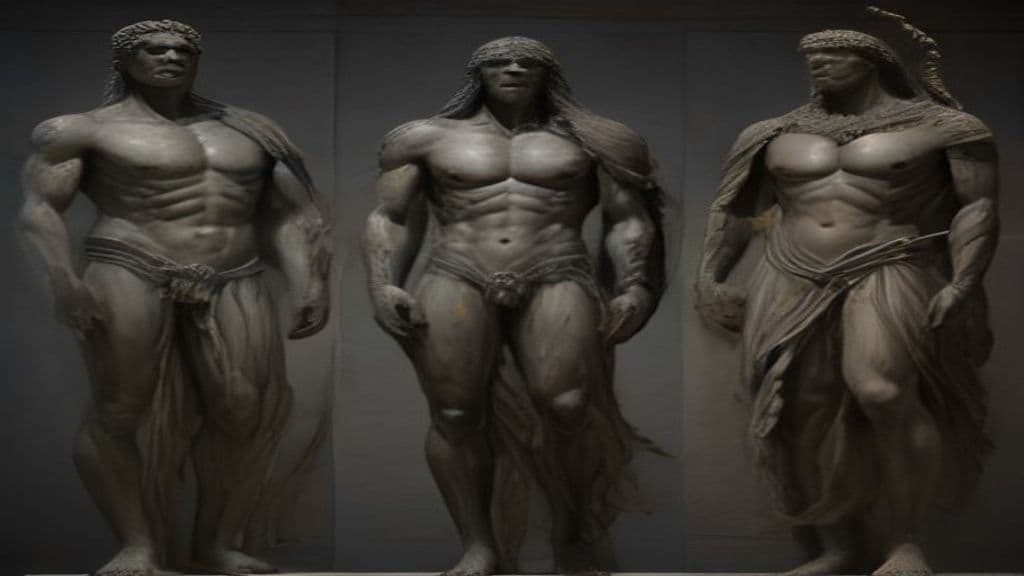
Ancient sources and the supplied materials give no detailed physical description of Iphitus (no measurements, clothing specifics, or unique marks). He is identified by social role and kinship — an Oechalian prince, son of Eurytus and brother of Iole — and in narrative and iconographic traditions appears as a named noble of the heroic generation rather than as an individually fleshed-out physical type.
No supernatural powers or magical abilities are attested for Iphitus in the provided sources. He is portrayed as a mortal member of the heroic-age nobility; some catalogues list him among the Argonauts, which situates him within the cohort of heroic companions but does not ascribe explicit extraordinary faculties. Narratively he acts as defender or seeker (sources note he 'defended [Heracles] and went in search of [his] cattle' in some visual-tradition descriptions) and chiefly functions as a named victim whose murder has legal, social, and ritual consequences within the mythic economy.
Weaknesses
- conditionmortal vulnerability
Wards
None recorded.

Heracles
Heracles is the greatest hero of Greek myth whose career bridges mortal hero-cult and full divinization. Celebrated for his Twelve Labours, martial prowess, and travels between the mortal world, the underworld, and Olympus, he functioned as a civic patron, ancestor of royal lines (the Heracleidae), and object of cult that treated him both as chthonic hero and as god.
Argonauts
A band of human heroes in Greek myth who sailed aboard the ship Argo under Jason to Colchis to retrieve the Golden Fleece. Their identity is defined by membership in the celebrated voyage and by shared heroic lineages; membership lists and details vary by source.
*Perkʷūnos
*Perkʷūnos is the reconstructed Proto-Indo-European thunder‑god hypothesized by comparative linguistics and mythology. Scholarly reconstructions portray him as a storm or thunder figure associated with fructifying rain and as the combatant who fights a multi‑headed water‑serpent to release life‑giving waters; no direct attestations from the Proto‑Indo‑European period survive and the figure is inferred from later Indo‑European traditions.
*Péh₂usōn (reconstructed)
Péh₂usōn is a hypothetical Proto‑Indo‑European pastoral guardian reconstructed by comparative scholars from parallels in Greek and Vedic traditions. Proposed as a Graeco‑Aryan ancestor‑figure, the reconstruction describes a protector of flocks, roads, and travellers rather than an attested historical cultic personality.
3-D Man
3-D Man is a Marvel Comics superhero identity associated with a 1950s-era origin in which the body of Chuck Chandler can materialize in three-dimensional existence when activated by his brother Hal via a pair of glasses. The mantle was later assumed by Delroy Garrett (formerly Triathlon) in modern continuity.
5 Ronin
5 Ronin is a 2011 Marvel Comics five-issue limited series that reimagines five Marvel superhero archetypes as rōnin (masterless samurai) in a fictionalized post‑Sekigahara feudal Japan. The work places Wolverine, Hulk, Punisher, Psylocke, and Deadpool analogues into period roles to explore displacement, revenge, and identity in an era of political upheaval.
57 Mnemosyne
57 Mnemosyne is a large main-belt asteroid (S-type) discovered in 1859 and named after the Greek Titaness Mnemosyne. It is a non-sentient astronomical body studied for its orbital and rotational properties and has been used in dynamical measurements related to Jupiter.
A Elbereth Gilthoniel
An Elvish hymn in Sindarin addressed to Elbereth (Varda) from J. R. R. Tolkien's legendarium. Presented in The Lord of the Rings and later musical and dramatic adaptations, the hymn functions as devotional poetic language that evokes Elvish reverence for the star-kindler rather than an independent supernatural agent.
A.R.G.U.S.
A.R.G.U.S. is a fictional clandestine United States government agency in the DC Comics universe that investigates, contains, and manages superhuman, meta-human, and supernatural incidents and assets. Introduced in The New 52 continuity, it functions as an institutional actor providing intelligence, logistical support, covert task forces (notably Task Force X / the Suicide Squad), and a dedicated magic division across comics and media adaptations.
Aba (disambiguation / name-form)
Aba is a polyvalent name-form attested across many unrelated contexts (place names, personal names, animal names, and brief mythological listings). The provided sources do not support a single, coherent supernatural entity called "Aba" and offer no descriptive or ritual material for such a being.
Abaddon
In Hebrew scripture Abaddon is primarily a noun meaning 'destruction' or a section/condition of the underworld paired with Sheol; in the New Testament Book of Revelation Abaddon is personified as an angelic figure (Greek Apollyon) described as the king of an army of locusts released from the abyss during the apocalypse.
Aban Yasht
The Aban Yasht is a hymn from the Persian tradition that praises Anahita, a goddess associated with water, fertility, and wisdom. It consists of 132 stanzas and is part of the 21 Yashts collection. (Note: - Power tier should be "Primordial" or possibly "Cosmic", given that it's a hymn of great spiritual significance and associated with a goddess. - The article incorrectly states that Anahita is associa)
Abarbarea
Abarbarea is a name attested in classical Greek and Roman sources for freshwater nymphs (naiads). The name appears for at least two individual mythic figures — a naiad wife of Bucolion and a naiad counted among ancestors of the Tyrians — and Hesychius records plural forms that may indicate the name was also used as a class-name (Abarbareai / Abarbalaiai).
Abas
Abas (Ancient Greek: Ἄβας, gen.: Ἄβαντος) is not a single mythic being but a recurring personal name borne by multiple mortals and minor mythic figures in Greek epic and genealogical traditions — kings, founders, seers, warriors, attendants, a centaur, and a youth transformed by a goddess. The name is glossed in the sources as 'guileless' or 'good-hearted' and appears across Argive, Theban, Trojan, Euboean, and other local cycles.
Community Record
- [1]Iphitus (son of Eurytus) — Wikipedia. Wikipedia entry 'Iphitus (son of Eurytus)' summarizing mythographic traditions including his killing by Heracles.wiki
- [2]Labors Legacy (Apollodorus paraphrase) — Archive LP0051. Labors Legacy paraphrase of Apollodorus: account that Heracles killed Iphitus, sought absolution, and was told by an oracle to sell himself into slavery for three years and give the money to Eurytus; subsequently purchased by Omphale.literary
- [3]The Argonauts Assembled, from The Fables of Hyginus — Archive LP0078. Catalogue material including lists that in some traditions include Iphitus among the Argonauts.literary
- [4]Lucas Cranach — 'Hercules at the Court of Omphale' (catalog note). Catalog description referencing a painting tradition: Iphitus defended the king and sought Hercules and the cattle; Hercules, in an attack of madness, killed Iphitus.other
- [5]Iphitus of Oechalia — Wikipedia (general). General summary entry noting Iphitus as Oechalian prince, Argonaut, and victim of Heracles' madness.wiki
- [6]Iole — Wikipedia. Contextual material linking Iphitus to his sister Iole and the dispute between Eurytus and Heracles that precipitates the episode.wiki