
The principal origin for the figure of Ixtab in the provided materials is Diego de Landa’s 16th‑century Relación, which reports that Maya people in Yucatán believed those who hanged themselves went to a particular heaven escorted by 'la diosa de la horca... Ix Tab.' That colonial report is the central documentary basis; other documentary traces (comparative references to ah Tab/Tabay and an image in the Dresden Codex that some authors have linked to a suspended woman) are fragmentary and contested. Modern scholarship warns that the picture of a pre‑Spanish 'suicide goddess' rests on sparse evidence and may be an overinterpretation or later reading of Landa’s account and related imagery.
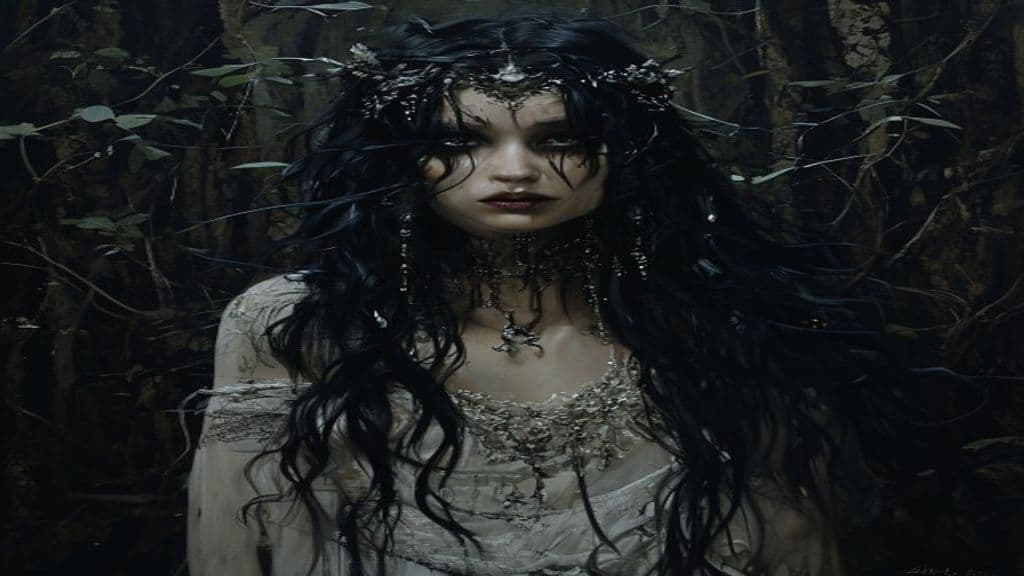
No detailed, uncontested traditional iconography of Ixtab is recorded in the provided sources. Landa’s text names her but gives no physical description. A suspended female figure with a rope around the neck appears in the Dresden Codex (DC53b) and has been proposed by some writers to represent Ixtab; the same sources emphasize that this identification is speculative and that the image occurs in an eclipse section where it may instead symbolize lunar/eclipse motifs or consequences for the Moon Goddess. Modern artistic portrayals are creative reinterpretations rather than documented traditional depictions.
In Diego de Landa’s report Ixtab’s primary function is psychopompic: she 'would bring' those who hanged themselves to their heaven, implying an intermediary role for a specific mode of death. Comparative discussion in the sources connects the name to ah Tab or ensnaring/hunting deities, proposing—hypothetically rather than as established fact—that the rope/noose functions symbolically as a snare consecrating a person to such a being. Later popular folklore figures with similar names (e.g., the Xtabay) are described as predatory seductresses who ensnare men, but that behavior is distinct from the benevolent escort role attributed to Ixtab in the colonial report. Scholarship cautions that any attribution of agency encouraging suicide or a 'cult of suicide' is likely sensationalized and not securely supported by the available evidence.
Acat
Acat is a Maya deity associated with the craft and ritual of tattooing, described in the cited sources as being invoked in relation to the tools, inks, and workspaces of tattoo artists and as steadying the artists' hands so tattoos made in the image of gods could confer those gods' power.
Ah Muzen Cab
Ah Muzen Cab is a Yucatán Maya divine figure associated with bees and honey, attested in summary sources as protector of Melipona bees and as a participant in Chilam Balam creation and ritual chapters. He is also linked in secondary accounts to the upside-down 'Descending' or 'Diving God' image found in Maya iconography at sites such as Tulum.
Akna
Akna is a female figure named in modern secondary sources as associated with childbirth and motherhood. The provided materials conflate brief mentions linking the name to both Maya and Inuit maternal goddesses; primary Maya iconographic or epigraphic evidence for a distinct Maya Akna is not supplied in the sources.
Alux (aluxoʼob)
The alux (plural aluxoʼob or aluxob) is a small, place-bound sprite or spirit in Maya tradition of the Yucatán Peninsula, Belize, and Guatemala, conceived as knee-high, miniature, traditionally dressed Maya-like beings created by ancient gods and normally unseen but able to assume physical form to communicate or frighten humans.
Anteater (tradition)
In the provided sources, 'Anteater' refers to the real-world mammals of the suborder Vermilingua and to modern cultural/technical items named after that animal (games, software, student media). There is no documentation in these materials of an anteater as a supernatural entity within a traditional cosmology.
Awilix
Awilix is a principal deity of the Postclassic Kʼicheʼ Maya centered at Qʼumarkaj, serving as a lunar and night-associated patron of the Nijaʼibʼ lineage. The deity is linked with the moon, night, the Underworld, sickness and death, and is a patron of the Mesoamerican ballgame; sources record both feminine and possibly masculine identifications.
Bacab
In Yucatec Maya tradition the Bacab are a fourfold office of aged interior-earth deities who stand at the four cardinal points as holders of the world, associated with subterranean waters, thunder, rain, calendrical Year Bearer days, divination, and curing rituals.
Balam
Balam is a name that appears in modern secondary demonological compilations and in English-language reference listings as a demon-name; the supplied sources do not provide primary traditional descriptions, rites, or a sustained cosmology for a demon called Balam. The same lexical form (B'alam/Bahlam) is also a Maya-language word meaning 'jaguar' and occurs widely in Maya personal and place names, a distinct and unrelated usage.
Camazotz
Camazotz is a bat-associated spirit in Late Post‑Classic Kʼicheʼ Maya narrative (notably the Popol Vuh) and a recurring bat motif in Classic Maya iconography. In the Popol Vuh Camazotz appears as bat-like beings serving the lords of Xibalba who attack the Hero Twins; Classic imagery links leaf‑nosed bats to night, death, disease, and nahual (way‑spirit) functions.
Chaac
Chaac is the Maya god of rain, thunder, and lightning, a central agricultural deity who produces storms by striking clouds with a lightning axe. He appears as both a singular figure and as multiple directional Chaacs, is associated with subterranean waters (cenotes and caves), and is the focus of communal rain-request rituals and specialist rainmaker practices.
Chahk (Chac) — Classic Maya palace deity/manifestation
A Classic Maya divine figure depicted in late 8th-century palace art and associated with elite ritual contexts. In the provided sources the figure appears as a small, held effigy described as “a god of royalty,” notable for a serpent leg, grotesque head, and a smoking torch on its brow; textual references on the panel refer to an undefined ritual completed in 795.
Chaneque
Chaneques are small, place-bound sprite-like beings in Mexican and wider Mesoamerican folklore, described as owners or inhabitants of particular dangerous places and as guardians of nature and households. Traditions portray them ambivalently: they may protect harvests and homes when propitiated, yet can mislead travelers, displace souls, cause illness, or physically harass people in some accounts.
Community Record
- [1]Relación de las cosas de Yucatán (Diego de Landa) — quoted. Diego de Landa, Relación de las cosas de Yucatán (as quoted on Wikipedia entry for Ixtab)academic
- [2]Ixtab (Wikipedia). Wikipedia: Ixtab (summary and bibliography)wiki
- [3]Dresden Codex image discussion (DC53b) — as discussed in secondary summaries. Discussion of DC53b image and its contested identification with Ixtab (per sources cited in the Wikipedia article)academic
- [4]Revisiting the 'Suicide Goddess' in Maya Archaeology (secondary literature cited in notes). Modern scholarly literature summarized in the provided notes (e.g., Reyes‑Foster & Kangas 2016 referenced in the research materials)academic
- [5]Contemporary folklore comparison: Xtabay (summary in provided notes). Summary of the distinction between Ixtab (as reported by Landa) and the later folkloric Xtabay (Wikipedia entry and provided notes)folk