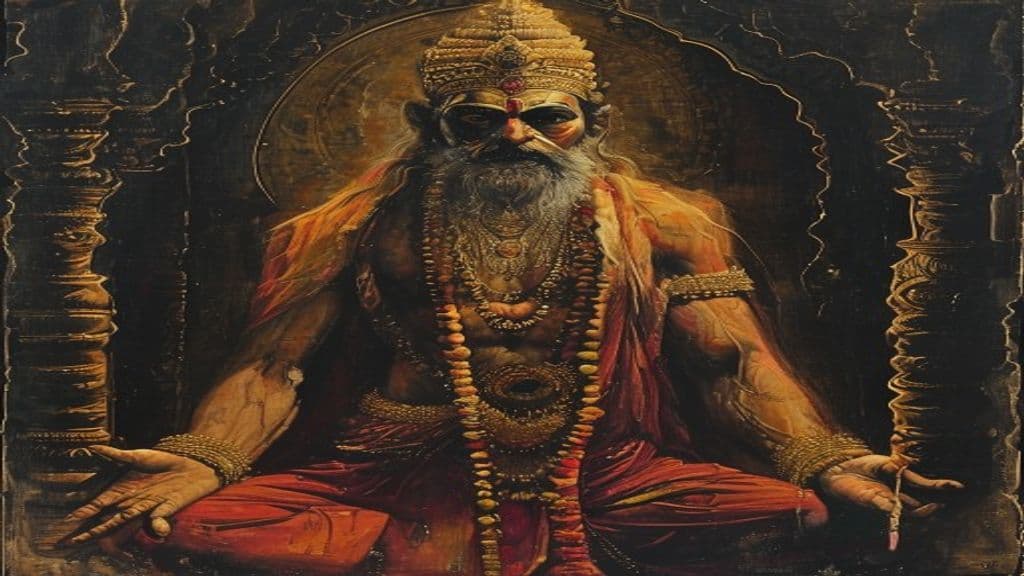
In Vedic and Puranic materials Kashyapa appears as one of the ancient rishis and as a progenitor figure. Puranic genealogies report that, through marriages (often to daughters of Daksha, with variant lists and numbers reported), he fathered many categories of beings — Devas, Danavas, Yakshas, Daityas and other living creatures — and so functions as a mythic ancestor. Local and later traditions link him to landscape origins (for example, the name Kashmir is often explained as derived from 'Kashyapa Mira' — the lake of the sage Kashyapa). Sources also note multiple distinct personages and variable accounts under the name Kashyapa across texts, so the identity operates as a category of seer as well as a single mythic figure.
The supplied sources do not give a fixed corporeal description of Kashyapa. He is treated in the literature as an ancestral seer, rishi, and teacher rather than as an apparition with particular physical traits; his presence is textual and genealogical (lists among the Saptarishis, appearances in hymns and Upanishadic and Puranic listings) rather than iconographically specified in the provided material.
Sources credit Kashyapa with composing some hymns in the Rigveda (notably material associated with Mandala IX) and with heading a family or school linked to Soma sacrifice hymns. In Puranic narratives he functions as a mythic progenitor, fathering many classes of beings by marriages with daughters of Daksha. Some legends ascribe to him the reclaiming or 'draining' of the Kashmir valley to make it habitable — a motif variously read as a literal landscape‑altering feat or as an allegory for civilizing/teaching activity. Overall his authority in the texts is expressed through sacred knowledge transmission, hymn composition, genealogical ordering, and foundational civilizing acts rather than enumerated magical feats.
*Péh₂usōn (reconstructed)
Péh₂usōn is a hypothetical Proto‑Indo‑European pastoral guardian reconstructed by comparative scholars from parallels in Greek and Vedic traditions. Proposed as a Graeco‑Aryan ancestor‑figure, the reconstruction describes a protector of flocks, roads, and travellers rather than an attested historical cultic personality.
Abhimanyu
Abhimanyu is a youthful Kuru/Pandava warrior-hero in the Sanskrit epic Mahābhārata. Son of Arjuna and Subhadra, he is famed for entering the Chakravyuha battle formation on the thirteenth day of the Kurukshetra War and dying at age sixteen; his posthumous son Parikshit continues the Kuru line.
Acala
Acala (Sanskrit: अचल, 'The Immovable') is a wrathful protective deity (dharmapala) in Vajrayāna and East Asian esoteric Buddhism, classed among the Wisdom Kings (Vidyārāja). He functions as a ritual focus for visualization and mantra practice intended to remove obstacles and bind or destroy hostile forces.
Acalanātha (Acala / Achala)
Acalanātha (also Acala or Achala) is a wrathful deity and dharmapāla — a protector of the Dharma — prominent in Vajrayana and East Asian Mahayana Buddhist contexts. Presented as a fierce, non‑human or semi‑divine protector-figure, Acalanātha functions to defend the teaching and practitioners by removing obstacles and confronting threats to the transmission and practice of Buddhism.
Achyuta
Achyuta (Sanskrit: अच्युत, acyuta) is primarily an epithet/theonym in Vaishnava Hindu tradition applied to Vishnu and Krishna, signifying the divine quality of being 'not fallen' — immutable, infallible, and imperishable. It functions as a devotional name in scripture, liturgy, and Pancharatra lists of divine emanations rather than as an autonomous folkloric spirit.
Acintya
Acintya is an Indonesian Hindu theological-symbolic representation of the ineffable supreme divine principle. In Balinese and Javanese practice it functions as a way to make ultimate reality present in ritual and art—often aniconically as an empty throne (padmasana) or anthropomorphically as a naked, flame-surrounded figure—rather than as a narrative, intervening deity.
Adi (asura)
Adi is attested in modern reference works as the name of an Asura who 'appears in the Matsya Purāṇa.' Beyond this single-line citation in secondary sources, no descriptive material about the figure is provided in the supplied research notes.
Adi Shakti
Adi Shakti (also Adi Parashakti, Mahadevi, Adya Shakti) is the primordial feminine power in Hindu/Shakta theology, regarded as the ultimate reality (Para Brahman) and the source from which all goddesses and gods manifest. She is both an impersonal cosmic principle (Mulaprakriti) and a focus of devotional invocation in temples, mantras, and pilgrimage sites such as Shakti Peethas.
Adi Vinayaka
Adi Vinayaka (Ādi Vināyaka; also called Nara Mukha Vinayaka) is a named iconographic and devotional form of the Hindu god Ganesha portraying the deity with a human head, described in sources as the form before the episode of decapitation by Shiva. It is rarely worshipped and appears in a small number of South Indian shrines and in devotional/musical repertoires.
Aditi
Aditi is a major Vedic goddess in Hindu tradition who personifies the boundless, infinite cosmic principle and functions as the maternal matrix from which many celestial deities (the Ādityas and other groups) are born. In the Vedic hymns she is invoked as a protective liberator who guards petitioners, provides wealth and safety, and frees devotees from hindrances such as sin and sickness.
Agastya
Agastya (also Agathiyar/Agasti) is a revered Vedic and later-period Indian rishi (sage) figure credited in textual traditions as an inspired seer, ascetic, teacher, culture-founder, and attributed author of Vedic, Puranic and Tamil works; in South Indian tradition he is associated with origins of Tamil grammar and Siddha medicine and is identified astronomically with the star Canopus.
Aghasura
Aghasura is an asura from the Vaishnava/Hindu narrative tradition (notably the Srimad‑Bhāgavatam) who, at the command of Kamsa, assumed the form of a vast serpent to ambush Kṛṣṇa and the cowherd boys in Vṛndāvana. The episode demonstrates Kṛṣṇa’s protective, divine power as he enters and destroys the demon from within.
Community Record
- [1]Kashyapa - Wikipedia. Wikipedia: Kashyapawiki
- [2]Kashyapa - Wikidata. Wikidata: Kashyapawiki
- [3]Digha Nikaya / Tevijja Sutta references (summary from notes). Notes citing Digha Nikaya listing Kassapa among early rishis (as reported in source set)literary
- [4]Archive: Ududumbara Kashyapa himige Niwan Maga desana. Archive material referencing Kashyapa tradition (Ududumbara sermons)other