
In Purāṇic and Devi-centred narratives (notably the Devi Mahatmya and related appendices), the gods beseech Parvati/Uma/Gauri for help against the asura brothers Shumbha and Nishumbha. From the sheath (kosha) of Parvati a female power issues forth — Kaushiki — who functions as an autonomous śakti to confront and slay the asuras. Pancharatra material (e.g., Lakshmi Tantra) also presents Kaushiki as a Kevala-Avatāra of Lakshmi who descended from Gauri to slay the demons. In Jain sources the term Kauśikīvidyā names one of the sixteen vidyās, understood there as an esoteric power used by Kauśikīpūrvaka Vidyadharas, whose efficacy is conditioned by correct ethical behaviour toward Jinas and ascetics.
Classical Purāṇic appendices describe an eight-armed manifestation bearing weapons (arrow, pestle, spear, discus/chakra, conch/śaṅkha, bell, ploughshare, and bow). Some sources portray Kaushiki as white- or bright-complexioned (contrasted in the episode with a dark/fierce goddess such as Chamunda/Kali); agamic passages (e.g., an Ajitāgama citation) describe Kaushiki as seated on a lion. Textual recensions vary on details such as complexion and exact attributes.
Kaushiki’s principal function in the textual corpus is martial: she manifests weapons and a retinue (including the Matrikas) and defeats the asura kings Shumbha and Nishumbha, restoring cosmic order. As a śakti she embodies protective and generative divine power in the sense of being an emanation of the supreme feminine principle; in Pancharatra material she is framed as an independent avatāra of Lakshmi who descends to protect the world. In Jain literature Kauśikīvidyā denotes an esoteric power usable by Vidyadharas, with the further behavioural constraint that practitioners lose these abilities if they disrespect Jinas, harm ascetics, or commit grave crimes.
Weaknesses
- otherNo specific vulnerabilities recorded in the cited sources
Wards
- mantraRecitation of Kaushiki's names (Rudrayāmala-Uttaratantra note: Kaushiki listed among thousand names of Kumāri whose recital grants spiritual reward)

Durga
Durga is a major Hindu goddess, central to the Shakta tradition as an aspect of the Divine Feminine (Mahadevi). She is venerated as a protective, martial mother-goddess who combats demonic forces (notably Mahishasura) to uphold dharma, and is celebrated in major festival cycles such as Navaratri and Durga Puja.

Kali
Kali is a major Hindu goddess associated with time (kāla), death, destruction, and also with liberating knowledge; she appears in Puranic and Tantric texts as a fierce battlefield power and as a protective Divine Mother (Kali Mātā).
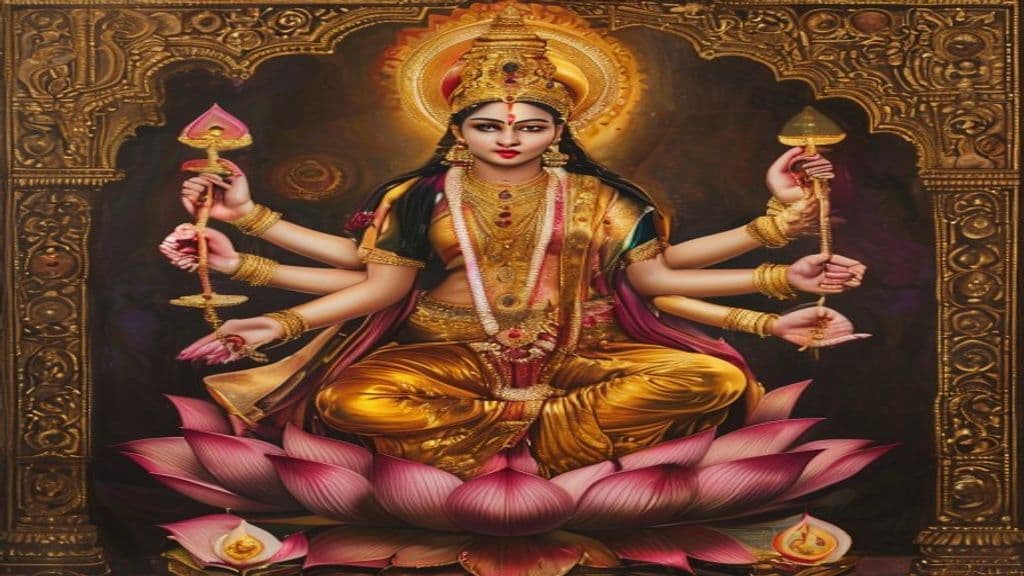
Lakshmi
Lakshmi is a principal Hindu goddess who personifies śrī (auspiciousness) and is revered as the giver of fortune, wealth, prosperity, beauty, fertility, sovereignty, and abundance. She is the consort and shakti of Vishnu in Vaishnavism, part of the Tridevi with Parvati and Sarasvati, and is the focus of popular devotional and festival practices such as Lakshmi Puja during Deepavali and Navaratri.

Parvati
Parvati is a principal goddess in Hindu tradition, worshipped as the consort of Shiva and as his shakti (divine power). She embodies a range of roles — devoted wife and mother, fertility and nourishment-giver, and in other manifestations a ferocious protector who destroys evil.

Matrikas
Matrikas (Sanskrit: mātṛkā, 'mothers') are a group of related mother-goddess figures in Hindu tradition, commonly rendered as seven (Saptamatrikas) or eight (Ashtamatrikas). They function ambivalently as protectors and as dangerous female powers tied to fertility, child mortality, disease, and martial activity, and were incorporated into temple and tantric/Shakta practice by the Kushana–Gupta and early medieval periods.
*Péh₂usōn (reconstructed)
Péh₂usōn is a hypothetical Proto‑Indo‑European pastoral guardian reconstructed by comparative scholars from parallels in Greek and Vedic traditions. Proposed as a Graeco‑Aryan ancestor‑figure, the reconstruction describes a protector of flocks, roads, and travellers rather than an attested historical cultic personality.
Abhimanyu
Abhimanyu is a youthful Kuru/Pandava warrior-hero in the Sanskrit epic Mahābhārata. Son of Arjuna and Subhadra, he is famed for entering the Chakravyuha battle formation on the thirteenth day of the Kurukshetra War and dying at age sixteen; his posthumous son Parikshit continues the Kuru line.
Abhinandananātha
Abhinandananātha is the fourth Tīrthaṅkara (ford-maker) of the current Jain cosmic age (avasarpini). Traditional accounts place his birth in Ayodhyā to the Ikshvāku (Solar) dynasty, describe his renunciation and attainment of omniscience beneath a priyangu tree, and record his liberation on Mount Śikharjī.
Achyuta
Achyuta (Sanskrit: अच्युत, acyuta) is primarily an epithet/theonym in Vaishnava Hindu tradition applied to Vishnu and Krishna, signifying the divine quality of being 'not fallen' — immutable, infallible, and imperishable. It functions as a devotional name in scripture, liturgy, and Pancharatra lists of divine emanations rather than as an autonomous folkloric spirit.
Acintya
Acintya is an Indonesian Hindu theological-symbolic representation of the ineffable supreme divine principle. In Balinese and Javanese practice it functions as a way to make ultimate reality present in ritual and art—often aniconically as an empty throne (padmasana) or anthropomorphically as a naked, flame-surrounded figure—rather than as a narrative, intervening deity.
Adi (asura)
Adi is attested in modern reference works as the name of an Asura who 'appears in the Matsya Purāṇa.' Beyond this single-line citation in secondary sources, no descriptive material about the figure is provided in the supplied research notes.
Adi Shakti
Adi Shakti (also Adi Parashakti, Mahadevi, Adya Shakti) is the primordial feminine power in Hindu/Shakta theology, regarded as the ultimate reality (Para Brahman) and the source from which all goddesses and gods manifest. She is both an impersonal cosmic principle (Mulaprakriti) and a focus of devotional invocation in temples, mantras, and pilgrimage sites such as Shakti Peethas.
Adi Vinayaka
Adi Vinayaka (Ādi Vināyaka; also called Nara Mukha Vinayaka) is a named iconographic and devotional form of the Hindu god Ganesha portraying the deity with a human head, described in sources as the form before the episode of decapitation by Shiva. It is rarely worshipped and appears in a small number of South Indian shrines and in devotional/musical repertoires.
Aditi
Aditi is a major Vedic goddess in Hindu tradition who personifies the boundless, infinite cosmic principle and functions as the maternal matrix from which many celestial deities (the Ādityas and other groups) are born. In the Vedic hymns she is invoked as a protective liberator who guards petitioners, provides wealth and safety, and frees devotees from hindrances such as sin and sickness.
Agastya
Agastya (also Agathiyar/Agasti) is a revered Vedic and later-period Indian rishi (sage) figure credited in textual traditions as an inspired seer, ascetic, teacher, culture-founder, and attributed author of Vedic, Puranic and Tamil works; in South Indian tradition he is associated with origins of Tamil grammar and Siddha medicine and is identified astronomically with the star Canopus.
Aghasura
Aghasura is an asura from the Vaishnava/Hindu narrative tradition (notably the Srimad‑Bhāgavatam) who, at the command of Kamsa, assumed the form of a vast serpent to ambush Kṛṣṇa and the cowherd boys in Vṛndāvana. The episode demonstrates Kṛṣṇa’s protective, divine power as he enters and destroys the demon from within.
Agiya Baital
The fire-form of the Vetala — a cremation ground spirit of UP and Bihar that manifests as a wandering flame rather than a corpse-inhabitor, leading night travellers off roads and into marshland or flames with a dancing fire that seems always just ahead.
Community Record
- [1]Kaushiki (Wikipedia). Wikipedia: Kaushikiwiki
- [2]Ajitāgama (quoted passage). Ajitāgama, Kriyāpāda 53/7-8 (quoted in research notes)literary
- [3]Devi Mahatmya (appendices summary). Devi Mahatmya appendices (weapon list and narrative of emergence) (summarized in research notes)literary
- [4]Lakshmi Tantra (Pancharatra summary). Lakshmi Tantra (Pancharatra) — Kaushiki as Kevala-Avatāra of Lakshmi (summary in research notes)literary
- [5]Rudrayāmala-Uttaratantra (name-recitation note). Rudrayāmala-Uttaratantra (Kaushiki listed among thousand names of Kumāri; recital efficacy) (summarized in research notes)literary
- [6]Trishashtishalakapurushacaritra (Hemachandra) — Kauśikīvidyā. Jain Trishashtishalakapurushacaritra (Kauśikīvidyā and ethical constraints on Vidyadharas) (summarized in research notes)literary
- [7]Valmiki Ramayana — Bala Kanda Sarga 34 (Kaushiki river mention). Valmiki Ramayana, Bala Kanda, Sarga 34 (reference to a Kaushiki river) (provided in research notes)literary