
No cosmogonic origin or mythic birth narrative for Keneō is recorded in the supplied sources. Available accounts present him functionally as a component of popular Japanese Buddhist representations of the afterlife: an attendant at the Sanzu River whose role is procedural and punitive within the system of postmortem judgment. He appears in the tableau of riverbank punishments alongside Datsue-ba and other judges/attendants of the underworld, reflecting syncretic folk-Buddhist conceptions of karmic retribution rather than a distinct origin story.
The supplied material contains no detailed physical description beyond the name itself and the classification as an Oni. The kanji 懸衣翁 translate as "clothes hanging old man," indicating an old man associated with hanging garments. Sources identify him as an Oni in the Buddhist underworld, but do not provide further specifics of facial features, attire, or iconography.
Source accounts attribute to Keneō the actions of receiving and hanging the clothes of arriving souls on a riverside branch that bends to reflect the gravity of their sins, and of flaying and hanging a soul's skin if the soul arrives naked. He is described as working in tandem with Datsue-ba in administering corporeal punishments (for example, after Datsue-ba breaks a thief's fingers they together tie the sinner's head to the sinner's feet) and as walking the river edge to torment souls, including those of children too young to cross the Sanzu River. These behaviors are presented as postmortem enforcement actions recorded in popular accounts.
Weaknesses
None recorded.
Wards
- ritualplacement of 6 mon with the body

Datsue-ba
A supernatural old-woman ogress figure in Japanese Buddhist underworld imagery who sits by the Sanzu River and strips the deceased of their garments (or, in some accounts, their skin) as part of post-mortem judgement. She functions as a liminal, procedural agent within Ten Kings / Six Realms iconography rather than as a creator or cosmic force.
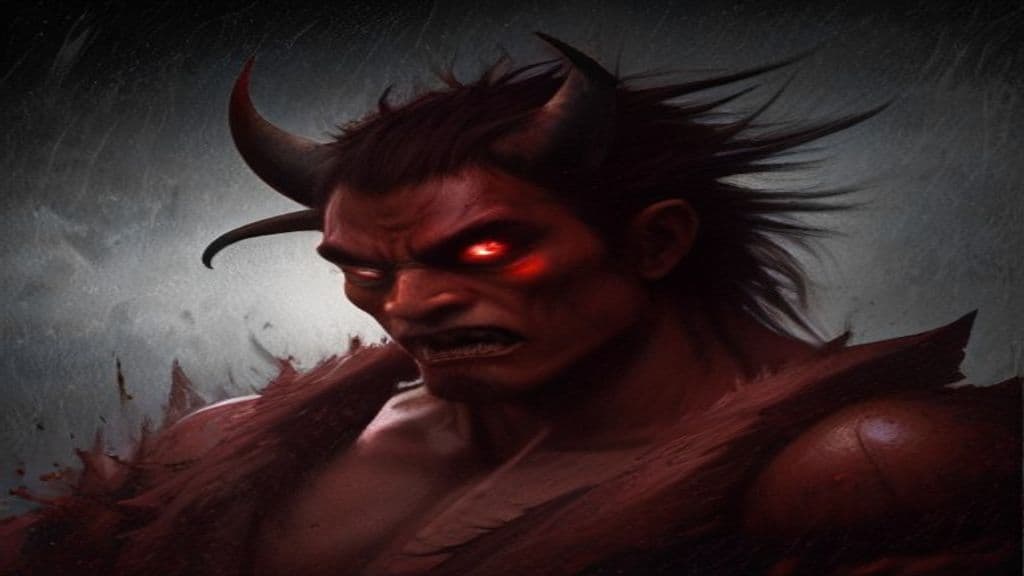
Oni
Powerful supernatural beings of Japanese folklore — associated with misfortune, disease, and the punishment of sinners in hell. Fearsome, often depicted as guardians of the underworld.
5 Ronin
5 Ronin is a 2011 Marvel Comics five-issue limited series that reimagines five Marvel superhero archetypes as rōnin (masterless samurai) in a fictionalized post‑Sekigahara feudal Japan. The work places Wolverine, Hulk, Punisher, Psylocke, and Deadpool analogues into period roles to explore displacement, revenge, and identity in an era of political upheaval.
Abumi-guchi
A Japanese yōkai classed as a tsukumogami: an animated stirrup (abumi) depicted in Sekien Toriyama's Gazu Hyakki Tsurezure Bukuro. Traditional accounts say it is formed from a stirrup that belonged to a soldier who fell in battle and that it waits where the stirrup lies for its dead owner to return.
Abura-akago
An Edo-period yōkai depicted as an oil‑licking infant or a ball of flame. First recorded in illustrated compendia (notably Toriyama Sekien's Konjaku Gazu Zoku Hyakki), the Abura-akago is tied to tales of oil‑stealing fires and functions in part as an etiological warning about wasting or stealing oil.
Abura-sumashi
A yōkai spirit from the Amakusa region of Kumamoto Prefecture, Japan, said to inhabit mountain passes. Traditionally explained as the ghost of a person who stole oil, it appears to surprise travelers and is represented in modern media with a straw-coat body and a potato- or stone-like head.
Aburabō / Abura-bōzu / Aosaginohi (traditions)
Two distinct Japanese traditions appear under related flame imagery: Aosaginohi/Aosagibi is presented as a will-o'-the-wisp type luminous night phenomenon interpreted as reflections from herons; aburabōzu (abura bōzu, "oil monk") appears in a separate anecdote as a reported fire-breathing apparition in a 12th-century Yasaka Shrine tale. The sources treat them as separate portrayals rather than a single unified being.
Acala
Acala (Sanskrit: अचल, 'The Immovable') is a wrathful protective deity (dharmapala) in Vajrayāna and East Asian esoteric Buddhism, classed among the Wisdom Kings (Vidyārāja). He functions as a ritual focus for visualization and mantra practice intended to remove obstacles and bind or destroy hostile forces.
Acalanātha (Acala / Achala)
Acalanātha (also Acala or Achala) is a wrathful deity and dharmapāla — a protector of the Dharma — prominent in Vajrayana and East Asian Mahayana Buddhist contexts. Presented as a fierce, non‑human or semi‑divine protector-figure, Acalanātha functions to defend the teaching and practitioners by removing obstacles and confronting threats to the transmission and practice of Buddhism.
Agaru
Agaru (attested historically as Agarum) appears in the supplied sources as a Bronze Age Near Eastern toponym—often identified with Failaka Island—and as a modern personal or media name. The provided material contains no evidence that Agaru is a supernatural being in any traditional cosmology.
Agni
Agni is the Vedic personification of fire in Hindu tradition: a sacred, mediating principle that manifests as terrestrial fire, atmospheric lightning, and celestial sun, and that receives and conveys sacrificial offerings. Prominent in the Rigvedic corpus, Agni functions as sanctifier, witness of rites of passage, and a transformational inner principle in later Upanishadic literature.
Aizen Myō-ō (Rāgarāja)
Aizen Myō-ō corresponds to the deity Rāgarāja, a wrathful/transformation-oriented figure venerated in Esoteric and Vajrayāna Buddhist traditions. The figure is especially revered in Chinese Esoteric Buddhism in Chinese communities and in the Japanese Esoteric schools Shingon and Tendai.
Ajisukitakahikone
Ajisukitakahikone is a kami in Japanese mythic literature (Kojiki/Nihon Shoki). He appears in the transfer-of-rule cycle between heaven and earth, is described as a son of Ōkuninushi, associated with the Kamo cult (called Kamo no ōmikami in some modern museum/catalog entries), and features in narratives that explain landscape formation and meteorological genealogy.
Aka Manto
Aka Manto (赤マント, "Red Cloak") is a Japanese urban legend and schoolyard ghost-story about a masked, cloaked figure who appears in public or school toilet stalls and forces occupants to choose between colored toilet paper; each choice in the tale produces a violent supernatural consequence. The legend is part of modern popular folklore recorded in school contexts from the 1930s onward rather than a formal religious myth.
Community Record
- [1]Keneō. "Keneō (懸衣翁) is a Japanese Oni who sits at the edge of the Sanzu River in the Buddhist underworld. His name translates to clothes hanging old man."; "Once the adult soul arrives at the river Datsue-ba forces the sinners to take off their clothes, and Keneō hangs these clothes on a riverside branch that bends to reflect the gravity of the sins. If a soul arrives without clothes, Keneō flays the person's skin and hangs it from the tree instead."; "For those who steal, for example, Datsue-ba breaks their fingers, and together with Keneō, she ties the sinner's head to the sinner's feet. Keneō and Datsue-ba also walk along the edge of the river and torment the souls of children that are too young to cross the river."wiki
- [2]Keneō (Wikidata). Wikidata entry categorizing Keneō as a Buddhist mythological creature / underworld figure.other
- [3]Sai no Kawara, Jizo, Judges of Hell (Underworld) — Japanese Buddhism Dictionary Project. Contextual material on Sanzu River, judges of hell, and related underworld figures referenced in the same field of belief.folk