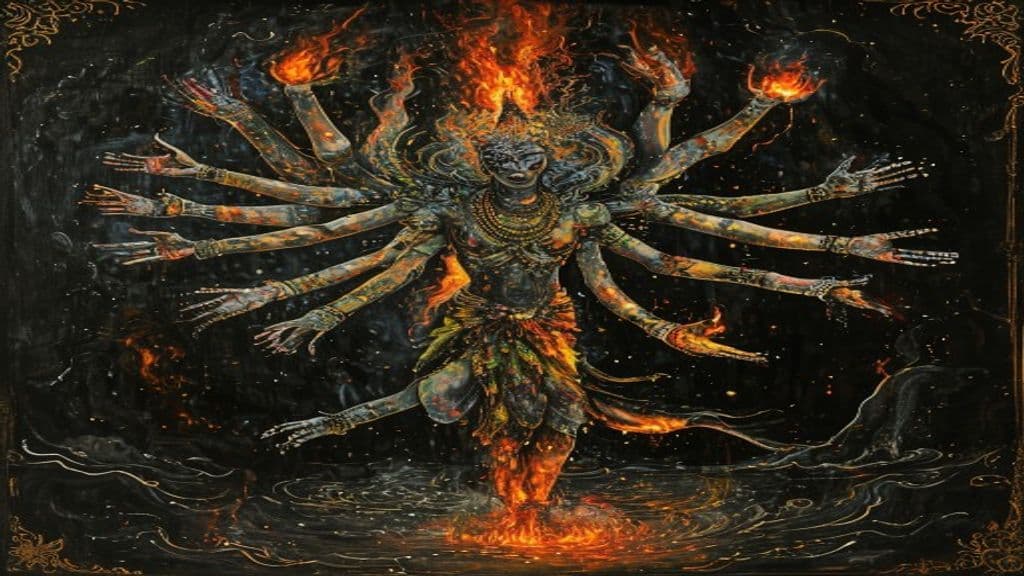
According to the Ayyavazhi sacred text Akilathirattu Ammanai (as summarized in secondary sources), Kroni was born in the first of the Eight Yukams as the first evil in the universe. He rose as an existential threat until Mayon undertook tavam (penance) and, with Shiva's granting of assistance, sliced Kroni into six fragments. Those six fragments were then born as principal evils (asuras) in six successive yukams, requiring Mayon to incarnate repeatedly to defeat them.
The Akilathirattu Ammanai summary describes Kroni in the first yukam as possessing 'multitudinous limbs each the size of a mountain' with 'a fire of ravenous hunger in his stomach.' Mythic actions attributed to this form include drinking all the waters of the sea and swallowing Kailayam (Kailash), the abode of Shiva, before proceeding to devour the universe.
Mythically Kroni exhibits cosmically destructive appetite—drinking seas, swallowing Kailayam, and attempting to devour the universe. After being cut into six fragments by Mayon, those fragments recur across the next six yukams as named antagonists (for example: Kuntomasali; Thillaimallalan and Mallosivahanan; Suraparppan, Sinkamukasuran, Iraniyan; Ravanan; Thuriyothanan and the ninety-nine brothers; and Kaliyan). Kroni functions philosophically as the principle of evil obstructing the soul's attainment of absolute bliss; some secondary interpretations map the six fragments to six inner evils (sometimes related to chakra concepts), though that chakra correspondence is not explicit in the primary scripture and is contested.
Weaknesses
- otherSlicing by Mayon after tavam (divine intervention by Mayon/Vishnu and aid from Shiva as narrated in Akilathirattu Ammanai)
Wards
None recorded.

Adi Vinayaka
Adi Vinayaka (Ādi Vināyaka; also called Nara Mukha Vinayaka) is a named iconographic and devotional form of the Hindu god Ganesha portraying the deity with a human head, described in sources as the form before the episode of decapitation by Shiva. It is rarely worshipped and appears in a small number of South Indian shrines and in devotional/musical repertoires.
Agastya
Agastya (also Agathiyar/Agasti) is a revered Vedic and later-period Indian rishi (sage) figure credited in textual traditions as an inspired seer, ascetic, teacher, culture-founder, and attributed author of Vedic, Puranic and Tamil works; in South Indian tradition he is associated with origins of Tamil grammar and Siddha medicine and is identified astronomically with the star Canopus.
Agiya Baital
The fire-form of the Vetala — a cremation ground spirit of UP and Bihar that manifests as a wandering flame rather than a corpse-inhabitor, leading night travellers off roads and into marshland or flames with a dancing fire that seems always just ahead.
Agniveśa
Agniveśa is a legendary rṣi (sage) in the Ayurvedic textual tradition, traditionally credited as the pupil of Punarvasu Atreya and as the attributed author of the lost Agniveśa Saṃhitā / Agniveśatantra. Later Ayurvedic compilers, notably Charaka, are described in the sources as having compiled, edited, and modified material attributed to Agniveśa into texts such as the Charaka Saṃhitā.
Ahiravan (Mahiravan)
Ahiravan (also Mahiravan) is a rakshasa-king of Patala in Ramayana-derived narratives who abducts Rama and Lakshmana to sacrifice them to a goddess. Presented as a brother or trusted ally of Ravana in eastern Ramayana recensions, he is defeated and beheaded by Hanuman with divine aid.
Aiyanar
Aiyanar (Aiyaṉār, ஐயனார்) is a Tamil rural tutelary deity venerated chiefly in village contexts of Tamil Nadu and among Tamil communities in Sri Lanka. Portrayed as a martial guardian often mounted on a horse or elephant and accompanied by attendant spirits, he functions primarily to protect village boundaries, people, and livestock and has later been syncretized with the Sanskritic Sastha tradition.
Aiyyanar
Aiyyanar (also spelled Aiyanar) is a Tamil rural village deity venerated in South India and Sri Lanka, primarily among rural Tamil communities. He is associated in material culture with large, colorful roadside and temple statues often shown with companions and mounted on horses or elephants, and functions as a local protective/patronal figure within village devotional practice.
Akṣayakumāra
Akṣayakumāra appears in the Ramayana as the youngest son of Rāvaṇa and a warrior sent to oppose Hanuman in the Ashoka Vatika episode; described as about sixteen, he fights bravely from a chariot and is killed by Hanuman.
Alakh Niranjan
A doctrinal and devotional formula in the Nath-yogi tradition denoting the unseen, unblemished ultimate reality (Nirguna Brahman/Atman). Used as a salutational invocation, theological name, and signifier of realised Self rather than a personified supernatural being.
Alakshmi
Alakshmi is an inauspicious female supernatural figure in Hindu tradition, presented as the negation or shadow-counterpart of the prosperity-goddess Lakshmi. She personifies poverty, grief, jealousy and social discord and is managed in domestic ritual and festival practice.
Alamelu
Alamelu (also Alamelu Manga / Alarmel Mangai) is a South Indian devotional name for the goddess Padmavati, identified in sources as an avatar of Lakshmi and the consort of Venkateswara; the name is also used widely as a female personal name and in titles of cultural works in Tamil and Telugu contexts.
Aleya
Ghost lights of the Sundarbans delta — flickering flames over swamp water said to be the souls of dead fishermen, luring the living off safe paths into drowning waters.
Community Record
- [1]Kroni. Wikipedia, 'Kroni' (summary of Akilathirattu Ammanai and secondary interpretations)wiki
- [2]Akilam one. Wikipedia entry summarizing portions of the Akilathirattu Ammanai (primary scripture of Ayyavazhi) as cited in secondary sourceswiki
- [3]Kroni | Villains Wiki. Villains Wiki (Fandom) summary of mythic elements associated with Kroniother
- [4]Kroni Demon Names List. HellHorror summary mentioning names and fragments associated with Kroniother