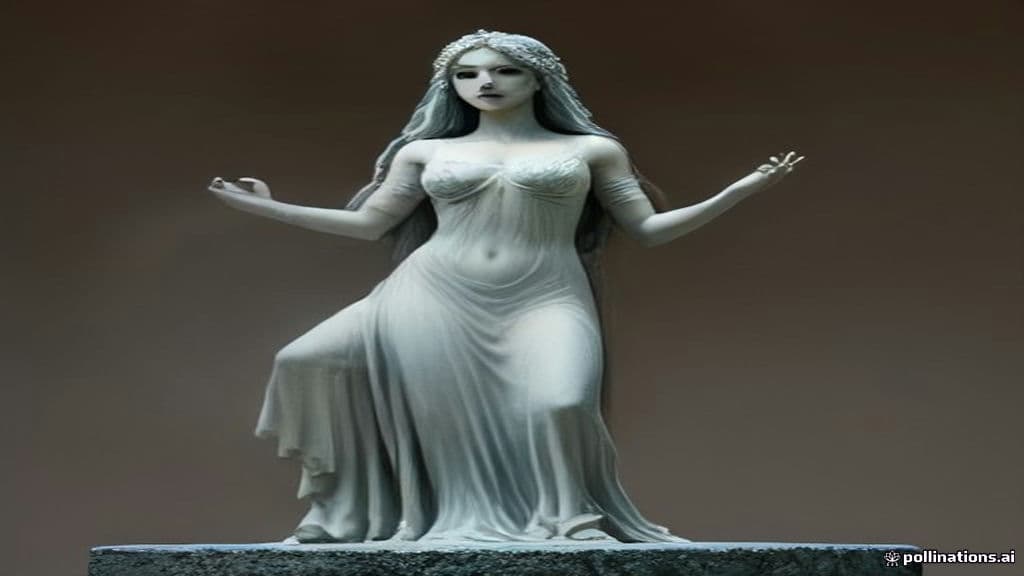
Laodamia is not a single origin figure but a name attached to multiple mythic women across Greek tradition. Notable attestations include: (1) Laodamia, daughter of Bellerophon, a Lycian princess who in one account is mother of Sarpedon by Zeus (a Homeric/epic variant); she is also said in some traditions to have died suddenly, shot by Artemis while weaving; (2) Laodamia, daughter of Acastus and Astydamia, wife of Protesilaus, whose husband died at Troy and who, according to later retellings, killed herself rather than live without him and was granted a brief reunion with his phantom (some sources specify a three‑hour visitation). Other bearers of the name appear in varied genealogies (e.g., Arcadian and Spartan contexts), reflecting the name's reuse across local cycles and heroic generations.
Classical sources present the Laodamias as mortal noblewomen rather than as nonhuman apparitions. Descriptions are of ordinary human female figures within their mythic settings: the daughter of Bellerophon is portrayed as a Lycian princess; the wife of Protesilaus is presented as a Phylacian/Thessalian noblewoman. Where supernatural imagery appears in later literary reception, it concerns the phantom of Protesilaus rather than Laodamia herself.
The sources do not ascribe innate supernatural powers to any Laodamia; they are mortal actors whose lives are affected by gods and fate. Their notable behaviors and narrative consequences include bearing a divine son in one tradition (mothering Sarpedon by Zeus), suffering sudden divine‑caused death in another (Artemis striking her while weaving), and committing suicide from grief after the death of a husband (Protesilaus). In reception literature the theme appears of the gods permitting a dead husband to appear briefly to Laodamia (later accounts specify a three‑hour visit), but this is an action performed by divine agents and concerns the husband's phantom, not a power of Laodamia herself.
Weaknesses
- conditionmortal vulnerability
Wards
None recorded.
*Péh₂usōn (reconstructed)
Péh₂usōn is a hypothetical Proto‑Indo‑European pastoral guardian reconstructed by comparative scholars from parallels in Greek and Vedic traditions. Proposed as a Graeco‑Aryan ancestor‑figure, the reconstruction describes a protector of flocks, roads, and travellers rather than an attested historical cultic personality.
3-D Man
3-D Man is a Marvel Comics superhero identity associated with a 1950s-era origin in which the body of Chuck Chandler can materialize in three-dimensional existence when activated by his brother Hal via a pair of glasses. The mantle was later assumed by Delroy Garrett (formerly Triathlon) in modern continuity.
5 Ronin
5 Ronin is a 2011 Marvel Comics five-issue limited series that reimagines five Marvel superhero archetypes as rōnin (masterless samurai) in a fictionalized post‑Sekigahara feudal Japan. The work places Wolverine, Hulk, Punisher, Psylocke, and Deadpool analogues into period roles to explore displacement, revenge, and identity in an era of political upheaval.
58 Concordia
58 Concordia is a fairly large main-belt asteroid orbiting the Sun, discovered in 1860 and named after the Roman goddess Concordia. Astronomical sources classify it as a C-type (carbonaceous) body with a multi-year orbital period and measurable rotation and pole orientations.
9MOTHER9HORSE9EYES9
An anonymous Reddit screen name and online persona used by the author of the Interface series, a multipart speculative-horror narrative posted in short installments across Reddit in 2016. The name functions as the signature of an authorial identity and as a focal label for a fandom that created archives, a subreddit, and a wiki documenting the story and its fictional phenomena (notably entities called "flesh interfaces").
A Elbereth Gilthoniel
An Elvish hymn in Sindarin addressed to Elbereth (Varda) from J. R. R. Tolkien's legendarium. Presented in The Lord of the Rings and later musical and dramatic adaptations, the hymn functions as devotional poetic language that evokes Elvish reverence for the star-kindler rather than an independent supernatural agent.
A.R.G.U.S.
A.R.G.U.S. is a fictional clandestine United States government agency in the DC Comics universe that investigates, contains, and manages superhuman, meta-human, and supernatural incidents and assets. Introduced in The New 52 continuity, it functions as an institutional actor providing intelligence, logistical support, covert task forces (notably Task Force X / the Suicide Squad), and a dedicated magic division across comics and media adaptations.
Aba (disambiguation / name-form)
Aba is a polyvalent name-form attested across many unrelated contexts (place names, personal names, animal names, and brief mythological listings). The provided sources do not support a single, coherent supernatural entity called "Aba" and offer no descriptive or ritual material for such a being.
Abarbarea
Abarbarea is a name attested in classical Greek and Roman sources for freshwater nymphs (naiads). The name appears for at least two individual mythic figures — a naiad wife of Bucolion and a naiad counted among ancestors of the Tyrians — and Hesychius records plural forms that may indicate the name was also used as a class-name (Abarbareai / Abarbalaiai).
Abas
Abas (Ancient Greek: Ἄβας, gen.: Ἄβαντος) is not a single mythic being but a recurring personal name borne by multiple mortals and minor mythic figures in Greek epic and genealogical traditions — kings, founders, seers, warriors, attendants, a centaur, and a youth transformed by a goddess. The name is glossed in the sources as 'guileless' or 'good-hearted' and appears across Argive, Theban, Trojan, Euboean, and other local cycles.
Abderus
Abderus (Ancient Greek: Ἄβδηρος, romanized Ábdēros) is a mortal heroic figure in Greek myth closely associated with Heracles, remembered as the youth left in charge of the Mares of Diomedes who was killed by them. He functions as an eponymous local/divine-hero ancestor for the city of Abdera and received funerary commemoration and athletic agones at his tomb.
Abena Mansa
A name attested in a single contemporary Ghanaian blog anecdote as a 'mysterious being'; available sources do not establish Abena Mansa as a coherent, traditional supernatural figure or provide corroborating ethnographic detail.
Community Record
- [1]Laodamia - Wikipedia. Wikipedia, article 'Laodamia'wiki
- [2]Laodamia - L3 (course material). Course summary 'Laodamia - L3'other
- [3]Europa (Archive LP0020) — Apollodorus excerpt (genealogical treatment). Apollodorus (as presented in Archive LP0020) noting Homeric tradition of Sarpedon as son of Zeus by Laodamia, daughter of Bellerophonacademic
- [4]Laodamia (poem) — William Wordsworth (and analyses). Wordsworth's poem 'Laodamia' and modern analyses treating the phantom visitation motifliterary
- [5]Laodamia Wife of Protesilaus - Greek Legends and Myths. Popular retelling summarizing Laodamia's suicide after Protesilaus's deathfolk
- [6]Laodamia | RPO (Representative Poetry Online). RPO entry on 'Laodamia' (reception and poetic treatments)literary