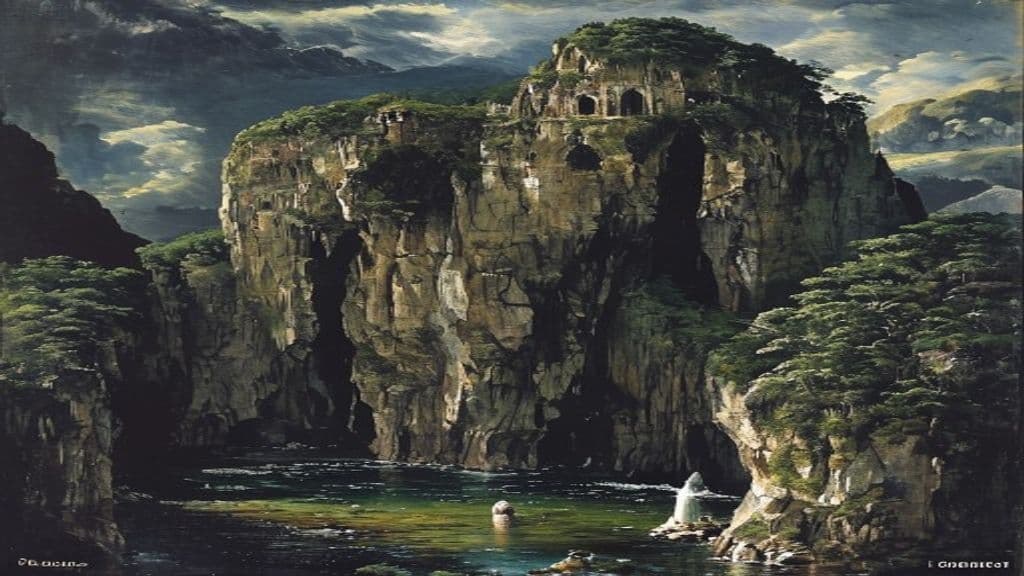
The familiar image of the Lorelei as a siren‑like woman was popularized in early 19th‑century literature: Clemens Brentano's 1801 ballad and Heinrich Heine's 1824 poem shaped the modern motif of a beautiful female figure associated with the rock. The place-name itself — from Rhine dialect lureln ('murmuring') + Old German ley ('rock') — predates these poems and long carried reputational associations with dangerous currents and echoes; older local legends (for example, tales of dwarfs in caves) also existed around the site. Thus the literary femme fatale was grafted onto a preexisting hazardous toponym and repertory of place‑legends rather than emerging wholly apart from the named landscape.
As a place: the Lorelei (Loreley) is a 132-metre-high (433 ft) steep slate rock on the right bank of the River Rhine at Sankt Goarshausen in the Rhine Gorge; the summit area includes the Loreley Amphitheatre (built in the 1930s) and the site lies within the culturally significant Upper Middle Rhine Valley. As a legendary woman (per cited literary accounts): she is typically pictured in the Heine image as a beautiful woman sitting on the cliff, combing her golden hair and singing; Brentano's ballad likewise refers to a 'beautiful Lore Lay' though without extensive corporeal detail. The supplied sources provide no consistent, older corporeal description beyond these literary depictions.
In the literary tradition recorded in the supplied sources, Lorelei's attributed agency is mainly persuasive/disruptive rather than cosmically transformative: Heine's poem depicts her as unwittingly distracting boatmen by sitting on the cliff, combing her hair, and singing, resulting in shipwrecks; Brentano's ballad accuses her of bewitching men, leading to their deaths and to her tragic fall, after which the rock is said in the poem to retain an echo of her name. The sources emphasize that the rock's dangerous currents, acoustic murmuring, and echo are the material causes of accidents and that the female figure operates as a poetic, personified explanation rather than a documented supernatural force independent of the landscape.
Weaknesses
- otherno attested weaknesses in supplied sources
Wards
- otherno documented wards in the supplied sources; practical avoidance (nautical caution) is the implied preventive measure

Abraun
Abraun is an attested name in German-language plant-legend scholarship (Der abraun, ein beitrag zur pflanzensagenkunde, 1916) and a short database entry (Wikidata) labels it as a spirit from German mythology. Surviving accessible documentation is extremely limited: the principal academic treatment is a 1916 contribution to pflanzensagenkunde (plant-saga studies), but the excerpts available here contain only bibliographic metadata and do not record tales, descriptions, or rituals.
Adils
Adils (Old Norse Aðils; also Eadgils, Adillus, Athisl, Adhel) is a semi‑legendary sixth‑century Swedish king attested in Old Norse saga material and later medieval traditions. He appears in saga episodes as a storied royal figure involved in warfare, court acts, and marriage suits rather than as a supernatural being.
Agilaz (Egil)
Agilaz (reconstructed Proto-Germanic) — commonly recorded in medieval sources as Egil or Ægil — is a legendary archer attested in Germanic heroic tradition. He appears as the brother of Völund (Wayland/Weland) in the Old Norse poem Völundarkviða and in the Thidreks saga, and his name is also inscribed on early medieval objects (Franks Casket, Pforzen buckle). The attested material presents him as a named heroic human archer within saga and inscriptional contexts rather than as a recurrent supernatural species.
Alaisiagae
A group of Germanic female deities attested in Roman Britain, worshipped by continental auxiliary troops at a shrine near Vercovicium (Housesteads) on Hadrian's Wall. Epigraphic evidence records dedications to named members (Beda, Fimmilena, and in other lists Baudihillia and Friagabis) alongside Mars Thincsus and the numen of the emperor; modern scholarship interprets them variously as war/victory goddesses, as goddesses associated with assembly/justice, or as part of Matronae‑type fertility/ancestor cults.
Alberich
In Germanic heroic legend, Alberich is a dwarf associated with elven qualities and power. (Note: 1. Power tier: Reduce to Ancient as Alberich's abilities are not described beyond being a dwarf with elven qualities. 2. Origin story: Clarify that Alberich is mentioned in multiple Germanic texts, bu)
Alcis
A pair of youthful brother-deities worshipped by the Naharvali, attested only in Tacitus' Germania (c. 98 CE). They were venerated in a sacred grove under the care of a priest in female attire and are compared by Roman ethnography to the Graeco‑Roman Dioscuri (Castor and Pollux).
Alf and Alfhild
Alf and Alfhild are legendary human figures from Old Norse/early Scandinavian narrative tradition preserved principally in Saxo Grammaticus' Gesta Danorum. The tale presents Alf as a Danish prince and Alfhild as a Geatish princess who becomes a shieldmaiden and leader of a fleet of female raiders; their story includes combat, recognition, marriage, and later dynastic conflict.
Allerleirauh
Allerleirauh is the eponymous heroine of a Brothers Grimm fairy tale (Grimm no. 65; ATU 510B) who flees an enforced-marriage crisis by disguising herself in a mantle of many furs, takes menial service in another court, and later reveals her identity through three magnificent dresses and token objects to secure recognition and marriage.
Alp
A German-speaking folkloric figure associated with nocturnal disturbance of sleepers. Historically tied to the broader Germanic family of 'elves' and treated variously as an eerie nature-being in medieval glosses and as a male nocturnal spirit in later folk accounts that sits on sleepers' chests and causes nightmares (Alptraum) and 'elf-pressure' (Alpdruck).
Alraune
Alraune is the German folkloric figure identified with the humanoid-shaped mandrake (Mandragora officinarum) and the eponymous female character in Hanns Heinz Ewers's 1911 novel. In folklore the mandrake/Alraune is associated with love philtres, fertility, and a medieval gallows-origin legend; in literature the name labels a woman artificially conceived from a criminal's semen, whose emotional life and actions dramatize the folk moral about such origins.
Altgermanische Religionsgeschichte
A historical survey of Germanic religious history, providing an overview of the pantheon of gods and goddesses. (Note: - Power tier is not applicable to historical surveys - The article should reflect that it's a historical survey, not an entity with abilities or appearance - Consider adding information on the signifi)
Amleth
Amleth (Old Norse: Amlóði; Latinized Amlethus) is a legendary medieval Scandinavian prince and saga-hero best known from Saxo Grammaticus' Gesta Danorum. He is a human protagonist whose story centers on feigned madness, cunning survival, exile to Britain, marriage, wealth-gathering, and eventual vengeance against his father's murderer; the tale later inspired the character of Shakespeare's Hamlet and numerous adaptations.
Community Record
- [1]Lorelei - Wikipedia. Wikipedia: 'Lorelei' article (accessed via provided research notes)wiki
- [2]Lorelei - Wikidata. Wikidata entry Q785391 (referenced in supplied material)other
- [3]Clemens Brentano, early 19th-century ballad (as discussed in sources). Discussion of Brentano's ballad in Lorelei article (summary in supplied notes)literary
- [4]Heinrich Heine, 'Die Lore-Ley' (1824) (as discussed in sources). Discussion of Heine's poem and its image in Lorelei article (summary in supplied notes)literary
- [5]Archive references mentioning the name 'Lorelei' (legal documents). Archive item referencing individuals named Lorelei (not folkloric content)other
- [6]Archive reference (sample). Archive item referencing individuals named Lorelei (not folkloric content)other