
According to the tradition preserved in the sources, the figure worshipped as Mazu is the deified form of Lin Moniang (林默娘), a woman from a fishing village on Meizhou Island in Putian, Fujian, said to have lived in the late tenth century. Early records (an inscription dated to 1150) note that after her death people erected a temple on her home island and credited her with abilities such as foretelling a person's good and ill luck. Over subsequent centuries imperial courts conferred successive honorifics and celestial titles (examples in the corpus include Linghui Furen, Linghui Fei, and later titles such as Tianfei/Tianhou), which positioned the local heroine within formal heavenly nomenclature while popular devotion and miracle literature (e.g., accounts of the Princess of Heaven's blessings) circulated and expanded her cult.
The supplied sources do not record a single, immutable iconographic description, but they do attest that Mazu is commonly represented and enshrined as a female deity in temples and that a portable image or statue is used in major communal rites such as the Dajia Mazu Pilgrimage (in which a statue is placed in a litter and carried on a round‑trip procession between temples). Legend traditions describe Lin Moniang as a quiet, pensive child (her personal name glossed as 'Silent One'), and some later popular narratives include miraculous birth imagery and devotional associations with Guanyin; however, the notes emphasize that no single consistent bodily attributes (dress, facial type, standard pose) are fixed across the sources excerpted here.
Sources consistently describe Mazu as a protective tutelary figure for people who make their living from or travel by sea: traditionally she is believed to "roam the seas, safeguarding her devotees through miraculous interventions." An early inscription (1150) attributes to her divinatory capacity—she could "foretell a man's good and ill luck"—linking her to shamanic and prophetic roles. Popular narratives and cult practice credit her with responsive intervention in emergencies; ritual pragmatics recorded in the sources hold that invoking her familiar name (Mazu / A‑Ma / Mazupo) will elicit faster aid than using formal celestial titles. Later legends and devotional literature sometimes align her devotion to or identification with Guanyin, associating her cult with compassion and miraculous efficacy. Over time her remit has broadened from strictly maritime protection to wider social and communal roles, as reflected in temple patronage, imperial titles, and mass pilgrimages.
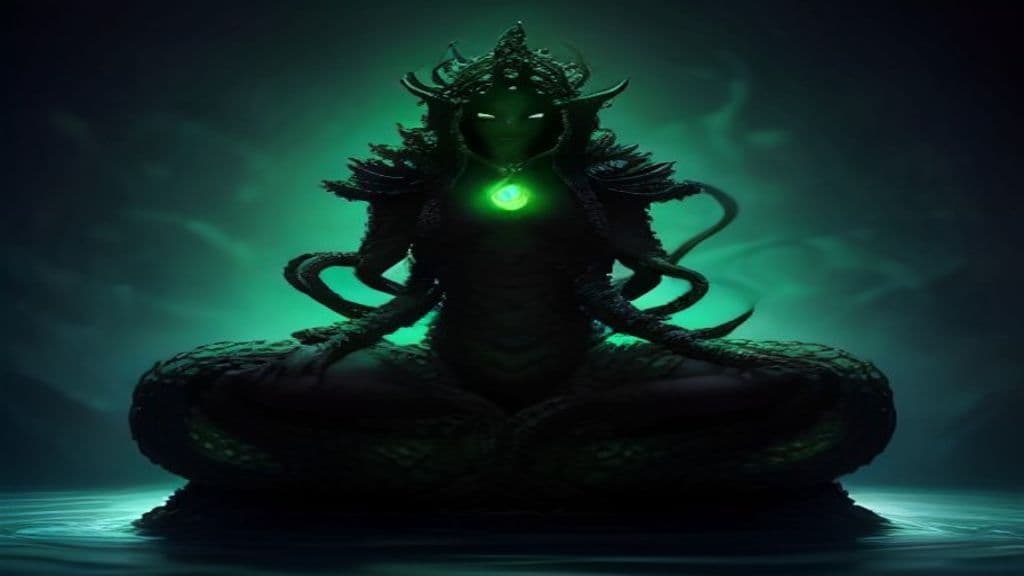
Naga
Divine serpent beings of Hindu, Buddhist, and Jain cosmology — powerful guardians of water, earth, and underground treasures. Revered as deities in South and Southeast Asia.

Domovoi
The house spirit of Slavic tradition — a small, invisible guardian of the home bound to a specific dwelling and its family. Protective when respected; dangerous when insulted or forgotten.
Acala
Acala (Sanskrit: अचल, 'The Immovable') is a wrathful protective deity (dharmapala) in Vajrayāna and East Asian esoteric Buddhism, classed among the Wisdom Kings (Vidyārāja). He functions as a ritual focus for visualization and mantra practice intended to remove obstacles and bind or destroy hostile forces.
Acalanātha (Acala / Achala)
Acalanātha (also Acala or Achala) is a wrathful deity and dharmapāla — a protector of the Dharma — prominent in Vajrayana and East Asian Mahayana Buddhist contexts. Presented as a fierce, non‑human or semi‑divine protector-figure, Acalanātha functions to defend the teaching and practitioners by removing obstacles and confronting threats to the transmission and practice of Buddhism.
Agni
Agni is the Vedic personification of fire in Hindu tradition: a sacred, mediating principle that manifests as terrestrial fire, atmospheric lightning, and celestial sun, and that receives and conveys sacrificial offerings. Prominent in the Rigvedic corpus, Agni functions as sanctifier, witness of rites of passage, and a transformational inner principle in later Upanishadic literature.
Aizen Myō-ō (Rāgarāja)
Aizen Myō-ō corresponds to the deity Rāgarāja, a wrathful/transformation-oriented figure venerated in Esoteric and Vajrayāna Buddhist traditions. The figure is especially revered in Chinese Esoteric Buddhism in Chinese communities and in the Japanese Esoteric schools Shingon and Tendai.
Akhu Tönpa
A Tibetan trickster figure, sent by Chenrezig to teach the art of being shrewd and witty, while championing the common man against social hierarchies. (Note: - Power tier should be Lesser or Minor Spirit, not Ancient, as it's more aligned with local spirit level of trickster figures. - The ability to outwit those in positions of power suggests Greater or P)
Akshobhya
Akshobhya is a transcendent buddha of Mahāyāna and Vajrayāna Buddhism, one of the Five Wisdom (Dhyāni) Buddhas. He personifies 'mirror knowledge' (ādarśa-jñāna), is conventionally placed in the East, and is lord of the eastern Pure Land Abhirati; in esoteric texts he is associated with the eastern Vajra division and invoked in mantra/mandala ritual contexts.
Akuma
Akuma (悪魔/あくま) in Japanese sources is an evil spirit, devil, or demon associated with misfortune and mental disturbance. The term appears in Buddhist texts and Heian-period literature and was later used to translate the Christian figure of Satan, as well as the Buddhist Mara.
Amanojaku
Amanojaku (天邪鬼 / あまのじゃく) is a Japanese yōkai-type being portrayed as a contrarian, heart-reading trickster. Treated in different contexts as a small ogre (ko-oni), a wicked demon (jaki) in Buddhist iconography, and a folkloric spirit that provokes human vice, it appears across regional tales with variable roles from malicious kidnapper to household oddity.
Amida Nyorai
Amida Nyorai (Amitābha / Amitāyus) is a principal Mahayana Buddha venerated across East Asia as the embodiment of Infinite Light and Infinite Life who presides over a Western Pure Land and is invoked as the savior who receives the dying into rebirth there.
Amitābha
Amitābha is a central celestial Buddha of Mahayana Buddhism who presides over the western Pure Land called Sukhāvatī. Devotional practices invoking his 'measureless' light and life (nianfo/nembutsu) are presented in Pure Land traditions as a path by which beings may be reborn in his buddhafield and quickly attain Buddhahood.
Amitābha Buddha
Amitābha is a principal Mahayana Buddha who presides over the Western Pure Land (the Land of Ultimate Bliss). Devotional practices—most centrally recitation of his name and chanting of Pure Land sutras—are presented in sources as the means by which Amitābha welcomes practitioners for rebirth in his hindrance-free realm.
Amoghapāśa
Amoghapāśa is recorded in the supplied sources as a named manifestation or form of the bodhisattva Avalokiteśvara/Lokeśvara attested in Mahāyāna and Vajrayāna contexts. The evidence in the provided material is archival and bibliographic (sūtra/dhāraṇī/maṇḍala filenames and database entries) rather than descriptive narrative or doctrinal exposition.
Community Record
- [1]Mazu - Wikipedia. Wikipedia contributors, 'Mazu', Wikipedia, The Free Encyclopedia.wiki
- [2]Dajia Mazu Pilgrimage - Wikipedia. Wikipedia contributors, 'Dajia Mazu Pilgrimage', Wikipedia, The Free Encyclopedia.wiki
- [3]Rediffusion Singapore — The Legend of Mazu (Cantonese radio archive). Rediffusion Singapore archive, '媽祖传奇 (The Legend of Mazu)'.literary
- [4]‘She’s in our hearts’: Devotees from China and Taiwan come together to celebrate the goddess Mazu. The World from PRX, 'She’s in our hearts': Devotees from China and Taiwan come together to celebrate the goddess Mazu.other
- [5]Photographing the Mazu Maritime Pilgrimage. TaiwanQuest, 'Photographing the Mazu Maritime Pilgrimage'.other
- [6]Mazu and MAZU - Sam Matey‑Coste. Sam Matey‑Coste, 'Mazu and MAZU'.other