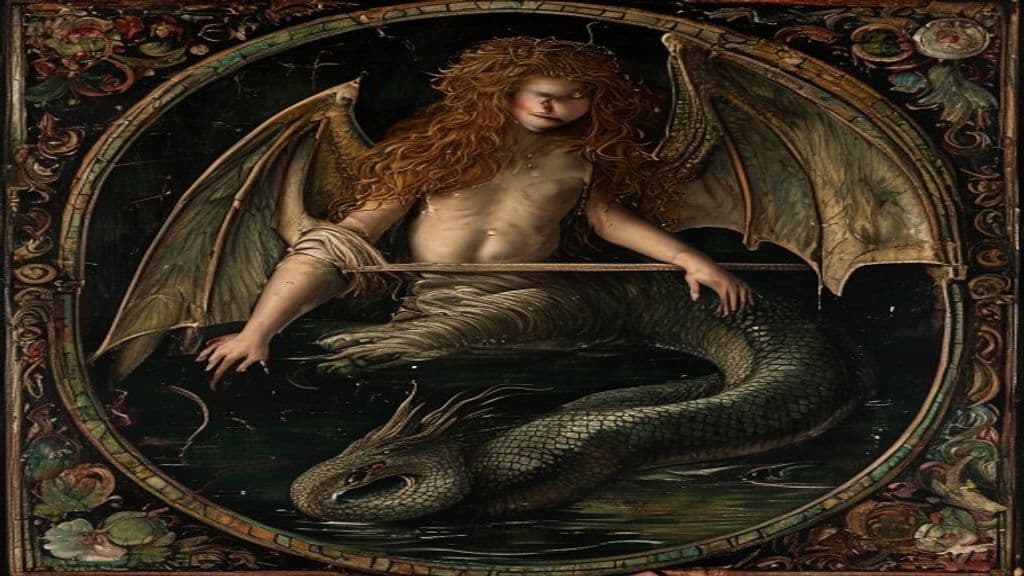
In the best‑known medieval literary version (Jean d'Arras, 1393) Mélusine is the daughter of Pressine (Pressyne) and is subject to a family curse that causes her to assume a two‑tailed serpentine form from the waist down on a recurring day (Saturday in Jean d'Arras). She appears as a supernatural woman who can enter into marriage with a mortal (Raymondin in the tale) on the condition that her husband never see her on that day; she aids in providing wealth and organizing the building of marvelous castles. Variants and regional traditions connect a related figure (Mère Lusine) with fairy builders and the founding of local edifices. Genealogical legends tie her as ancestress to houses such as Lusignan, Plantagenet, Limburg‑Luxembourg and Anjou in medieval popular lore; these attributions function as folkloric origin myths rather than historical genealogy.
Mélusine is usually depicted as a woman who is human above the waist and a serpent or fish from the waist down; medieval and later illustrations and texts sometimes show two tails or wings. In Jean d'Arras she is revealed 'in half‑serpent form' while bathing when the marital taboo is broken, and when enraged or driven off she may assume a more fearsome draconic form. Iconography and descriptions vary by version and region.
She alternates between human and serpentine/fish forms (and in Jean d'Arras may become draconic when her secret is revealed). Narratives attribute to her the capacity to marry a human, bear numerous children (Jean d'Arras records up to ten sons), confer wealth, land, and the organization or supervision of marvelous castle construction, and act as a territorial genius loci tied to springs, wells, forests, and particular castles. She also performs recurring supernatural interventions after departure—lamenting in monstrous form at the deaths of descendants and returning at night in some tales to nurse infants. The tale world includes curses, imprisonments, and magical objects (e.g., the two rings Mélusine gives Raymondin on departure).
Weaknesses
- conditionhusband's oath / marital taboo (do not see her on the specified day)
Wards
- conditionobservance of the Saturday privacy/taboo (Jean d'Arras)
Accolon
Accolon is a mortal knight of the Arthurian court, presented in the Post-Vulgate Merlin tradition and Malory's Le Morte d'Arthur as Morgan le Fay's paramour and instrument in a plot to supplant King Arthur; his tale centers on enchanted weapons (Excalibur and its scabbard), love-manipulation, and a tragic duel with Arthur.
Acionna
Acionna is a local Gallo-Roman water goddess attested by a single votive inscription found at a spring in the Orléanais region. The inscription, discovered by Jollois in 1822 and datable by style to the 2nd century CE, dedicates a portico and ornaments "AUG(ustae) ACIONNAE" and was recovered from the Fontaine de l'Étuvée in Orléans; archaeological work in 2007 uncovered remains of a Gallo-Roman temple and a section of an aqueduct at the site.
Adsullata
Adsullata is attested as a Continental Celtic river goddess associated with the River Savus (modern Sava) in the Roman province of Noricum. Later traditions record her presence in Brittany as a goddess of hot springs and present her as an antecedent or origin-form of the Anglo‑Celtic sun goddess Sul.
Aglovale
Aglovale (also Agloval, Aglovan, Aglovaus, Acglavael) is a human knight of Arthurian romance, presented as the eldest legitimate son of King Pellinore and a Knight of the Round Table in the Vulgate/Post‑Vulgate cycles, Malory, and later adaptations. He brings his long‑lost brother Perceval to Camelot, takes part in military actions (including slaying Agrippa in one account), and his death is related in varying ways across traditions (accidental at Gawain's hand, deliberate murder by Orkney kin, or killed during Lancelot's rescue of Guinevere).
Agolant
Agolant is a literary Saracen king who appears as a recurring antagonist in medieval and Renaissance epic cycles (Matter of France). He functions as a human royal opponent to Charlemagne and his peers, supplying martial episodes, genealogical connections, and the transfer of legendary arms and horses in chansons de geste and later Italian romances.
Agravain
Agravain is a literary knight of Arthurian romance cycles: one of the sons of King Lot of Orkney, a member of the Round Table, and a recurring figure in French and English medieval prose and verse. He is portrayed as a skilled but morally problematic courtly knight whose jealousy, malice, and intra-familial violence drive key narrative conflicts (notably the slaying of Lamorak and the exposure of Guinevere).
Agrestes
Agrestes is a legendary pagan king of Camelot appearing in accounts of the 13th‑century Arthurian Vulgate Cycle. Presented as a human antagonist to the Christian mission associated with Joseph of Arimathea (or his son Josephus), his violent persecution of converts is followed by madness, self‑destruction, and the subsequent consolidation of Christianity in Camelot.
Ambisagrus
Ambisagrus is a local Gaulish deity attested in Gallo‑Roman religion, worshipped at Aquileia in Cisalpine Gaul and identified there with Jupiter Optimus Maximus under Roman interpretatio. The name is tentatively analyzed from Proto‑Celtic elements *ambi‑ + *sagro‑.
Anextiomarus
Anextiomarus (Gaulish Anextlomāros; feminine Anextlomara) is an ancient Celtic theonym or epithet attested in Romano-British and Gallo-Roman inscriptions. In the sources it functions as an epithet of a solar deity syncretized with the Roman god Apollo and is glossed in one source as meaning roughly "Great Protection," indicating a protective, beneficent cult function in votive contexts.
Arduinna
Arduinna is a local Gallo-Roman tutelary goddess of the Ardennes (Arduenna) — a divine personification of wooded heights — attested in two inscriptions and later equated with the Roman Diana. Iconography associating her with a boar-riding huntress exists in modern literature but the identification is uncertain.
Arragoussets
Arragoussets are a class of dwarf-like, troglodyte beings in Anglo-Norman folklore of Guernsey, portrayed as a warlike subterranean people who emerged from a named coastal cavern and committed lethal raids on the human population; the surviving account names only two human survivors, a man and a boy, who hid in an abandoned oven for multiple years.
Arvernus
Arvernus is a Gallo-Roman theonym attested as a tribal epithet of the Arverni and identified with the Gaulish form of the Roman god Mercury in inscriptional and onomastic sources. The name functions as a localized manifestation of Mercury tying the Roman deity to the Arverni people and their territory (notably the Puy-de-Dôme / Auvergne lexical field).
Community Record
- [1]Melusine - Wikipedia. Wikipedia entry 'Melusine' (summary of Jean d'Arras and folkloric motifs)wiki
- [2]Mélusine by Jean d'Arras (Prose, 1393) - Project Gutenberg edition. Jean d'Arras, 'Mélusine' (prose tale, 1393) — primary literary redaction cited in summariesliterary
- [3]Wikidata: Mélusine. Wikidata entry for Mélusine (identifying variants and linked resources)other