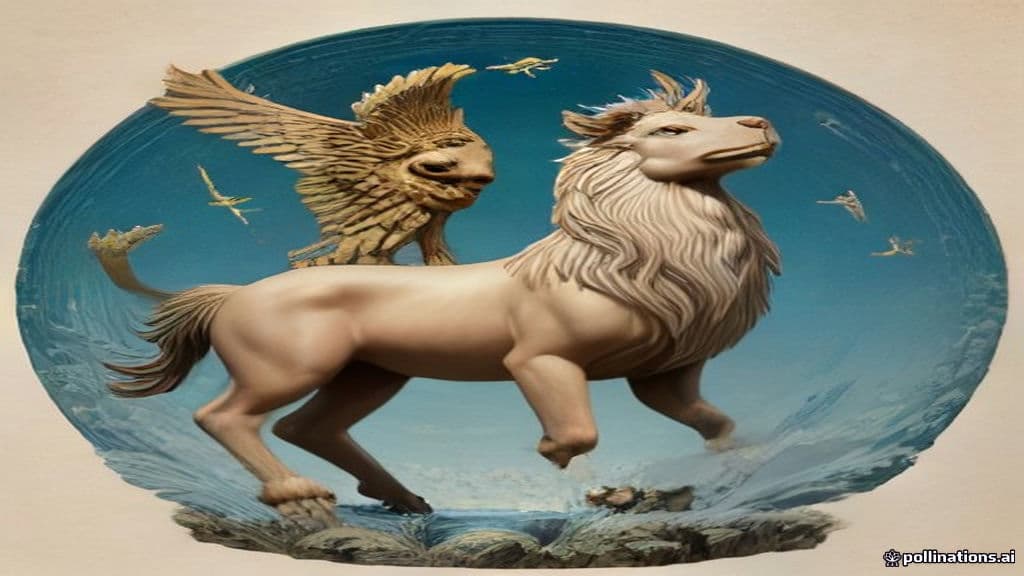
No indigenous Minoan narrative name or mythic origin is recorded in the supplied sources. Modern scholarship treats the figure as a visual-religious type in Bronze Age Crete. Several scholars (e.g., Weingarten) argue that the earliest forms derive from Egyptian prototypes (notably hippopotamus-associated figures such as Taweret and related composite guardians) around c. 1800–1700 BCE; this is presented as a scholarly hypothesis of cultural transmission rather than as an attested Minoan origin myth. Suggested functional parallels (e.g., fertility or protective roles) are speculative and not securely attested in Minoan textual evidence.
Variable composite creature attested in glyptic and pictorial art. Commonly shown with hybrid/animal heads—frequently lion-headed or hippopotamus-headed—and otherwise composite bodily configurations akin to other Aegean hybrids (griffin, sphinx). Often depicted carrying water vessels or ewers, sometimes shown in pairs as supporters of deities, and pictured within hunting, sacrificial and processional tableaux. Specific bodily configurations and head-types vary across examples.
Primarily an iconographic cultic attendant: depicted carrying water vessels (libation-bearing), supporting or flanking deities, conveying large beasts to sacrifice, and participating in sacrificial or processional sequences. Rarely shown performing the act of slaughter (one cited Zakro seal impression depicts a Genius slaying a bull), and sometimes depicted encouraging human ritual actors in sacrificial scenes. Sources emphasize a generally benign, serviceable role rather than a malign, destructive agency.

Taweret
Taweret is an ancient Egyptian household protectress associated primarily with childbirth, fertility, and domestic protection. Depicted in composite hippopotamus-derived form, she appears on amulets, birth wands, and funerary objects and is invoked as a pacificatory maternal figure aiding both living birth and symbolic rebirth.

Griffin
The griffin (also griffon, gryphon) is a composite legendary creature combining the body, tail, and hind legs of a lion with the head, wings, and often taloned forelegs of an eagle. In classical and medieval Eurasian traditions it functions chiefly as a majestic guardian figure associated with rulership and the protection of treasure, and appears widely across artistic vocabularies rather than as a single codified religious being.

Sphinx
A composite mythical figure with a human head and a lion's body known from Egyptian monumental guardianship and a distinct Greek monster tradition that riddles and kills those who fail to answer. In Egyptian contexts it functions as a benevolent royal and solar emblem carved as statuary; in Greek myth it is an animate, treacherous tester of humans.
Griffin
The griffin (also griffon, gryphon) is a composite legendary creature combining the body, tail, and hind legs of a lion with the head, wings, and often taloned forelegs of an eagle. In classical and medieval Eurasian traditions it functions chiefly as a majestic guardian figure associated with rulership and the protection of treasure, and appears widely across artistic vocabularies rather than as a single codified religious being.
*Perkʷūnos
*Perkʷūnos is the reconstructed Proto-Indo-European thunder‑god hypothesized by comparative linguistics and mythology. Scholarly reconstructions portray him as a storm or thunder figure associated with fructifying rain and as the combatant who fights a multi‑headed water‑serpent to release life‑giving waters; no direct attestations from the Proto‑Indo‑European period survive and the figure is inferred from later Indo‑European traditions.
*Péh₂usōn (reconstructed)
Péh₂usōn is a hypothetical Proto‑Indo‑European pastoral guardian reconstructed by comparative scholars from parallels in Greek and Vedic traditions. Proposed as a Graeco‑Aryan ancestor‑figure, the reconstruction describes a protector of flocks, roads, and travellers rather than an attested historical cultic personality.
57 Mnemosyne
57 Mnemosyne is a large main-belt asteroid (S-type) discovered in 1859 and named after the Greek Titaness Mnemosyne. It is a non-sentient astronomical body studied for its orbital and rotational properties and has been used in dynamical measurements related to Jupiter.
Aba (disambiguation / name-form)
Aba is a polyvalent name-form attested across many unrelated contexts (place names, personal names, animal names, and brief mythological listings). The provided sources do not support a single, coherent supernatural entity called "Aba" and offer no descriptive or ritual material for such a being.
Abaddon
In Hebrew scripture Abaddon is primarily a noun meaning 'destruction' or a section/condition of the underworld paired with Sheol; in the New Testament Book of Revelation Abaddon is personified as an angelic figure (Greek Apollyon) described as the king of an army of locusts released from the abyss during the apocalypse.
Aban Yasht
The Aban Yasht is a hymn from the Persian tradition that praises Anahita, a goddess associated with water, fertility, and wisdom. It consists of 132 stanzas and is part of the 21 Yashts collection. (Note: - Power tier should be "Primordial" or possibly "Cosmic", given that it's a hymn of great spiritual significance and associated with a goddess. - The article incorrectly states that Anahita is associa)
Abarbarea
Abarbarea is a name attested in classical Greek and Roman sources for freshwater nymphs (naiads). The name appears for at least two individual mythic figures — a naiad wife of Bucolion and a naiad counted among ancestors of the Tyrians — and Hesychius records plural forms that may indicate the name was also used as a class-name (Abarbareai / Abarbalaiai).
Abas
Abas (Ancient Greek: Ἄβας, gen.: Ἄβαντος) is not a single mythic being but a recurring personal name borne by multiple mortals and minor mythic figures in Greek epic and genealogical traditions — kings, founders, seers, warriors, attendants, a centaur, and a youth transformed by a goddess. The name is glossed in the sources as 'guileless' or 'good-hearted' and appears across Argive, Theban, Trojan, Euboean, and other local cycles.
Abath
No corroborated folkloric entity named "Abath" is documented in the provided sources. The string appears in the supplied material only as a surname/personal name in Aruban/Dutch-Caribbean archival records and as an unrelated taxonomic or encyclopedic hit; no mythic attributes, origin stories, rituals, or apotropaic practices for an entity called Abath are present in the documents reviewed.
Abatur
Abatur is an uthra (celestial emanation) in Mandaeism described as the 'father of the Uthras' and called the Ancient (ʿattīqā). He resides on the boundary between the World of Light and lower regions, functions as a judge who weighs souls (Abatur Muzania), and supplies instructions and materials to the demiurgic uthra Ptahil in accounts from the Diwan (Scroll) of Abatur.
Abatwa (Twa / Batwa)
Abatwa (also recorded as Twa, Batwa, Mutwa; singular forms Barhwa or Murhwa in some transcriptions) are indigenous hunter‑gatherer peoples of the Great Lakes region of Central Africa, historically identified as some of the earliest inhabitants of the area. The available sources treat them as human ethnic groups whose livelihoods, lands, and populations have been severely affected by conservation policies and modern violence.
Abderus
Abderus (Ancient Greek: Ἄβδηρος, romanized Ábdēros) is a mortal heroic figure in Greek myth closely associated with Heracles, remembered as the youth left in charge of the Mares of Diomedes who was killed by them. He functions as an eponymous local/divine-hero ancestor for the city of Abdera and received funerary commemoration and athletic agones at his tomb.
Community Record
- [1]Minoan Genius - Wikipedia. Wikipedia contributors, "Minoan Genius," Wikipedia, The Free Encyclopediawiki
- [2]The Transformation of Egyptian Taweret into the Minoan Genius (and related works). J. Weingarten, multiple publications (Weingarten 1991; Weingarten & Hallager 1993; Weingarten 2013) as cited in the provided notesacademic
- [3]The Minoan Genius (Gill PhD thesis/published 1964). M. A. V. Gill, The Minoan Genius (PhD thesis 1961; published 1964) as cited in the provided notesacademic
- [4]Génie minoen et génie egyptien, un emprunt raisonné. C. Sambin, BCH 113 (1989), as cited in the provided notesacademic
- [5]CMS catalog references (Zakro Z 104; Kakovatos CMS XI 208). CMS seal catalog entries and monthly seal descriptions (Zakro and Kakovatos examples referenced in the supplied notes)academic
- [6]Minoan seals (general background). Wikipedia contributors, "Minoan seals," Wikipedia, The Free Encyclopediawiki
- [7]Minoan religion (context). Wikipedia contributors, "Minoan religion," Wikipedia, The Free Encyclopediawiki
- [8]Opoudjis: Minoan Genius overview. Opoudjis, 'Minoan material and interpretations' (overview site) as cited in the provided notesother