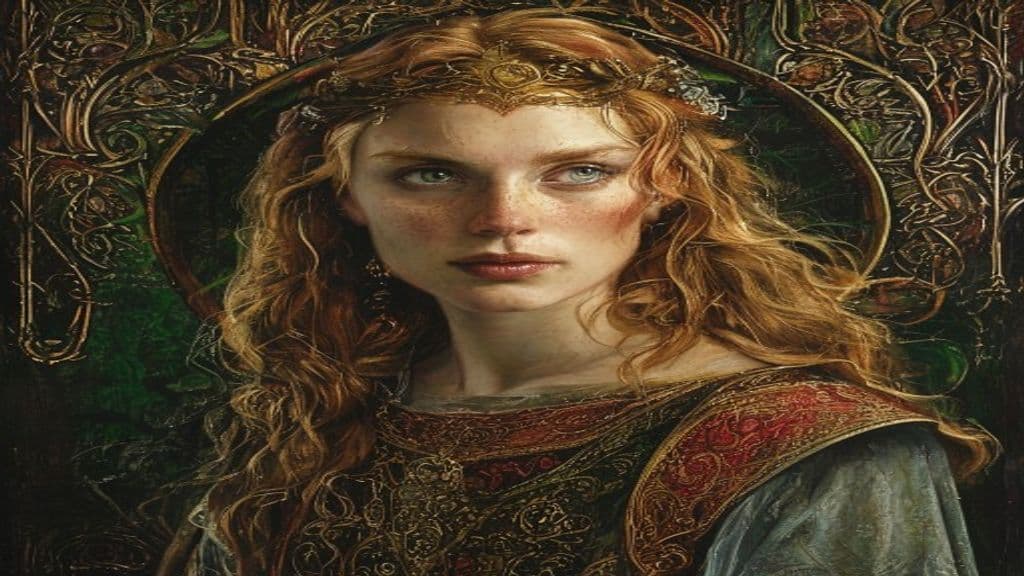
The earliest medieval form recorded by Geoffrey of Monmouth (Vita Merlini, c.1150) names her Morgen and places her as leader among nine magical sisters of the Isle of Apples (Avalon), a role emphasizing an otherworldly, island-based female community. The name Morgen is likely derived from Old Welsh/Old Breton meaning 'sea-born' (from Common Brittonic *Mori-genā), linking her to Celtic water-spirit traditions (Morgens/Mari-Morgans). The later medieval and early modern tradition—most famously in Thomas Malory—popularized the pseudo-French addition 'le Fay' (from la fée, 'the fairy'), producing the familiar English form Morgan le Fay and merging fairy-queen and courtly-sorceress strands into a more variable character. Across centuries of retelling authors alternately present her as an otherworldly fay-queen, an immortal ruler of Avalon, or a noblewoman and sorceress at Arthur's court.
No single canonical physical description exists across sources. Medieval and poetic texts sometimes depict her as a richly attired, luminous and alluring woman (for example, a poetic excerpt describing her 'in dim samite' with a gold hoop in her hair and 'soft gray eyes' and 'soft red lips'), but such lines are illustrative variants rather than a universal portrait. In other traditions she is implied to possess an elevated, queenly aspect as ruler of Avalon or appears as a courtly noblewoman when treated as Arthur's kin or a member of his court.
Across traditions Morgan is an accomplished enchantress, witch, sorceress, and healer. Early texts emphasize her salvific/healing role—presiding over Avalon and tending the wounded Arthur—while later prose romances enlarge her repertoire to include high-level magic, scheming and manipulation at court, seduction and sexual agency in romance episodes, and rivalry with other magic-users (e.g., narrative pairings with Merlin in some stories). In some continuations she is portrayed as long-lived or immortal as queen of Avalon; in others she remains human but exceptionally skilled in magical arts. Her moral alignment shifts by author: benevolent healer in some accounts, capricious or hostile antagonist in others, with reconciliation motifs (e.g., conveying Arthur to Avalon) persisting in the tradition.
*Perkʷūnos
*Perkʷūnos is the reconstructed Proto-Indo-European thunder‑god hypothesized by comparative linguistics and mythology. Scholarly reconstructions portray him as a storm or thunder figure associated with fructifying rain and as the combatant who fights a multi‑headed water‑serpent to release life‑giving waters; no direct attestations from the Proto‑Indo‑European period survive and the figure is inferred from later Indo‑European traditions.
*Péh₂usōn (reconstructed)
Péh₂usōn is a hypothetical Proto‑Indo‑European pastoral guardian reconstructed by comparative scholars from parallels in Greek and Vedic traditions. Proposed as a Graeco‑Aryan ancestor‑figure, the reconstruction describes a protector of flocks, roads, and travellers rather than an attested historical cultic personality.
57 Mnemosyne
57 Mnemosyne is a large main-belt asteroid (S-type) discovered in 1859 and named after the Greek Titaness Mnemosyne. It is a non-sentient astronomical body studied for its orbital and rotational properties and has been used in dynamical measurements related to Jupiter.
Abaddon
In Hebrew scripture Abaddon is primarily a noun meaning 'destruction' or a section/condition of the underworld paired with Sheol; in the New Testament Book of Revelation Abaddon is personified as an angelic figure (Greek Apollyon) described as the king of an army of locusts released from the abyss during the apocalypse.
Aban Yasht
The Aban Yasht is a hymn from the Persian tradition that praises Anahita, a goddess associated with water, fertility, and wisdom. It consists of 132 stanzas and is part of the 21 Yashts collection. (Note: - Power tier should be "Primordial" or possibly "Cosmic", given that it's a hymn of great spiritual significance and associated with a goddess. - The article incorrectly states that Anahita is associa)
Abandinus
Abandinus is a locally attested Romano‑Celtic theonym known from a single inscribed bronze feather (votive object) dedicated at Godmanchester (the Roman fort Durovigutum) in Cambridgeshire. Scholars interpret him as a local god or male spirit tied to a specific place and possibly associated with a nearby spring or stream; this association is tentative and based on etymological readings of the name.
Abarta (Ábartach)
Abarta (also Ábartach) is a figure of Irish myth who, in surviving accounts, tricks Fionn mac Cumhaill's warriors by giving them a supernatural grey horse that bears them into the Otherworld. Sources variably identify him as a member of the Tuatha Dé Danann or as a Fomorian; after the incident he is compelled to release the captured warriors and is refused entry to the Fianna.
Abath
No corroborated folkloric entity named "Abath" is documented in the provided sources. The string appears in the supplied material only as a surname/personal name in Aruban/Dutch-Caribbean archival records and as an unrelated taxonomic or encyclopedic hit; no mythic attributes, origin stories, rituals, or apotropaic practices for an entity called Abath are present in the documents reviewed.
Abatur
Abatur is an uthra (celestial emanation) in Mandaeism described as the 'father of the Uthras' and called the Ancient (ʿattīqā). He resides on the boundary between the World of Light and lower regions, functions as a judge who weighs souls (Abatur Muzania), and supplies instructions and materials to the demiurgic uthra Ptahil in accounts from the Diwan (Scroll) of Abatur.
Abatwa (Twa / Batwa)
Abatwa (also recorded as Twa, Batwa, Mutwa; singular forms Barhwa or Murhwa in some transcriptions) are indigenous hunter‑gatherer peoples of the Great Lakes region of Central Africa, historically identified as some of the earliest inhabitants of the area. The available sources treat them as human ethnic groups whose livelihoods, lands, and populations have been severely affected by conservation policies and modern violence.
Abcán (Abhcán)
Abcán (modern spelling Abhcán) is a named dwarf poet and musician of the Tuatha Dé Danann in Irish myth. He appears in a small number of narratives as a musician whose art has soporific power and as the ferryman who brings the goddess Ruad from the Otherworld to the human world.
Abdiel
Abdiel (Hebrew עֲבְדִּיאֵל) is primarily a theophoric Hebrew personal name meaning "servant of El/servant of God," attested once in the Hebrew Bible (1 Chronicles 5:15). In later literature—most notably John Milton's Paradise Lost—Abdiel is reimagined as a faithful seraph who opposes Satan's revolt. The provided sources do not treat Abdiel as an autonomous folkloric spirit type or record rituals or wards associated with the name.
Community Record
- [1]Morgan le Fay — Wikipedia. Wikipedia: Morgan le Faywiki
- [2]Wikidata: Morgan le Fay. Wikidata entry Q321305wiki
- [3]Vita Merlini (Geoffrey of Monmouth) and discussions of Morgen/Avalon. Camelot Project: Morgan le Fay thematic entry (discussing Geoffrey of Monmouth and Avalon material)literary
- [4]Cawein — Morgan (poetic excerpt). Poetic excerpt illustrating a courtly depiction of Morganliterary
- [5]Arthur The King The Complete Series by Graeme Fife (archive reference). Archive: radio-play series referencing Arthurian materialother
- [6]Modern cultural adaptations and comics references (selected). Wikipedia: Morgan le Fay (Marvel Comics) — noted as derivative modern adaptationother