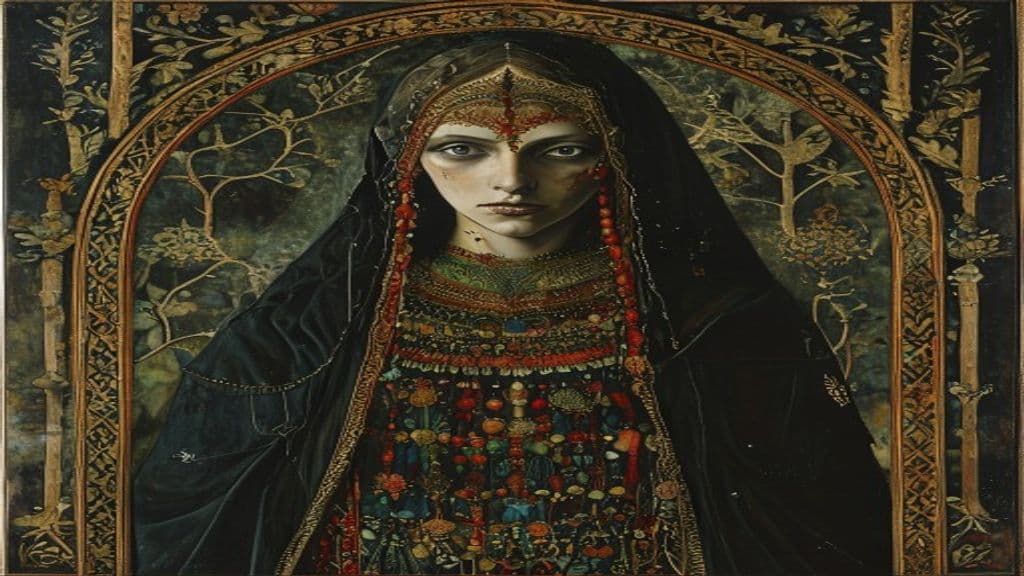
Source material presents Māra as an ancient Dawn-goddess (previously called Austra) and the highest-ranking goddess in Latvian mythology. Scholarly opinion is divided: some view her as a pre-Christian Baltic deity, while others see her as a syncretic figure shaped by identification with the Christian Mary among semi-Christian Livonian peasants. The celebration of Māra on August 15 (the same date as the Assumption of Mary) is noted as probable evidence of Christian influence on the timing and perhaps the character of the festival.
The cited source does not provide a consistent anthropomorphic description. Instead, Māra's presence is registered through role-titles and toponyms: she is named 'Govu māte' ('Mother of Cows'), associated with 'Māras zeme' ('Māra's land'), and referenced through domestic-economic epithets (e.g. in the saying 'God made the table, Māra made the bread'). Regional name-forms (Māre, Mārīte, Mārša, Māršava) indicate local folk personifications, but no fixed physical iconography or bodily attributes are specified in the cited material.
According to the source, Māra functions as patroness of all feminine duties (children, cattle), patroness of economic activities, markets and money, and as a territorial/pastoral goddess (Māras zeme; Mother of Cows). Cosmologically she operates as the counterpart to Dievs: 'Being the alternate side of Dievs, she takes a person's body after their death while Dievs is taking the soul.' In western Latvia she was strongly associated with Laima and in some contexts may have been considered the same deity, indicating overlapping lifecycle and fortune-related functions.

Aitvaras
Aitvaras is a Baltic (primarily Lithuanian) household/nature spirit that, according to available summaries, lodges in homes and provides its household with material goods—often described as stolen gold and grain—while also bringing misfortune or trouble. It is variously described as a rooster- or chicken-like bird indoors and as a dragon-like or serpentine bird outdoors, often with fiery/meteor imagery.
Alatyr
A sacred world-stone in East Slavic and wider Slavic folklore, described as the "father to all stones" and the "navel of the earth." Located at the world's center (often on Buyan island), it is associated with a miraculous spring, sacred letters, healing properties, and liminality between the human world and other realms.
Alka
Alka (plural alkas) is a class of sacred natural places in pre-Christian Baltic religion—Latvian and Lithuanian—functioning as set-apart cult sites where offerings and sacrifices were made. Treated as holy ground rather than a single anthropomorphic spirit, alkas served as loci connecting communities with ancestors and otherworldly realms and frequently appear in toponyms across the Baltic landscape.
Auseklis
Auseklis is a named youthful celestial being in Latvian folk-song tradition (dainas), associated with the dawn and a particular eight-pointed star emblem. He appears among the Dieva dēli (sons of Dievs) as an attendant of the Sun (Saule), a suitor in the mythic 'celestial wedding', and a participant in household-like sky rituals.
Aušrinė
Aušrinė is the Lithuanian personification and deity of the morning star (planet Venus) in traditional Baltic cosmology. She is a feminine liminal figure associated with dawn, beauty, youth, love, health and renewal who appears each morning to prepare the way for Saulė (the Sun).
Ašvieniai
Ašvieniai are the paired divine twins of Baltic (particularly Lithuanian) tradition, horse-associated celestial beings who pull the chariot of Saulė (the Sun) across the sky and appear as protective little horses used as apotropaic motifs in vernacular architecture and household objects.
Bangpūtys
Bangpūtys is a reconstructed masculine sea-and-storm deity from Lithuanian mythology. Known from very scanty sources, modern mythologists portray him as an austere, vindictive master of winds and the sea and as the reconstructed father-figure of the cardinal wind-gods.
Black cat
A domestic cat with black fur that functions both as an ordinary companion animal and as a versatile folkloric symbol. In many traditions it is an omen of good or bad fortune, is associated with witches and seafaring luck, and has been repurposed in modern political and cultural symbolism.
Dievas
Dievas (Lithuanian; Dievs in Latvian; Diews in Old Prussian) is the primordial supreme sky deity in Baltic religion, understood as the luminous sky-dome, a creator and ruler of gods, and a god of light, prosperity and time. The lexeme is a Baltic reflex of Proto-Indo-European *Dyēus and, following Christianization, the same word came to denote the Christian God.
Dievs (Dievas)
Dievs (Latvian Dievs; Lithuanian Dievas) is the primordial sky‑father of the Baltic traditional pantheon, presented in sources as a supreme luminous sky power, creator and ruler of the gods, and associated with light, prosperity, and cosmic order. The theonym survives in modern Latvian language and civic/religious usage but the supplied corpus gives little on specific myths, iconography, or ritual praxis tied to the pre‑Christian figure.
Eglė the Queen of Serpents (Žilvinas)
A central figure of a Lithuanian folktale in which a speaking serpentine ruler—called the grass-snake/serpent prince Žilvinas—marries the human maiden Eglė, keeps an underwater palace and household, can be summoned by a secret chant, and whose story culminates in human→tree metamorphoses after betrayal.
Gabija
Gabija is the Lithuanian household fire spirit and protector of the hearth and family. Treated as a living presence in the home, she is cared for through routine domestic practices (feeding, covering embers, providing water) and is held responsible in folklore for wandering or destructive fires when offended or neglected.
Community Record
- [1]Māra — Wikipedia. Wikipedia contributors, 'Māra', Wikipedia, The Free Encyclopedia, https://en.wikipedia.org/wiki/M%C4%81ra (accessed via provided research notes)wiki