
According to the cited tradition, nāgas are described in legend as the children of the sage Kashyapa and Kadru. This genealogical placement situates them within broader Hindu cosmological and mythic frameworks, marking them as a distinct race or lineage with ancestral ties rather than as isolated monsters. Their origin as offspring within recognized mythic genealogies contributes to their standing as divine or semi-divine beings in the traditions that revere or depict them.
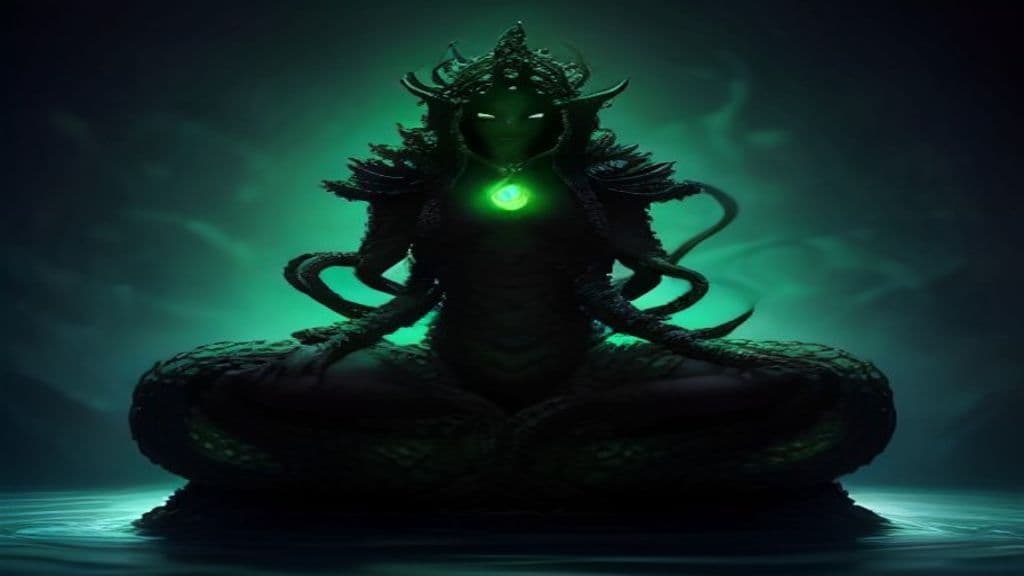
Nāgas are principally depicted in three forms. One common depiction renders them as entirely human in form but with snakes upon the head and neck. Another form is that of ordinary serpents, appearing as common snakes. A third widespread depiction is anthropomorphic or half-human/half-snake beings, combining human and serpent morphology (for example, human torso with serpent lower body). Female members of the kind are referred to as nāginī and are represented across these same visual registers.
Direct documentation of folkloric abilities and behaviors is absent from the provided materials. The disambiguation-style sources associate the term with Ichchadhari Nāgas — a named category in Indian folklore commonly described elsewhere as shape‑shifting — but the supplied documents do not record specific powers, typical motives, or interaction patterns with humans. Popular-media uses (films and TV series) imply supernatural traits used for horror or melodrama, but specific abilities are not enumerated in these sources.
*Péh₂usōn (reconstructed)
Péh₂usōn is a hypothetical Proto‑Indo‑European pastoral guardian reconstructed by comparative scholars from parallels in Greek and Vedic traditions. Proposed as a Graeco‑Aryan ancestor‑figure, the reconstruction describes a protector of flocks, roads, and travellers rather than an attested historical cultic personality.
Abhimanyu
Abhimanyu is a youthful Kuru/Pandava warrior-hero in the Sanskrit epic Mahābhārata. Son of Arjuna and Subhadra, he is famed for entering the Chakravyuha battle formation on the thirteenth day of the Kurukshetra War and dying at age sixteen; his posthumous son Parikshit continues the Kuru line.
Acala
Acala (Sanskrit: अचल, 'The Immovable') is a wrathful protective deity (dharmapala) in Vajrayāna and East Asian esoteric Buddhism, classed among the Wisdom Kings (Vidyārāja). He functions as a ritual focus for visualization and mantra practice intended to remove obstacles and bind or destroy hostile forces.
Acalanātha (Acala / Achala)
Acalanātha (also Acala or Achala) is a wrathful deity and dharmapāla — a protector of the Dharma — prominent in Vajrayana and East Asian Mahayana Buddhist contexts. Presented as a fierce, non‑human or semi‑divine protector-figure, Acalanātha functions to defend the teaching and practitioners by removing obstacles and confronting threats to the transmission and practice of Buddhism.
Achyuta
Achyuta (Sanskrit: अच्युत, acyuta) is primarily an epithet/theonym in Vaishnava Hindu tradition applied to Vishnu and Krishna, signifying the divine quality of being 'not fallen' — immutable, infallible, and imperishable. It functions as a devotional name in scripture, liturgy, and Pancharatra lists of divine emanations rather than as an autonomous folkloric spirit.
Acintya
Acintya is an Indonesian Hindu theological-symbolic representation of the ineffable supreme divine principle. In Balinese and Javanese practice it functions as a way to make ultimate reality present in ritual and art—often aniconically as an empty throne (padmasana) or anthropomorphically as a naked, flame-surrounded figure—rather than as a narrative, intervening deity.
Adi (asura)
Adi is attested in modern reference works as the name of an Asura who 'appears in the Matsya Purāṇa.' Beyond this single-line citation in secondary sources, no descriptive material about the figure is provided in the supplied research notes.
Adi Shakti
Adi Shakti (also Adi Parashakti, Mahadevi, Adya Shakti) is the primordial feminine power in Hindu/Shakta theology, regarded as the ultimate reality (Para Brahman) and the source from which all goddesses and gods manifest. She is both an impersonal cosmic principle (Mulaprakriti) and a focus of devotional invocation in temples, mantras, and pilgrimage sites such as Shakti Peethas.
Adi Vinayaka
Adi Vinayaka (Ādi Vināyaka; also called Nara Mukha Vinayaka) is a named iconographic and devotional form of the Hindu god Ganesha portraying the deity with a human head, described in sources as the form before the episode of decapitation by Shiva. It is rarely worshipped and appears in a small number of South Indian shrines and in devotional/musical repertoires.
Aditi
Aditi is a major Vedic goddess in Hindu tradition who personifies the boundless, infinite cosmic principle and functions as the maternal matrix from which many celestial deities (the Ādityas and other groups) are born. In the Vedic hymns she is invoked as a protective liberator who guards petitioners, provides wealth and safety, and frees devotees from hindrances such as sin and sickness.
Agastya
Agastya (also Agathiyar/Agasti) is a revered Vedic and later-period Indian rishi (sage) figure credited in textual traditions as an inspired seer, ascetic, teacher, culture-founder, and attributed author of Vedic, Puranic and Tamil works; in South Indian tradition he is associated with origins of Tamil grammar and Siddha medicine and is identified astronomically with the star Canopus.
Aghasura
Aghasura is an asura from the Vaishnava/Hindu narrative tradition (notably the Srimad‑Bhāgavatam) who, at the command of Kamsa, assumed the form of a vast serpent to ambush Kṛṣṇa and the cowherd boys in Vṛndāvana. The episode demonstrates Kṛṣṇa’s protective, divine power as he enters and destroys the demon from within.
Community Record
- [1]Nagin — Wikipedia (disambiguation). "Nāginī, in Hindu mythology, a female Nāga"; "Nagini or Naiṇī Devī, a Nagin worshipped as mother goddess in the Indian Central Himalaya"; "Ichchadhari Naags, shape-shifting Nāgas in Indian folklore."wiki
- [2]Nagin (1976 film) — Wikipedia. "Nagin (transl. Female Serpent) is a 1976 Hindi-language horror film..."wiki
- [3]Wikidata: Nagin. Wikidata entry linked in source list for the term 'Nagin'.wiki
- [4]Nagin (Nāginī/Ichchadhari Nag) — Wikipedia. Wikipedia: "In various Asian religious traditions, the Nāgas are a divine, or semi-divine, race of half-human, half-serpent beings that reside in the netherworld (Patala), and can occasionally take human or part-human form, or are so depicted in art." and related excerpts.wiki