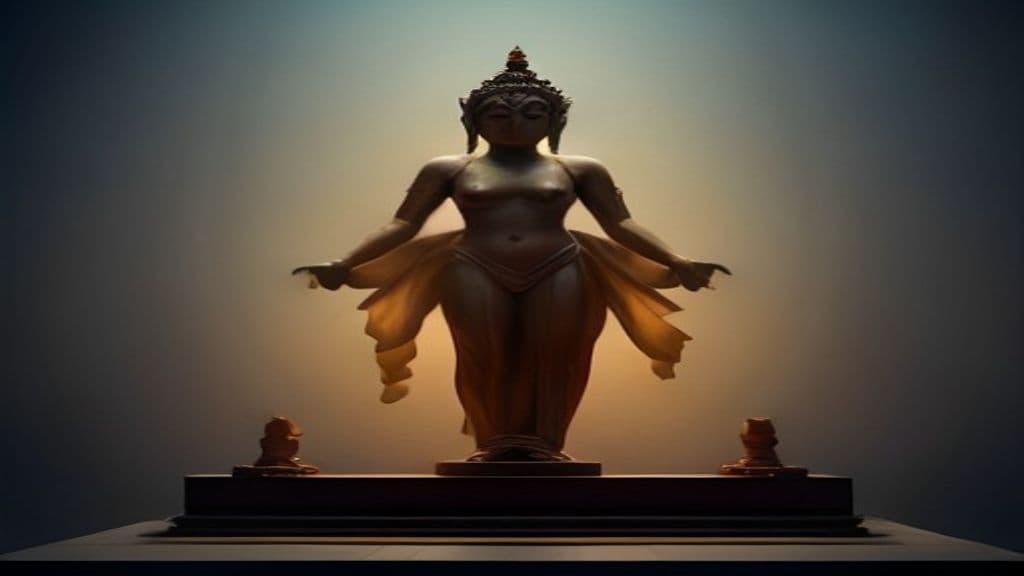
Burmese nat devotion predates the conversion to Theravada Buddhism in Burma and was politically formalized under King Anawrahta, who endorsed an official pantheon (commonly enumerated as the 37 Great Nats) and allowed nats to be housed in Buddhist temples so adherents could continue their older cults while adopting Buddhism. Many of the canonical Great Nats are said to have been human beings who met violent deaths and were subsequently deified; other nats are resident spirits of natural features (trees, waters, mountains).
There is no single canonical physical form for nats as a class in the supplied sources; they are represented and experienced through ritual embodiment, statues, costumes, and mediumship at shrines and festivals. The 37 Great Nats are often represented at pilgrimage sites and village shrines, and during nat pwè festivals nat kadaws enact nats through dance and costume, producing variable anthropomorphic portrayals rather than a standardized iconography.
Nats are social spiritual agents with human-like wants and flaws who demand propitiation and offerings. Many are tutelary or territorial spirits tied to villages, households, lineages, trees, forests, mountains, and waters. They can possess or embody mediums (nat kadaws) during nat pwè, allowing communicative exchange; they respond to offerings and ritual negotiation and may punish transgressions (for example, wrath is believed to follow desecration of a tree or sacred site).
Weaknesses
- conditionRequires propitiation and offerings
- conditionSocial obligation and lineage ties (failure to observe hereditary obligations may anger a nat)
Wards
- ritualMaintenance of nat kun / nat sin (village shrine) and household shrine with coconut and perfume
- ritualNat pwè (spirit festival) with nat kadaw mediumship and hsaing waing orchestra
- ritualNat kannah pwè (urban/communal supplication ritual for migrants)
- conditionRespect for sacred natural sites (avoidance of indiscriminate felling or desecration of trees/forests/mountains)
Acala
Acala (Sanskrit: अचल, 'The Immovable') is a wrathful protective deity (dharmapala) in Vajrayāna and East Asian esoteric Buddhism, classed among the Wisdom Kings (Vidyārāja). He functions as a ritual focus for visualization and mantra practice intended to remove obstacles and bind or destroy hostile forces.
Acalanātha (Acala / Achala)
Acalanātha (also Acala or Achala) is a wrathful deity and dharmapāla — a protector of the Dharma — prominent in Vajrayana and East Asian Mahayana Buddhist contexts. Presented as a fierce, non‑human or semi‑divine protector-figure, Acalanātha functions to defend the teaching and practitioners by removing obstacles and confronting threats to the transmission and practice of Buddhism.
Agni
Agni is the Vedic personification of fire in Hindu tradition: a sacred, mediating principle that manifests as terrestrial fire, atmospheric lightning, and celestial sun, and that receives and conveys sacrificial offerings. Prominent in the Rigvedic corpus, Agni functions as sanctifier, witness of rites of passage, and a transformational inner principle in later Upanishadic literature.
Aizen Myō-ō (Rāgarāja)
Aizen Myō-ō corresponds to the deity Rāgarāja, a wrathful/transformation-oriented figure venerated in Esoteric and Vajrayāna Buddhist traditions. The figure is especially revered in Chinese Esoteric Buddhism in Chinese communities and in the Japanese Esoteric schools Shingon and Tendai.
Akhu Tönpa
A Tibetan trickster figure, sent by Chenrezig to teach the art of being shrewd and witty, while championing the common man against social hierarchies. (Note: - Power tier should be Lesser or Minor Spirit, not Ancient, as it's more aligned with local spirit level of trickster figures. - The ability to outwit those in positions of power suggests Greater or P)
Akshobhya
Akshobhya is a transcendent buddha of Mahāyāna and Vajrayāna Buddhism, one of the Five Wisdom (Dhyāni) Buddhas. He personifies 'mirror knowledge' (ādarśa-jñāna), is conventionally placed in the East, and is lord of the eastern Pure Land Abhirati; in esoteric texts he is associated with the eastern Vajra division and invoked in mantra/mandala ritual contexts.
Akuma
Akuma (悪魔/あくま) in Japanese sources is an evil spirit, devil, or demon associated with misfortune and mental disturbance. The term appears in Buddhist texts and Heian-period literature and was later used to translate the Christian figure of Satan, as well as the Buddhist Mara.
Amanojaku
Amanojaku (天邪鬼 / あまのじゃく) is a Japanese yōkai-type being portrayed as a contrarian, heart-reading trickster. Treated in different contexts as a small ogre (ko-oni), a wicked demon (jaki) in Buddhist iconography, and a folkloric spirit that provokes human vice, it appears across regional tales with variable roles from malicious kidnapper to household oddity.
Amida Nyorai
Amida Nyorai (Amitābha / Amitāyus) is a principal Mahayana Buddha venerated across East Asia as the embodiment of Infinite Light and Infinite Life who presides over a Western Pure Land and is invoked as the savior who receives the dying into rebirth there.
Amitābha
Amitābha is a central celestial Buddha of Mahayana Buddhism who presides over the western Pure Land called Sukhāvatī. Devotional practices invoking his 'measureless' light and life (nianfo/nembutsu) are presented in Pure Land traditions as a path by which beings may be reborn in his buddhafield and quickly attain Buddhahood.
Amitābha Buddha
Amitābha is a principal Mahayana Buddha who presides over the Western Pure Land (the Land of Ultimate Bliss). Devotional practices—most centrally recitation of his name and chanting of Pure Land sutras—are presented in sources as the means by which Amitābha welcomes practitioners for rebirth in his hindrance-free realm.
Amoghapāśa
Amoghapāśa is recorded in the supplied sources as a named manifestation or form of the bodhisattva Avalokiteśvara/Lokeśvara attested in Mahāyāna and Vajrayāna contexts. The evidence in the provided material is archival and bibliographic (sūtra/dhāraṇī/maṇḍala filenames and database entries) rather than descriptive narrative or doctrinal exposition.
Community Record
- [1]Nat (deity) — Wikipedia. Wikipedia, 'Nat (deity)'wiki
- [2]Nat (deity) — duplicate reference. Wikipedia, 'Nat (deity)' (research notes)wiki